3D Printer Cabinet or Stand: What a Good One Does for Print Quality
Short answer A stand for a 3D printer has one job that matters: be rigid and heavy so the printer does not…
Nozzles, build plates, hotends and extruders — with fitment tables that say “not verified” when we have not checked, because a wrong answer here costs you a hotend.
Short answer A stand for a 3D printer has one job that matters: be rigid and heavy so the printer does not…
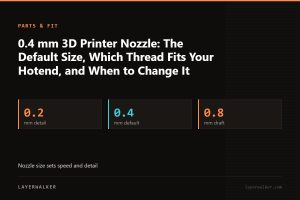
Short answer A 0.4 mm nozzle is the right default for almost everything: fine enough for detail, wide enough for speed. What…
Short answer For ABS, ASA or nylon in an enclosure you want a filter with both a HEPA stage for ultrafine particles…
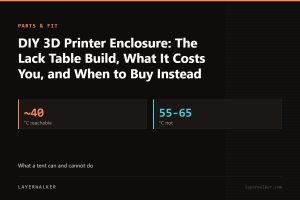
Short answer A DIY enclosure built from two IKEA Lack tables, four acrylic panels and some printed brackets holds a stable 40…
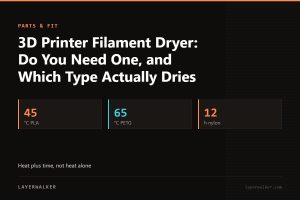
Short answer You need a filament dryer if you print PETG, TPU, nylon or anything with fibre in it, or if PLA…
Short answer An auto bed leveling probe such as the Creality CR Touch measures the bed at 9 to 25 points and…
Short answer A dry box is a sealed spool container with desiccant and a PTFE tube outlet, so you print PETG, TPU…
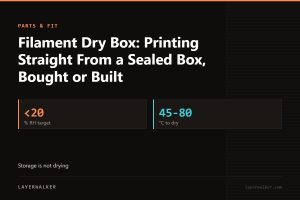
Short answer Store opened spools in a sealed container with a colour-indicating desiccant and a hygrometer showing under 20 % relative humidity.…
Short answer On a clean, textured PEI plate most filaments need no adhesive at all. Buy a bed adhesive for two jobs:…
Short answer You need an enclosure if you print ABS, ASA, nylon or polycarbonate: it holds the air around the part at…