TPU Stringing: Slow Down Before You Touch Retraction
LayerWalker is a participant in the Amazon Services LLC Associates Program. We may earn a commission when you buy through links on our site, at no extra cost to you.
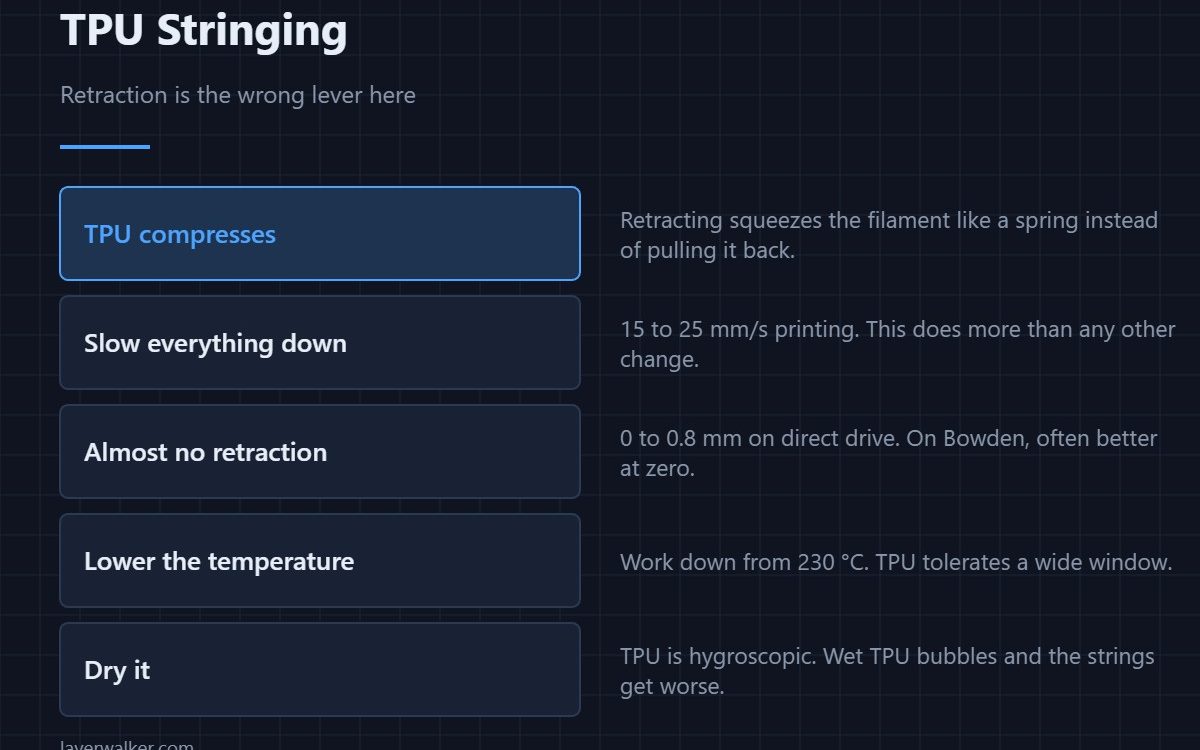
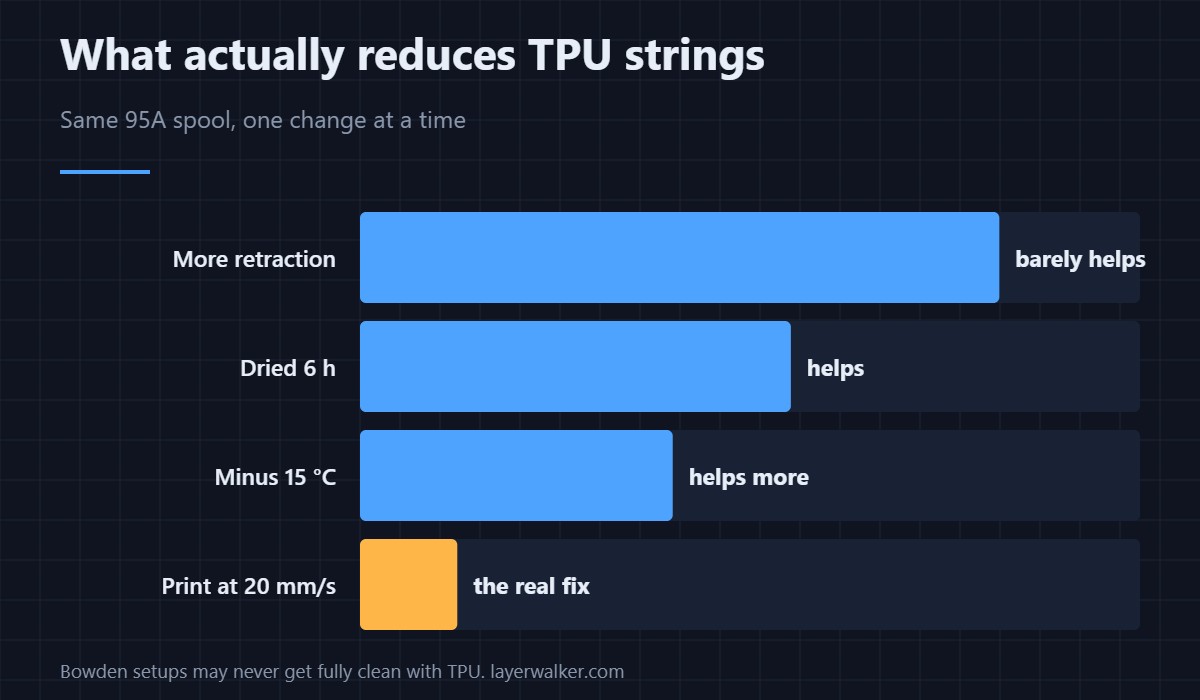
TPU stringing does not respond to retraction the way other filaments do, because TPU compresses like a spring instead of moving when you pull it. The fix is speed: drop to 15–25 mm/s. Then use almost no retraction — 0 to 0.8 mm on direct drive, often zero on Bowden — lower the temperature, and dry the spool.
Everything people learn about stringing on PLA misleads them on TPU. Adding retraction is the standard reflex, and on TPU it does very little and can make things worse by buckling the filament inside the extruder. The material is elastic; pulling on one end of a 500 mm Bowden tube full of rubber does not move the other end.
Where to buy

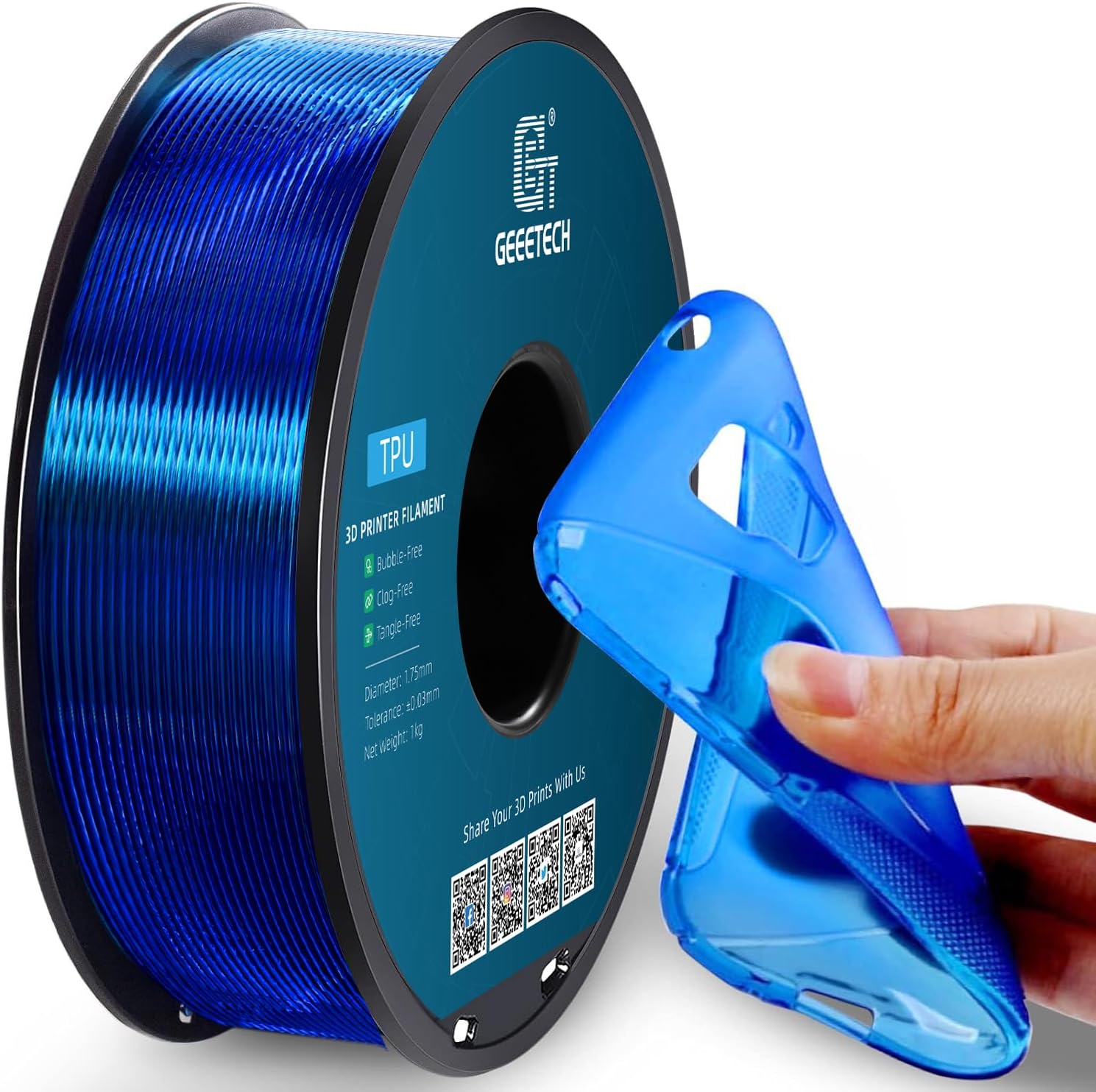
Geeetech TPU Filament 1.75mm, Shore 95A Flexible 3D Printer Filament with High Elasticity, 1KG (2.2lbs) Spool, Dimensional Accuracy ±0.03mm, Fits Most FDM Printers, Clear Blue

SUNLU Filament Dryer Box 2026 New Upgrade S1 Plus, Black
1. Speed, and it is not close
Print at 15–25 mm/s. This single change does more than everything else combined. Slower movement means less pressure built up in the nozzle, so there is less to ooze when the head travels, and it gives the extruder a chance to keep up with a filament that resists being pushed. If you only change one thing, change this.
2. Almost no retraction
On direct drive, 0.4–0.8 mm. On Bowden, try zero — many people get cleaner results with retraction fully disabled than with any value enabled, because every retraction on a Bowden TPU setup risks the filament bunching in the tube. This is the clearest practical case for direct drive over Bowden: with TPU it is not a preference, it is close to a requirement.
3. Temperature, downward
Start at 230 °C and work down in 5 °C steps. TPU has a wide usable window and most of it is hotter than it needs to be. Below about 210 °C layer bonding starts to suffer, which on a flexible part shows up as it tearing along a layer line.
4. Dry it
TPU is hygroscopic and a wet spool bubbles, pops and strings regardless of settings. Six hours at 55 °C — lower than PETG, because TPU softens sooner and can fuse to itself on the spool. Keep it in a sealed box afterwards; see filament storage.
What to accept
A Bowden printer may never get TPU fully clean, and that is a hardware limit rather than a tuning failure. Fine hairs that pull away with a heat gun pass are a reasonable outcome. What you should not accept is the extruder clicking or the filament looping out of the gear housing — that is too fast, too much retraction, or too loose a tensioner. The general picture is in stringing and oozing.
TPU Stringing FAQ
Should I use retraction at all with TPU?
A small amount on direct drive, often none on Bowden. Test with retraction disabled entirely as a baseline; if that is cleaner than your current profile, you were over-retracting.
Why does my extruder click when printing TPU?
The filament is buckling instead of advancing, usually because the print speed is too high or the path between the drive gear and the hotend has a gap it can escape into. Slow down first, then check the extruder for a gap.
Does harder TPU string less?
Yes. A 95A filament is far easier to print and strings less than a 85A one, because it buckles less and responds slightly better to retraction. If you are fighting soft TPU, try a harder shore rating before retuning.
Can I print TPU on a Bowden Ender 3?
Yes, slowly, with retraction near zero and a well-tensioned extruder. It works better after an extruder upgrade that removes the gaps the filament can escape into.

LayerWalker
Print defect diagnosis, calibration procedures and parts that actually fit. Corrections welcome through the contact page.