Direct Drive vs Bowden Extruder: What Changes, and Which Kit to Buy for an Ender-Class Printer
LayerWalker is a participant in the Amazon Services LLC Associates Program. We may earn a commission when you buy through links on our site, at no extra cost to you.
Convert to direct drive if you want to print TPU, if PETG stringing will not tune out, or if you are tired of Bowden tube wear. Stay Bowden if you print PLA and PETG well already and value a lighter toolhead for speed. A conversion kit for an Ender-class printer is an afternoon’s work and needs a re-tune of retraction, pressure advance and E-steps.
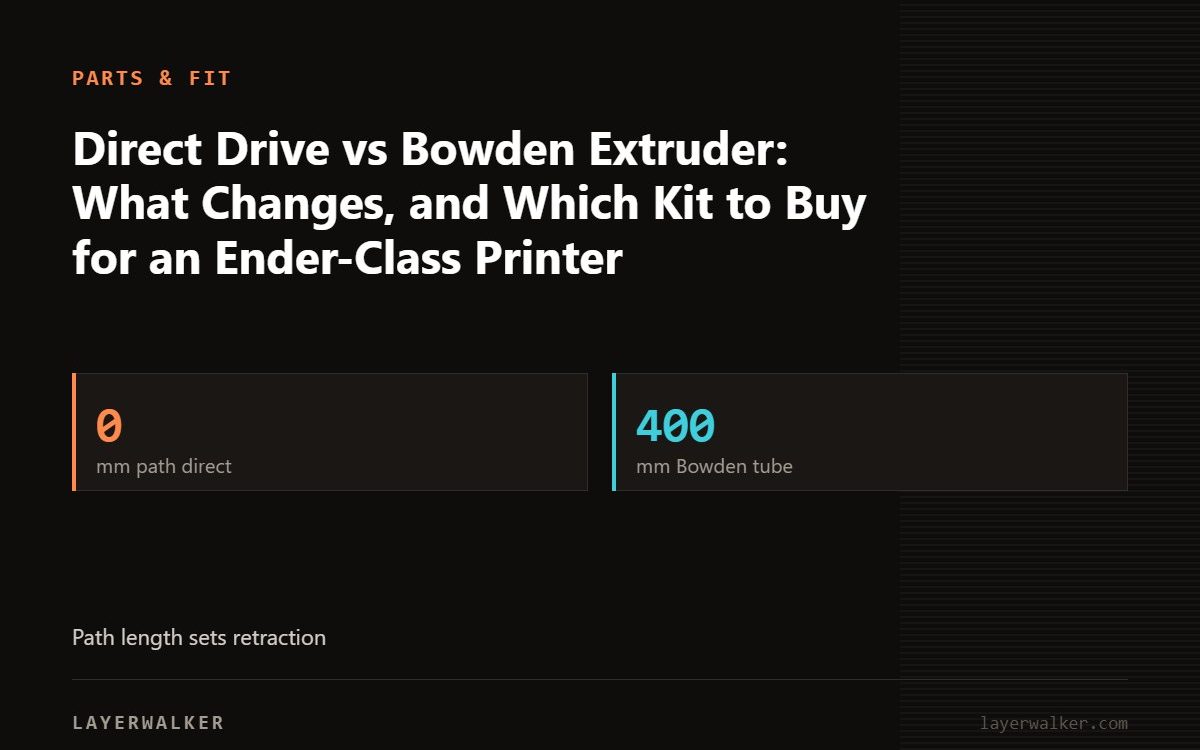
The extruder motor either sits on the hotend and pushes filament a few centimetres, or sits on the frame and pushes it through a metre of PTFE tube. That single difference decides how the printer handles flexible filament, how much retraction it needs, and how heavy the moving toolhead is. Most bed-slingers shipped Bowden because it was cheaper and lighter; almost every printer designed in the last few years ships direct drive because the trade-off favours it once the motor is small enough.
Where to buy


What each one does well
| Direct drive | Bowden | |
|---|---|---|
| TPU and flexibles | Prints them | Struggles below 95A, slow above |
| Retraction | 0.5 to 1.5 mm | 4 to 7 mm |
| Stringing | Easier to tune out | Tube slop adds ooze; see stringing |
| Toolhead mass | Heavier; more ringing without input shaping | Lighter; faster on old firmware |
| Maintenance | Short PTFE path, rarely wears | Tube wears at the hotend and needs trimming |
| Filament changes | Fast | Slower; long purge path |
When to convert
- You want TPU. This alone justifies it.
- PETG strings no matter what and the Bowden tube has visible play at the coupler.
- You print small detailed parts where 5 mm retractions leave gaps after travel.
- You are already replacing the hotend; many kits bundle both.
What a good kit includes
- A dual-gear extruder body with a spring-tensioned idler. Single-gear extruders slip on TPU.
- A mounting plate for your specific carriage and a short PTFE link to the hotend.
- Cable extension for the stepper, since the motor moves with the head.
- Clear fit list: Ender 3, 3 Pro, 3 V2 and the V3 SE and KE carriages are all different.
The kits in the box
The listed kits are dual-gear direct-drive conversions for the Ender 3 family and compatible clones, with mounting plates and the stepper extension. Check the fit list against your exact model, and if you also want a better hotend, take the variant that bundles one rather than fitting two kits.
After the swap
- Recalibrate E-steps or rotation distance; a new gear ratio changes it.
- Drop retraction to about 1 mm and re-tune from there.
- Re-tune pressure advance or linear advance; the value falls by an order of magnitude.
- Run input shaping or lower acceleration slightly; the heavier head rings more.
For the Ender 3 in particular, the specific kits and what each step up costs are in the Ender 3 extruder upgrade guide.
Direct drive extruder vs bowden FAQ
Will direct drive slow my printer?
On old firmware without input shaping, slightly, because you lower acceleration. On Klipper with input shaping, no.
Can I keep the stock hotend?
Yes with most kits. Upgrade the hotend when you want higher flow or 260 °C, not because of the extruder.
Is a “direct drive” kit that keeps a long tube really direct drive?
No. If there is more than a few centimetres of tube between the gears and the melt zone, it is a short Bowden.

LayerWalker
Print defect diagnosis, calibration procedures and parts that actually fit. Corrections welcome through the contact page.