3D Printer Glass Bed vs PEI: What Glass Still Does Better, and What It Costs You
LayerWalker is a participant in the Amazon Services LLC Associates Program. We may earn a commission when you buy through links on our site, at no extra cost to you.
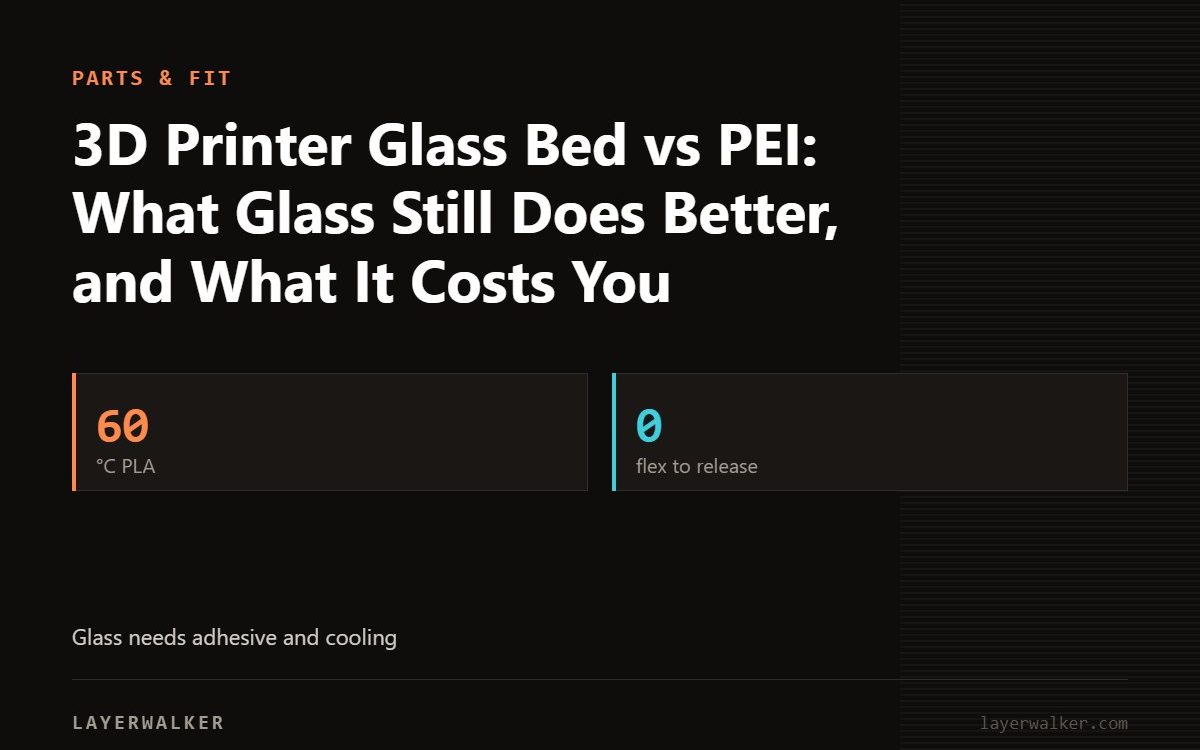
Keep a glass bed for two things: a perfectly flat reference when your PEI plate or aluminium bed is warped, and a mirror-gloss bottom on PLA display parts. For everyday printing a textured PEI spring-steel plate is easier: nothing sticks to bare glass without help, and parts have to cool fully before they release.
Glass was the standard surface for a decade because it is flat and cheap. Borosilicate does not warp with heat, so a first layer that is even in one corner is even in all four, and a part printed on it has a glossy, flat bottom. Then coated spring-steel plates arrived and solved the two things glass never did: gripping filament without adhesive and releasing it by flexing. Most printers now ship with PEI. Glass still has a place; it is just a narrower one.
Where to buy


Glass versus PEI
| Glass | Textured PEI | |
|---|---|---|
| Flatness | Excellent; a reference surface | Follows the bed underneath |
| Adhesion without help | Poor; needs glue, spray or a coating | Good for PLA, PETG, ABS, TPU |
| Release | Wait until cold; sometimes a scraper | Flex the sheet |
| Bottom finish | Mirror gloss | Matte pebble |
| Heat-up time | Slow; glass is thick and insulating | Fast |
| Damage | Chips if PETG is pulled off hot | Coating wears; replaceable |
When glass is the right choice
- Your aluminium bed is warped by more than a mesh can hide, and a flat glass sheet on top is cheaper than a new bed.
- You print PLA display pieces and want the glossy bottom.
- You print ABS or nylon on a liquid bed adhesive, which works well on glass.
When it is not
Everyday PLA and PETG, where a textured plate saves the glue stick and the waiting. Anything you need to remove quickly. Any printer with a weak bed heater, because glass adds heat-up time. The PEI guide covers the plate side.
The plates in the box
The box lists PEI spring-steel plates rather than glass, because for most people asking about a glass bed, the better move is a textured PEI plate on a magnetic base. If you specifically want glass, buy borosilicate cut to your bed size and 3 to 4 mm thick, and pair it with a spray or liquid adhesive.
Getting glass to work
- Clean with dish soap and water, then IPA. Fingerprints are the reason a first layer will not stick.
- Glue stick or spray for PLA and PETG; liquid bed adhesive for ABS.
- Bed 5 °C hotter than on PEI; glass insulates the top surface.
- Let it cool fully. Parts release themselves with a click as the glass contracts.
- Clip it down at the corners, not the edges, so the clips clear the nozzle.
3D printer glass bed FAQ
Can I put a PEI plate on top of glass?
Yes, with a magnetic base sheet stuck to the glass. It adds about 2 mm; re-home Z.
Does glass crack from heat?
Borosilicate does not. Window glass can.
Why did PETG chip my glass?
It was pulled off warm. PETG bonds to glass harder than glass bonds to itself.

LayerWalker
Print defect diagnosis, calibration procedures and parts that actually fit. Corrections welcome through the contact page.