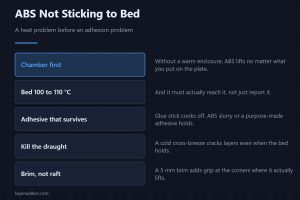
ASA Warping: The Enclosure Is the Fix, Not a Hotter Bed
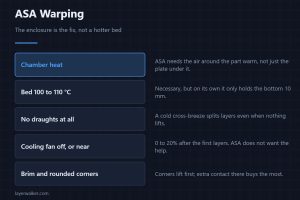
ASA warping is solved by an enclosure, not by pushing the bed hotter. What chamber temperature it needs, why draughts crack layers, and when a brim helps.
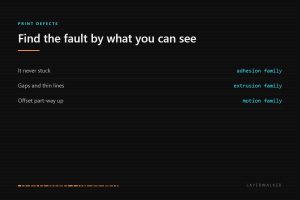
What you can see on the plate: stringing, warping, first layer failures, under-extrusion, layer shifts. Each page is written against one specific failure mode, with the settings that change it.
ASA warping is solved by an enclosure, not by pushing the bed hotter. What chamber temperature it needs, why draughts crack layers, and when a brim helps.
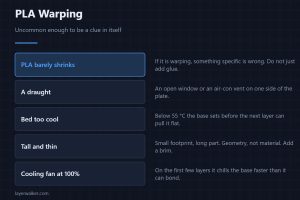
PLA warping is uncommon enough to be a clue in itself: it points at a draught, a cold bed or a tall thin part, not at bad filament. What to change, in order.
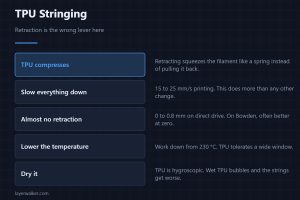
TPU stringing barely responds to retraction, because the filament compresses instead of moving. Slow the travel down first, then tune travel, then dry it.
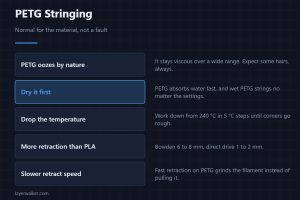
PETG stringing more than PLA is normal, not a fault. Why the material oozes, the retraction numbers that work, and why drying it matters far more here.
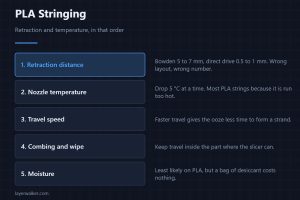
PLA stringing is retraction and temperature, in that order, and dry filament still strings if the settings are wrong. A test you can run in eight minutes.
ABS not sticking to bed is a heat problem before it is an adhesion one. Chamber temperature, bed prep that survives 100 degrees, and when a brim is enough.
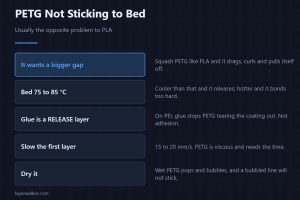
PETG not sticking to bed is rarer than PETG sticking too hard. The nozzle gap it wants, why glue is a release layer here, and the temperatures that work.
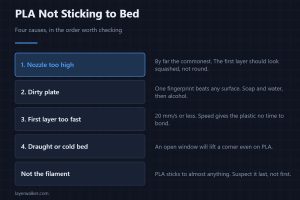
PLA not sticking to bed is almost never the filament. Four causes in the order worth checking: bed height, a dirty plate, first-layer speed, and draughts.
What to look for Three cheap things diagnose most of what follows. A tool kit with nozzle needles, tweezers and hex keys…
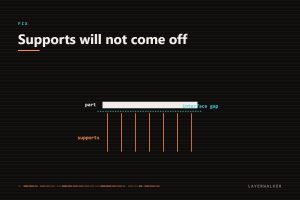
Supports fused to the part. Increase the Z gap and reduce the interface density.