PETG Not Sticking to Bed: Why It Is Usually the Opposite Problem
LayerWalker is a participant in the Amazon Services LLC Associates Program. We may earn a commission when you buy through links on our site, at no extra cost to you.
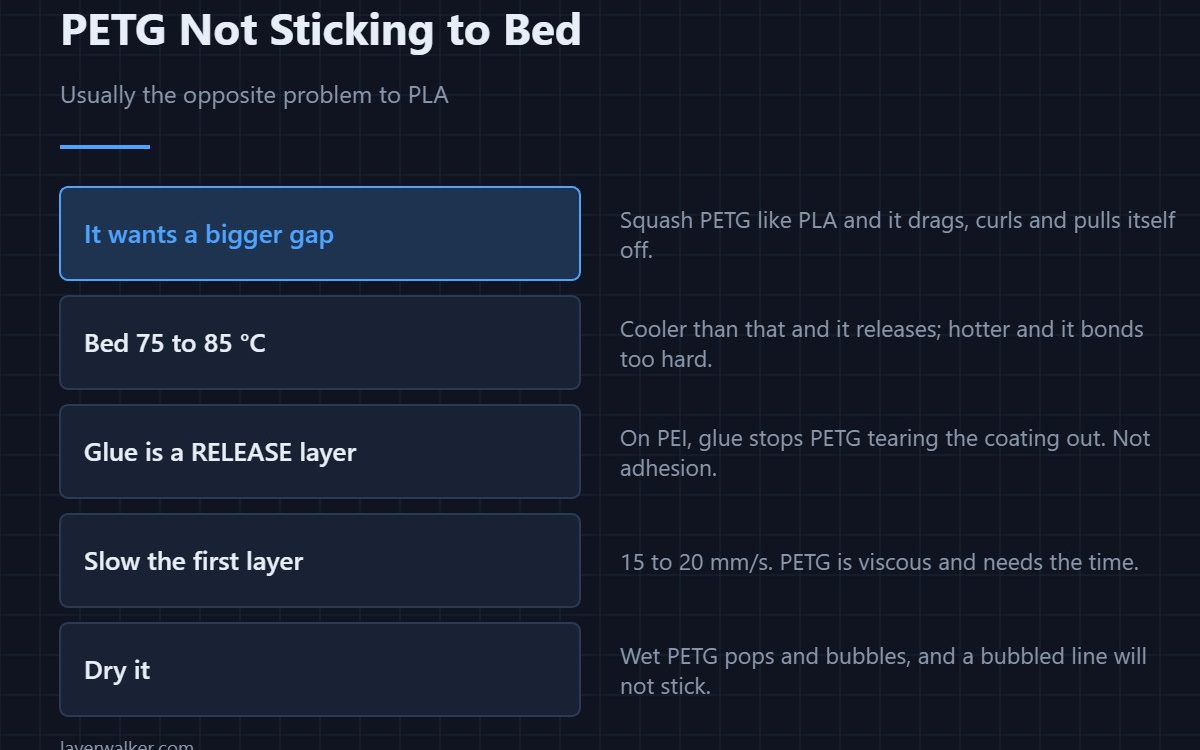
PETG not sticking to bed usually means the nozzle is too close, not too far. PETG needs a slightly larger first-layer gap than PLA; squash it the same way and the nozzle drags through the line and peels it up. Set the bed to 75–85 °C, slow the first layer to 15–20 mm/s, and dry the spool. On PEI, glue stick is a release layer, not an adhesive.
Most PETG adhesion advice is written by people applying PLA habits, and PETG punishes almost all of them. It is more viscous, it bonds chemically to PEI rather than just gripping it, and it holds moisture far faster. The failure mode looks identical to PLA lifting, but the fix usually runs in the opposite direction.
Where to buy


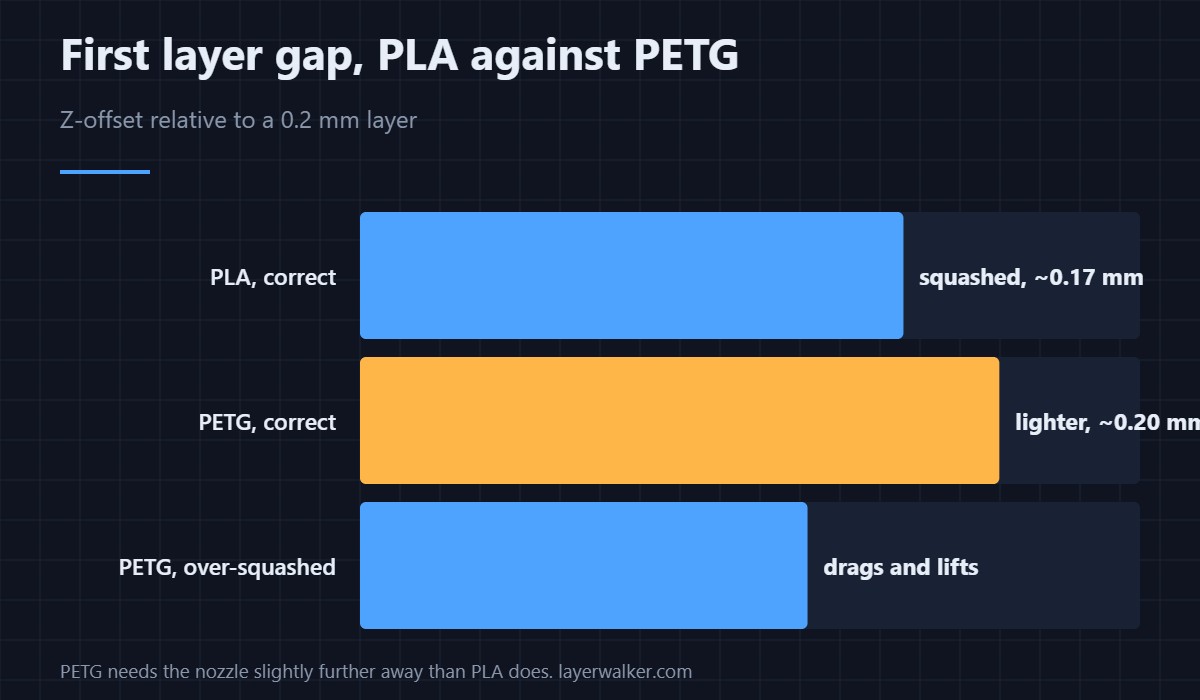
Give it a bigger gap
A correct PETG first layer is laid down, not pressed in. If you dial in the squish the way you would for PLA, the nozzle ploughs through the previous line, picks it up, and drags a ridge along behind it. Raise the Z-offset by roughly 0.02–0.03 mm from your PLA value and print a first-layer square to check: the lines should touch without merging into a glossy sheet.
Temperature, both ends
Bed at 75–85 °C. Below 70 °C PETG releases as it cools; above 90 °C it bonds to PEI hard enough to take the coating with it. Nozzle at 230–245 °C depending on the brand — run a temperature tower rather than trusting the spool label, which is usually a range wide enough to be useless. Full settings by material are in bed temperature by material.
Dry it, properly
PETG absorbs moisture faster than almost anything else on a hobby shelf, and it shows up at the first layer as popping, bubbles and lines that will not bond. A spool that has been open a fortnight in a normal room is already wet enough to matter. Six hours at 65 °C in a filament dryer fixes it; a sealed box with desiccant keeps it fixed. Storage is the part people skip.
Glue stick is for getting it off again
This confuses everyone. On bare glass, glue stick helps PETG stick. On PEI, PETG already sticks too well — it bonds chemically, and pulling a hot part off smooth PEI is how coatings get torn out in chunks. There, a thin layer of glue stick is a deliberate release layer. Textured PEI is more forgiving than smooth for exactly this reason; see the PEI plate comparison.
PETG Not Sticking to Bed FAQ
Why does my PETG first layer look stringy and torn?
The nozzle is too low and is dragging through what it just laid down. Raise the Z-offset slightly. This is the single most common PETG first-layer fault and it looks nothing like the PLA version.
What bed temperature should I use for PETG?
Start at 80 °C. Drop toward 75 °C if parts are hard to remove, raise toward 85 °C if corners lift. Going higher rarely helps and increases the risk of the part welding itself to a smooth plate.
Does PETG need an enclosure?
No, and it can print slightly worse in a hot one. PETG only shrinks about half as much as ABS. The full answer is in does PETG need an enclosure.
Why does PETG stick perfectly one day and not the next?
Moisture, nearly always. Nothing else changes that fast. If the spool has been on an open shelf between sessions, dry it before changing any settings.

LayerWalker
Print defect diagnosis, calibration procedures and parts that actually fit. Corrections welcome through the contact page.