PETG 3D Printer Filament: Which One to Buy and How to Print It Clean
LayerWalker is a participant in the Amazon Services LLC Associates Program. We may earn a commission when you buy through links on our site, at no extra cost to you.
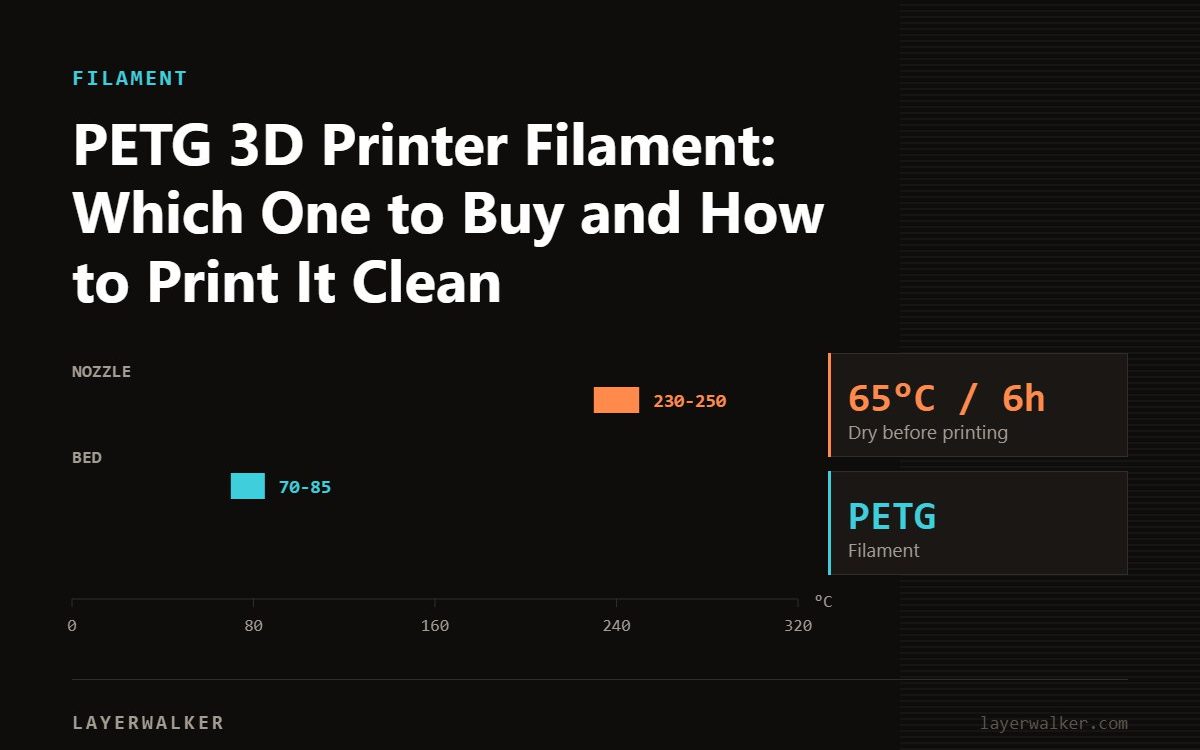
Buy PETG when a part must survive heat above 60 °C, outdoor use or repeated flexing: it is tougher than PLA and does not go brittle. Expect to dry it at 65 °C for 6 hours before a good print, use 230 to 250 °C at the nozzle and a 70 to 85 °C bed, and keep it off a smooth PEI sheet without a release layer.
PETG sits between PLA and ABS. It prints on an open printer without an enclosure, it survives a hot car dashboard, and it bends before it snaps, which is why it is the default material for brackets, enclosures and anything that gets screwed together. The price for that toughness is water: PETG absorbs moisture from the air in a day or two, and wet PETG strings, bubbles and prints weak layers that look fine and then split. Every complaint about PETG being hard to print is, almost always, a complaint about wet PETG.
The PLA versus PETG comparison covers when to pick each one. This guide is about choosing a spool and getting it to print.
Where to buy


ELEGOO Rapid PETG 3D Printer Filament 1.75mm Black 4 Pack Bundle

What separates good PETG from cheap PETG
- Diameter tolerance of ±0.03 mm or better. PETG is already prone to stringing; a spool that swings between 1.70 and 1.80 mm makes retraction tuning impossible.
- Vacuum bag with desiccant, and a sealed spool. If the spool arrives loose in a box it has been absorbing water since it left the factory.
- A stated melt-flow or speed rating. Standard PETG flows slowly and is happy at 40 to 80 mm/s. Spools labelled rapid or high-speed use a lower-viscosity blend that keeps up with CoreXY printers at 150 mm/s and above, and they string less at normal speeds too.
- Cardboard or plastic spool that fits your dryer. Most dryers take a 1 kg spool up to about 75 mm wide; 2 kg spools do not fit.
The spools in the box
Overture’s high-speed PETG is the safe first spool: tight tolerance, consistent colour between batches and a blend that tolerates both a slow bed-slinger and a fast enclosed printer. Elegoo Rapid PETG is formulated for high-flow hotends and is the one to pick if your printer routinely prints above 100 mm/s. The 16-roll bundle is for a farm or a school where price per kilogram matters more than brand; check each roll’s tolerance figure and dry every spool before use regardless of what the label says.
Settings that work
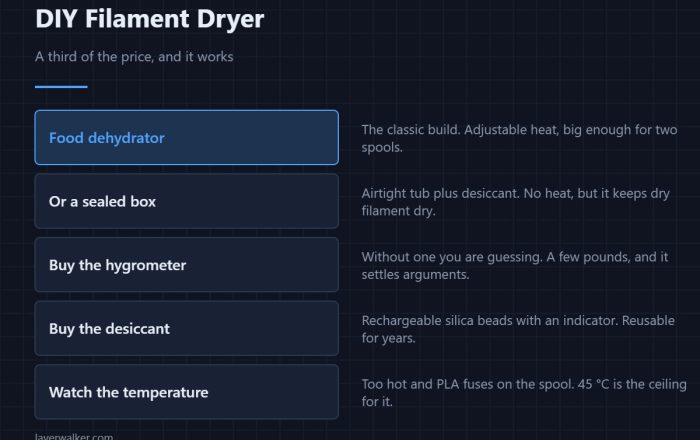
- Dry it. 65 °C for 6 to 8 hours in a filament dryer or a food dehydrator, then print from a dry box or the dryer itself.
- Nozzle 230 to 245 °C for standard PETG, 240 to 255 °C for rapid blends at speed. Bed 70 to 85 °C.
- Part cooling 30 to 50 %. Full fan makes PETG layers weak; zero fan makes it sag on overhangs.
- Retraction slightly longer and slower than PLA, and a Z-hop of 0.2 mm stops the nozzle dragging strings across the top surface. If you still see wisps, read the stringing guide: with PETG, drying beats retraction tuning every time.
- Bed surface. PETG bonds to smooth PEI so hard it rips the coating off. Use a textured PEI sheet, or wipe a glue-stick release layer on smooth PEI or glass.
When PETG is the wrong choice
Fine miniatures and anything with tiny details: PETG strings and blobs at small scale, and PLA is sharper. Parts that need to stay stiff under sustained load: PETG creeps over months where PLA holds shape. Very high heat above 80 °C: that is ASA or nylon territory.
PETG 3D printer filament FAQ
Is PETG food safe?
The raw polymer is; the printed part is not, because layer lines trap bacteria and the nozzle may contain lead. Treat it as not food safe.
Why does my PETG look cloudy and rough?
Water. Steam escaping the nozzle leaves micro-bubbles. Dry the spool and print the same file again before changing any setting.
Can I print PETG on a Bowden printer?
Yes. Keep retraction under 6 mm and speeds under 60 mm/s; PETG is not the problem material that TPU is on a Bowden setup.

LayerWalker
Print defect diagnosis, calibration procedures and parts that actually fit. Corrections welcome through the contact page.