Flashforge Camera: Built In on Some Models, an Add-On on Others
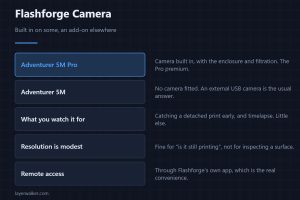
Flashforge camera options split by printer: built in on the 5M Pro, an add on elsewhere. What each one resolves, and whether the AI check is worth having.
Nozzles, build plates, hotends and extruders — with fitment tables that say “not verified” when we have not checked, because a wrong answer here costs you a hotend.
Flashforge camera options split by printer: built in on the 5M Pro, an add on elsewhere. What each one resolves, and whether the AI check is worth having.
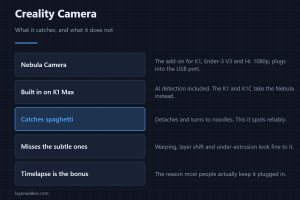
A Creality camera lets you watch a print and catch a failure early. Which models take the Nebula, what the AI detection catches, and what it plainly misses.
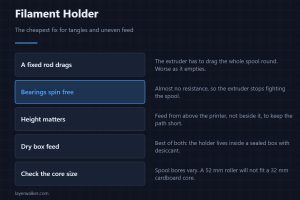
A filament holder is the cheapest fix for tangles and uneven feed. Bearings versus a fixed rod, when to feed from a dry box, and what fits your spools.
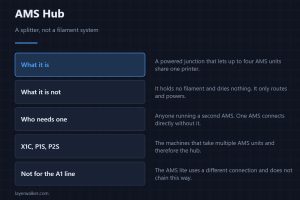
The AMS Hub is a splitter, not a filament system: it lets several AMS units share one printer. What it connects, what it will not do, and who needs one.
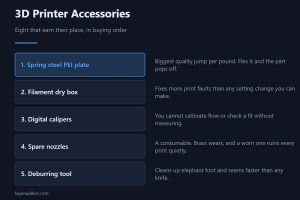
Most 3D printer accessories are clutter that ends up in a drawer. The eight that genuinely earn their place, in the order that makes sense to buy them.
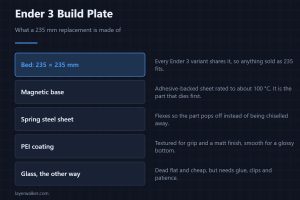
The Ender 3 build plate is 235 mm square, so replacements are cheap. PEI vs glass vs the stock sticker, textures that grip, and what the magnet must match.
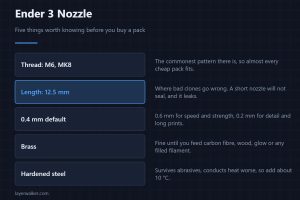
Every Ender 3 nozzle is an MK8 thread, so most cheap packs fit. Sizes that matter, brass vs hardened steel, and how to clear a clog without a strip-down.
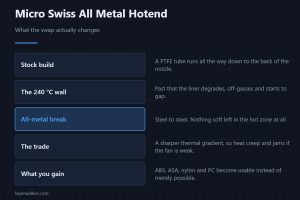
A Micro Swiss all metal hotend swaps the PTFE tube for a steel heat break. Which kit fits your Ender, Sovol or Creality, and the temperature it unlocks.
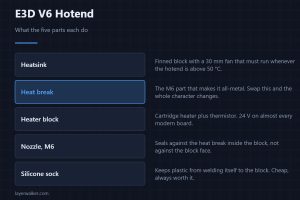
The E3D V6 hotend is the M6 standard most clones copy. What it fits, why the genuine one costs more, which nozzles thread in, and the heat-break trap.
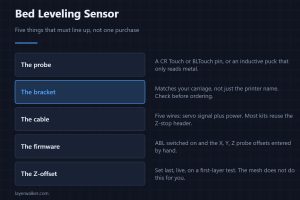
A bed leveling sensor only fixes an uneven bed, never a warped one. BLTouch vs CR Touch, which control board each one needs, and the wiring people get wrong.