Ender 3 Nozzle: MK8 Thread, Sizes, and Clearing a Clog
LayerWalker is a participant in the Amazon Services LLC Associates Program. We may earn a commission when you buy through links on our site, at no extra cost to you.
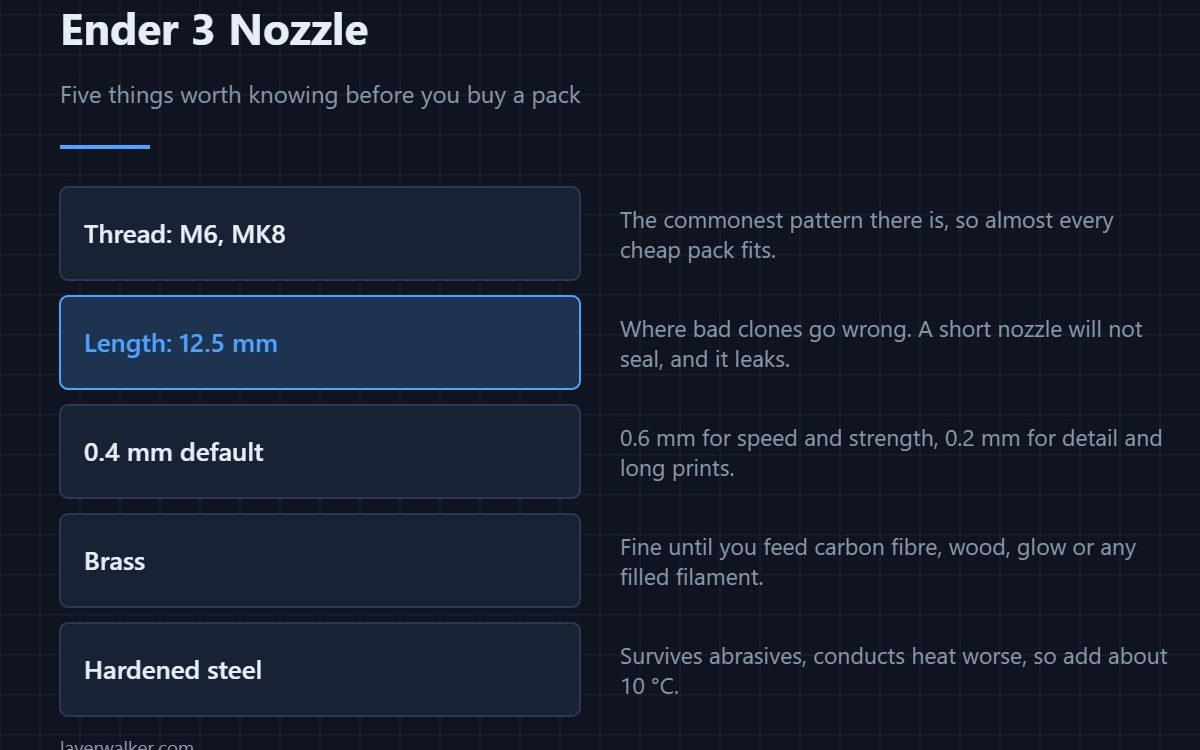
Every Ender 3 nozzle is an MK8-pattern M6 thread, 12.5 mm long, so nearly any cheap multipack will fit. Stay at 0.4 mm unless you have a reason to move: 0.6 mm for speed and strength, 0.2 mm for detail. Brass is fine until you feed anything filled, at which point it wears out in a spool or two and you want hardened steel.
The nozzle is the cheapest part on the printer and the one people replace last. It is also a consumable: brass wears measurably after a few kilograms of ordinary PLA and quickly with anything abrasive, and a worn nozzle quietly widens every extrusion until nothing fits together properly.
Where to buy


What fits an Ender 3
M6 thread, 1 mm pitch, 12.5 mm overall length, 6 mm hex flats. That is the MK8 pattern, and it is shared across the whole Ender 3 family including the Pro and V2. The one thing to check on a cheap pack is the length, because a nozzle a fraction short will not seat against the PTFE tube and molten plastic escapes up into the heater block — the classic ooze that looks like a leaking hotend. If you are unsure what you are holding, the four common thread formats are easy to tell apart with a ruler.
The V3 SE, KE and V3 use a different quick-swap hotend assembly, so packs sold for the original Ender 3 do not fit them. Check which machine you actually own in the Ender 3 lineup before ordering.
Which size to buy
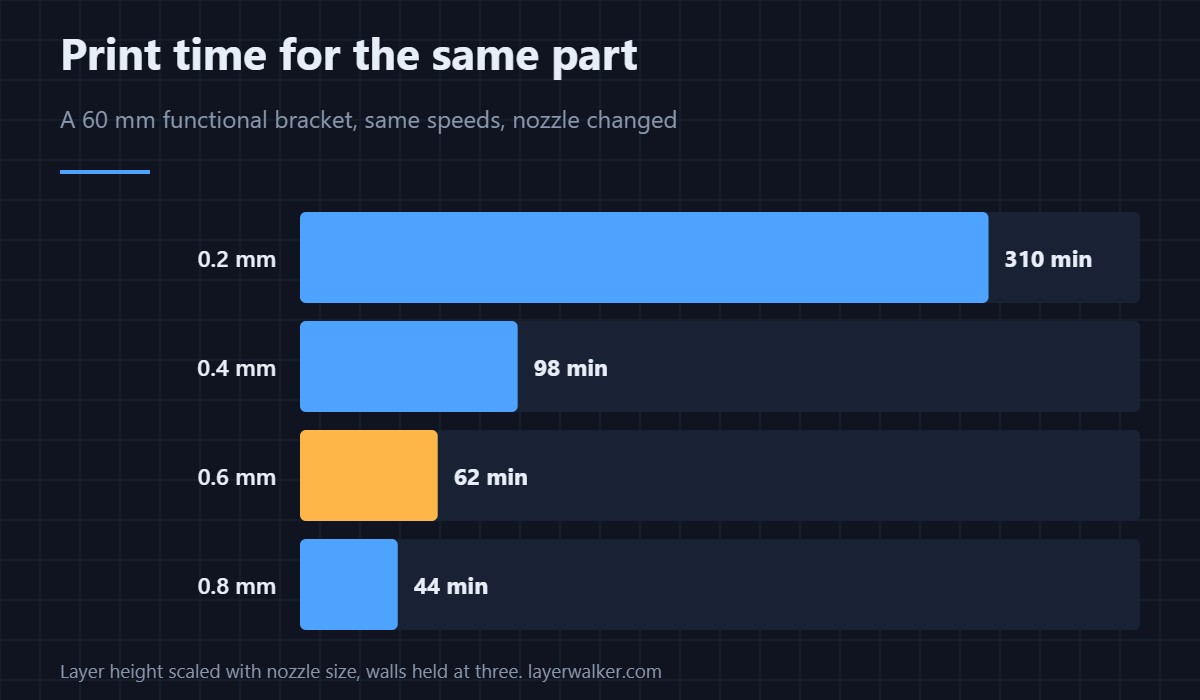
Going from 0.4 mm to 0.6 mm is the single cheapest speed upgrade on the platform, and it makes functional parts stronger because the extrusions are fatter and bond better. You lose fine detail and crisp small text. Going down to 0.2 mm does the reverse and triples your print times, which is why it belongs on miniatures and nothing else. More on why the default is what it is in the case for 0.4 mm.
Brass or hardened steel
Brass conducts heat well and cuts cleanly, which is why it is standard. It is also soft. Carbon fibre, glass fibre, wood fill, glow-in-the-dark and metal-fill filaments all act like sandpaper, and a brass nozzle fed a spool of carbon-filled nylon can end up visibly oval. Hardened steel survives it but conducts heat worse, so add roughly 10 °C. The full comparison, including plated copper as a middle option, is in brass vs hardened steel.
Clearing an Ender 3 clogged nozzle
Work from least invasive upwards. Heat to printing temperature and push filament through by hand to see whether it is partial or total. If nothing moves, try a cold pull: heat, insert filament, cool to about 90 °C for PLA, then pull firmly — the plug comes out shaped like the inside of the nozzle. Only then reach for a 0.35 mm cleaning needle, and only while hot. Never drill a cold nozzle; you will score the bore and it will clog faster afterwards. The step-by-step version is in nozzle cleaning, and the difference between partial and complete blockages in this breakdown.
If it clogs again within a few prints, the nozzle is not the problem. Look at the PTFE tube first — a browned or shrunken tube leaves a gap where plastic pools — then the heatsink fan, then whether an all-metal upgrade is what you actually needed.
Ender 3 Nozzle FAQ
How often should I replace an Ender 3 nozzle?
With plain PLA and PETG, every few kilograms, or whenever first layers start going inconsistent for no other reason. With filled filaments in a brass nozzle, treat it as a per-spool consumable.
Do cheap nozzle multipacks actually work?
Mostly, yes — the thread is standard and the tolerances that matter are loose. Measure the length on arrival and discard anything not close to 12.5 mm. For abrasives, buy a named hardened nozzle instead of a bargain pack.
Why does plastic build up on the outside of my nozzle?
Either the nozzle is not tight against the tube, which lets plastic escape into the block, or the nozzle was tightened cold and loosened as it heated. Tighten hot, at printing temperature, with the block held steady.
Will a bigger nozzle make my Ender 3 print faster?
Yes, and more than almost anything else you can do for the money. A 0.6 mm nozzle cuts print time by roughly a third. The limit is the hotend’s melt rate, which is where a high-flow hotend starts to matter.

LayerWalker
Print defect diagnosis, calibration procedures and parts that actually fit. Corrections welcome through the contact page.