Brass vs hardened steel nozzles
LayerWalker is a participant in the Amazon Services LLC Associates Program. We may earn a commission when you buy through links on our site, at no extra cost to you.
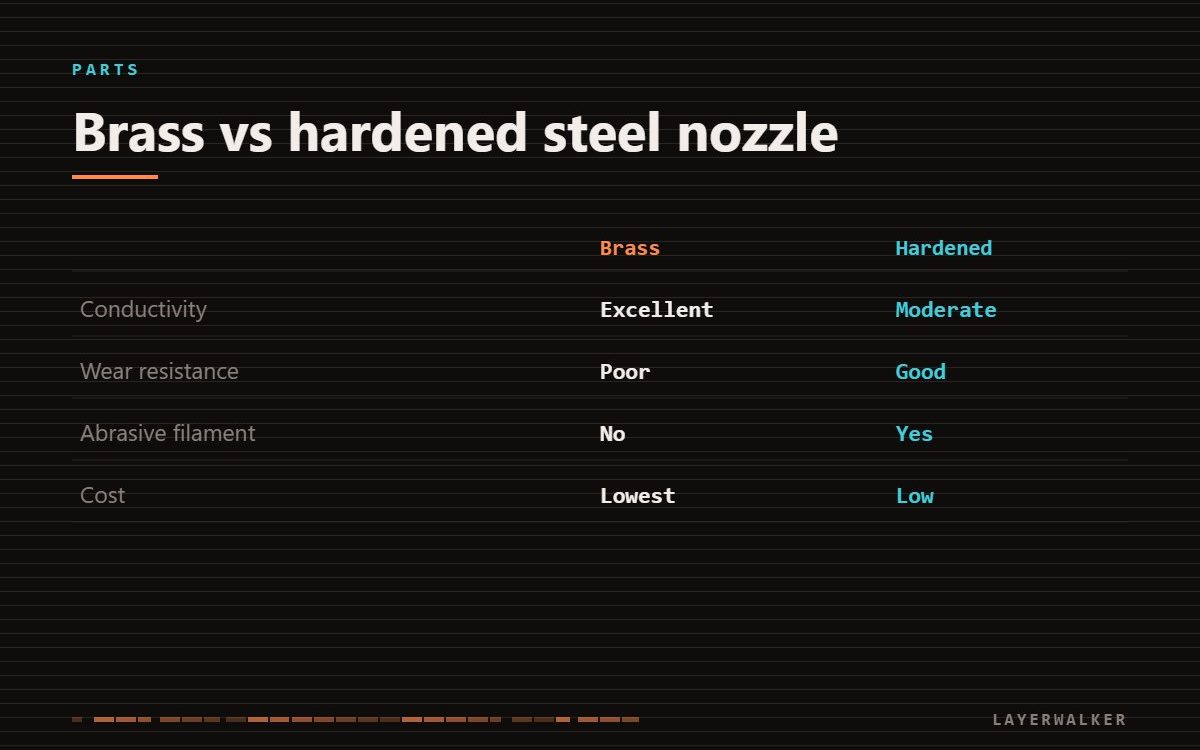
Print only PLA, PETG, ABS and ASA? Brass, every time — better heat transfer, cheaper, easier to keep clean. Print anything with carbon fibre, glass fibre or glow powder in it? Hardened steel, and raise your temperature 5-10 degC.
| Property | Value |
|---|---|
| Brass | thermal conductivity excellent, wear resistance poor, cost lowest |
| Hardened steel | conductivity moderate, wear resistance good, cost low |
| Stainless steel | conductivity poor, wear resistance moderate, corrosion resistant |
| Ruby tipped | conductivity excellent, wear resistance excellent, cost high |
| Tungsten carbide | conductivity good, wear resistance excellent, cost high |
Where to buy


8Pcs 3D Printer Upgraded Hardened Steel MK8 Nozzles w/DIY Tool Storage Box

Brass vs hardened steel nozzle: why brass wears so fast on abrasives
Chopped carbon fibre is harder than brass. Every millimetre of filament passing through drags fibres across the bore. The hole goes oval and grows, extrusion width drifts, and quality declines gradually. A brass nozzle can be measurably worn within one kilogram of carbon-filled filament.
The temperature penalty is real
Hardened steel conducts heat less well. After a swap, the plastic leaving the nozzle is slightly cooler than the sensor reading suggests, which shows up as weak layer bonding. Add 5-10 degC and reprint a temperature tower rather than assuming the old profile still applies.
Quality slowly declining on a machine that prints abrasive filament
Worn nozzle bore
- Look into the nozzle bore with a bright light. A worn bore is visibly oval or enlarged.
- Print a single-wall cube and measure the wall. Compare against your calibrated extrusion width.
- If the wall measures wider than intended and flow calibration cannot bring it back, the nozzle is worn.
- Replace with hardened steel if you print abrasives, brass if you do not.
- Recalibrate flow and Z offset after the change.
Treat brass as consumable
If you occasionally print carbon fibre and do not want to swap materials, keeping a stock of cheap brass nozzles and replacing them regularly is a legitimate strategy. What does not work is running brass on abrasives and expecting it to last.

LayerWalker
Print defect diagnosis, calibration procedures and parts that actually fit. Corrections welcome through the contact page.