PETG Stringing: Why It Strings More Than PLA, and What Fixes It
LayerWalker is a participant in the Amazon Services LLC Associates Program. We may earn a commission when you buy through links on our site, at no extra cost to you.
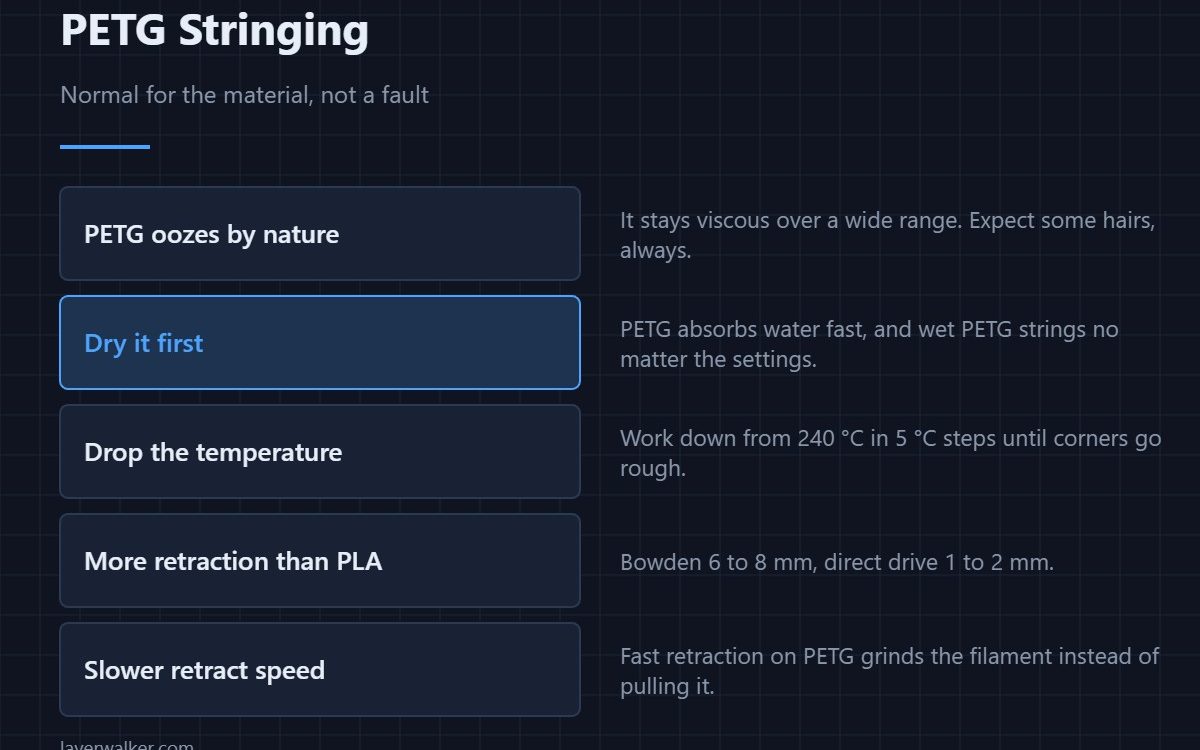
PETG stringing more than PLA is normal for the material, not a fault. PETG stays viscous across a wide temperature range and oozes by nature. The order that works: dry the spool, drop the nozzle temperature in 5 °C steps from 240 °C, increase retraction distance beyond your PLA value, and reduce retraction speed. Expect fine hairs even when it is tuned.
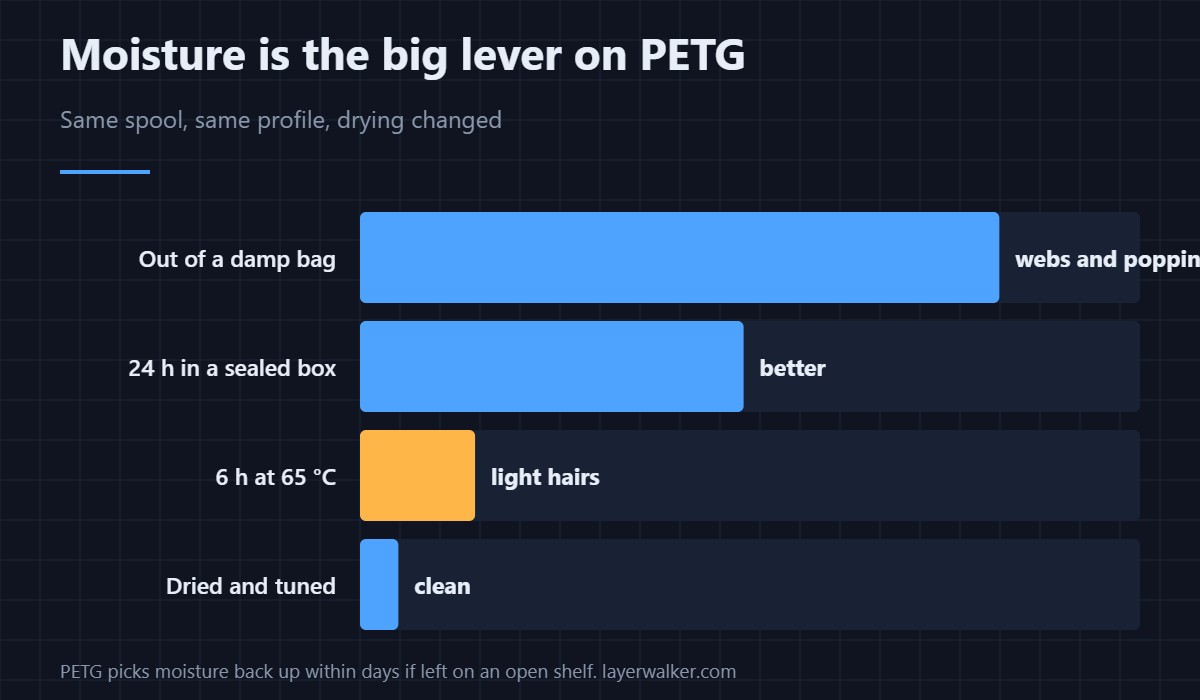
PETG is hygroscopic in a way PLA is not. A spool that has been open for two weeks in an ordinary room has already absorbed enough water to string, pop and print rough surfaces, and no amount of retraction tuning compensates for steam coming out of the nozzle.
Where to buy


1. Dry it before you change anything
Six hours at 65 °C in a filament dryer, or overnight if the spool has been out for months. You will hear the difference: wet PETG crackles as it extrudes. Then keep it dry — a sealed box with fresh desiccant, not a shelf. The practical routine is in drying filament and storage.
2. Temperature, downward from 240 °C
Most PETG runs well at 230–240 °C, and most people print it at 250 °C because the spool says it is allowed. Work down in 5 °C steps with a temperature tower until corners start looking rough or layers stop bonding, then go back up one step.
3. More retraction distance, slower retraction speed
PETG needs roughly a millimetre more than PLA: 6–8 mm on Bowden, 1–2 mm on direct drive. But it wants that retraction applied more slowly — around 25–35 mm/s rather than 45. PETG is soft and grippy, and a fast retraction grinds a flat spot into the filament instead of pulling it back, which then causes under-extrusion a few minutes later.
4. Cooling and travel
Run the part fan at 30–50%, not the 100% you would use for PLA. Too much cooling weakens PETG layer bonding without reducing strings much. Raise travel speed to 150 mm/s or so, and enable combing so the nozzle crosses open air as little as possible.
What good actually looks like
Tuned PETG still leaves fine hairs between parts. That is the material. What you should not have is thick strands, blobs at the start of each perimeter, or a rough gritty top surface — those mean either moisture or too much heat. The cross-material view is in stringing and oozing, and the PLA version of this page is at PLA stringing.
PETG Stringing FAQ
Why does PETG string when PLA does not, on the same printer?
Two reasons: PETG holds heat and stays fluid over a wider range, and it absorbs moisture far faster. The same profile that is tuned for PLA is too hot and under-retracted for PETG.
How do I know if my PETG is wet?
Listen. Wet filament crackles and pops as it extrudes, and the extruded line has visible bubbles or a rough matt surface instead of a glossy one. If you can hear it, drying will help more than any setting.
Should I use a higher retraction speed for PETG?
No, lower. Fast retraction on soft PETG grinds a flat onto the filament and the extruder loses grip. 25–35 mm/s is a good starting range.
Does a hardened nozzle help with PETG stringing?
Not directly. But a worn brass nozzle with a widened or scored bore strings more, so if the profile used to work and no longer does, inspect the nozzle before retuning.

LayerWalker
Print defect diagnosis, calibration procedures and parts that actually fit. Corrections welcome through the contact page.