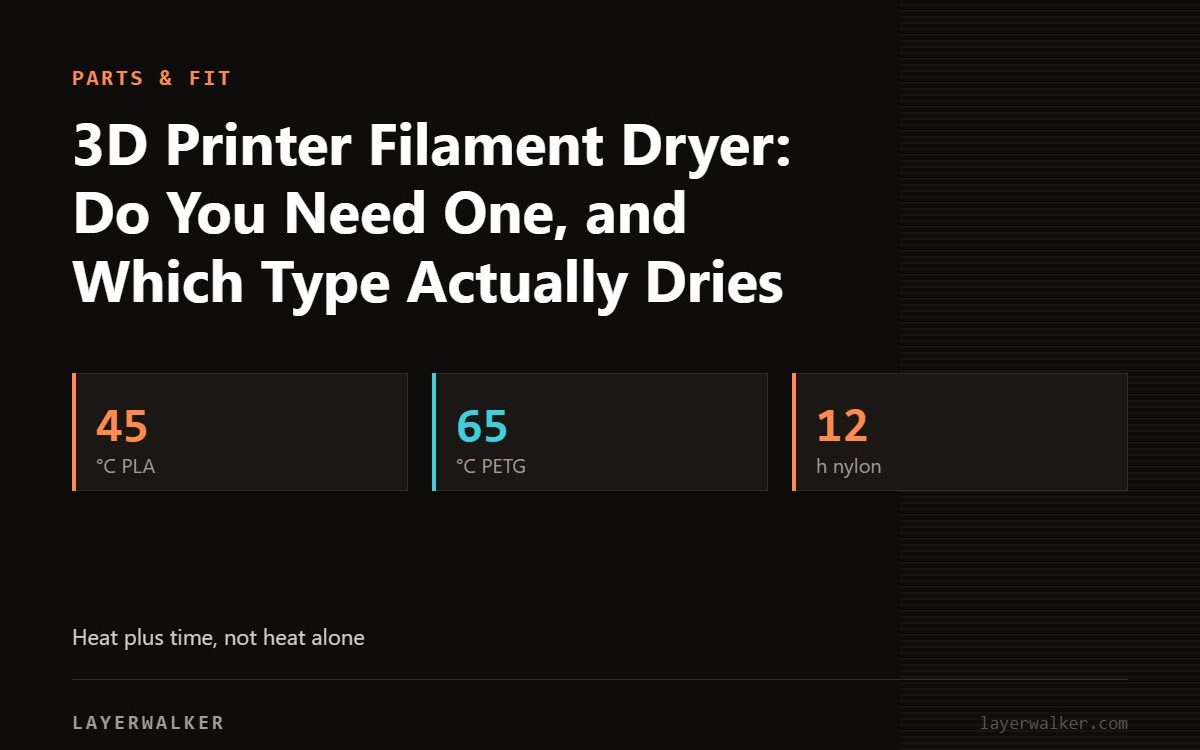
3D Printer Filament Dryer: Do You Need One, and Which Type Actually Dries
LayerWalker is a participant in the Amazon Services LLC Associates Program. We may earn a commission when you buy through links on our site, at no extra cost to you.
You need a filament dryer if you print PETG, TPU, nylon or anything with fibre in it, or if PLA has started stringing and snapping months after you opened it. Buy one whose stated maximum is at least 65 °C so it can dry PETG and ABS properly; a 50 °C box only handles PLA.
Filament is a sponge. PLA takes days to soak up enough water to matter, PETG a day or two, nylon and TPU a few hours in a humid room. When wet filament hits a 230 °C nozzle the water flashes to steam: you hear popping, you see stringing and tiny bubbles on the surface, and the layers bond weakly because the molten plastic is foamed. No slicer setting fixes this. A dryer, run before printing and ideally while printing, does.
Our drying temperatures and times guide covers each material; this guide is about choosing the hardware.
Where to buy


The one spec that matters: maximum temperature
PLA dries at 45 to 50 °C, PETG at 60 to 65 °C, ABS and ASA at 65 to 70 °C, nylon and polycarbonate at 70 to 90 °C. A dryer that tops out at 50 °C will keep PLA fresh and do nothing useful for nylon. Look at the maximum, not the marketing. Then check three more things:
- A circulation fan. Heat without airflow dries the outer wraps and leaves the core wet. Boxes with a fan finish in half the time.
- Print-through feed holes. A PTFE outlet on the lid lets you print straight from the dryer, so the spool never sees room air. This is the feature that turns a dryer from a chore into a set-and-forget upgrade for PETG.
- Spool capacity. Single-spool boxes suit one printer and one material at a time. Multi-spool dryers matter for a multi-material unit or a small farm, and they need more wattage to reach temperature with four spools of thermal mass inside.
- A hygrometer you can read. Below 20 % relative humidity inside the box is the target; if the display never gets there the seals are poor.
The dryers in the box
The Comgrow box is the entry-level single-spool dryer: enough for PLA and PETG, small footprint, print-through holes. SUNLU‘s S1 Plus adds a built-in circulation fan and a timer, which is the difference between drying a spool of PETG in six hours or in twelve, and it is the model to pick for one printer that prints PETG regularly. Creality’s Space Pi X4 is the four-spool unit with a 200 W heater; it is the right size for an AMS-style multi-material setup or for anyone who wants to dry nylon and PETG for a week’s printing in one run.
How to use one properly
- Dry before the first print from a new spool, even a sealed one: 6 hours at the material’s temperature.
- Print from the dryer at a holding temperature 5 to 10 °C lower than the drying temperature. This keeps PETG and TPU dry through a 20-hour print.
- Swap the desiccant. Dryers with a desiccant tray need it recharged in an oven every few weeks; a colour-changing pack tells you when.
- Do not exceed the spool’s own limit. Plastic spools soften above 70 °C; cardboard spools are fine but shed dust into the feed path.
When you do not need one
If you print PLA only, use a spool within two months of opening, and live somewhere dry, a sealed bag with fresh desiccant does the job. A food dehydrator with the trays removed is also a working dryer for around the same money, just without print-through feed.
If you would rather build than buy, a DIY filament dryer does the same drying for about a third of the price, with the two parts worth buying rather than improvising.
3D printer filament dryer FAQ
Can I dry filament in the oven?
Only if the oven holds 50 °C reliably, and most home ovens overshoot by 20 °C on the low setting and melt the spool. A dryer or dehydrator is safer.
How long does dried filament stay dry?
PLA a few weeks in open air; PETG a day or two; nylon and TPU a few hours in summer humidity. That is why print-through feed matters more than drying speed.
Does a dryer fix stringing?
If the stringing appeared after the spool had been open a while, yes, and completely. If a fresh dry spool strings, follow the retraction and temperature guide instead.

LayerWalker
Print defect diagnosis, calibration procedures and parts that actually fit. Corrections welcome through the contact page.