How Much Does It Cost to 3D Print? The Numbers That Actually Matter
LayerWalker is a participant in the Amazon Services LLC Associates Program. We may earn a commission when you buy through links on our site, at no extra cost to you.
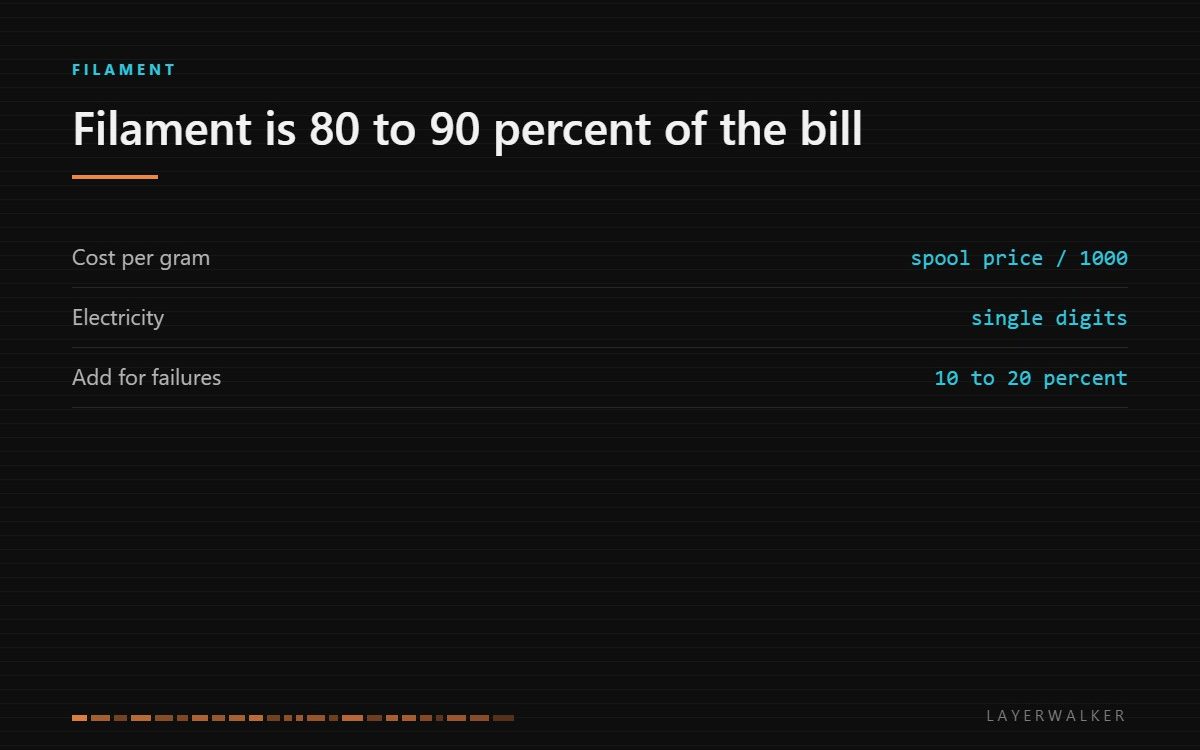
Filament is almost the whole bill. Take the slicer’s gram estimate, multiply by the spool price divided by 1000, and add roughly 10 to 20 percent for failures and purge. Electricity is usually a few cents an hour and matters far less than people expect.
Where to buy


Bambu Lab PLA 3D Printer Filament 1.75mm RFID 1kg with Spool, Black
What to look for
You need two measurements to stop guessing, and both are cheap. The first is a kitchen scale reading to 0.1 g, because the slicer estimate is a model and the spool is the truth. Weigh the spool before and after a job and you know the real consumption including purge and the skirt, which the estimate usually understates.
The second is a plug-in energy meter. Printer power draw swings enormously between bed heat-up and steady printing, so a nameplate wattage tells you nothing useful. A meter that logs kilowatt hours over a whole print gives you one number you can multiply by your tariff, and several of them show the cost directly once you enter your rate. Buy the scale first; it changes more answers.
The model
Four things cost money on an FDM print, and they are not close to equal.
| Item | How to calculate | Share of the bill |
|---|---|---|
| Filament | grams used × (spool price / 1000) | Usually 80 to 90 percent |
| Electricity | measured kWh × your tariff | Single digits |
| Wear items | nozzle, tank film, belts, plate, amortised per hour | Small but real |
| Failed prints | add a percentage to everything above | The one people omit |
Start with filament because it dominates. A spool sold by the kilogram divided by 1000 gives you a cost per gram, and the slicer tells you the grams. That single multiplication is within a few percent of the truth for most jobs, which is why elaborate calculators rarely beat it.
Electricity is smaller than the internet thinks
A desktop FDM printer draws its peak while the bed heats and very little once it is printing, so average draw over a long job is much lower than the peak figure on the label. Enclosed machines running high bed temperatures sit at the top of the range; a small open machine printing PLA sits at the bottom.
The reason to measure rather than look it up is that the answer depends on your material, your bed size and your room temperature, and the spread between those cases is larger than the spread between printer models. Once you have measured a typical job on your own machine you can stop thinking about it, because the number will be small enough to ignore against filament.
The costs people leave out
Failures are the big one. A print that fails at 80 percent has consumed 80 percent of the filament and produced nothing, and any honest cost per part has to carry that. Adding 10 to 20 percent to the material line covers it for most people; if your failure rate is higher than that, the fix is upstream and our pages on first layer adhesion and drying filament are worth more than any spreadsheet.
Then there is the purge. Every print starts with a prime line, and a multi-material job purges on every colour change, which on a four-colour model can exceed the weight of the part itself. If you print in multiple colours, weigh the waste once and you will change how you design.
Wear items are genuinely small per hour but not zero: nozzles, build plates, tubes and belts all have a life measured in hundreds of hours. Divide the part cost by that life and add it to the hourly rate if you are quoting work for someone else. For personal printing it rounds away.
Cost per part, for quoting
If you are pricing prints for other people, material plus electricity is a floor, not a price. The floor tells you what you must not go below; the price includes your time to set up, monitor, remove supports and finish, and that time is usually worth more than everything above it combined. People who quote from a filament calculator alone end up working for nothing, which is the most common way small print services fail.
A simple approach that survives contact with reality: material at cost plus your failure margin, machine time at a modest hourly rate to cover wear and the capital, and labour at whatever your time is worth. The first two are arithmetic. The third is a business decision.
FAQ
How much does a typical print cost? Weigh it. Most desktop prints are tens of grams, which at normal spool prices lands in cents rather than dollars.
Is the slicer estimate accurate? Close on filament weight, and it ignores failures and purge entirely. Treat it as the floor.
Does printing overnight cost much in electricity? Less than most people assume. Measure one job and you will stop worrying about it.
What raises cost most? Failure rate, then multi-colour purge. Neither appears in the slicer estimate.

LayerWalker
Print defect diagnosis, calibration procedures and parts that actually fit. Corrections welcome through the contact page.