Best PLA Filament Brands: What Actually Varies Between Spools
LayerWalker is a participant in the Amazon Services LLC Associates Program. We may earn a commission when you buy through links on our site, at no extra cost to you.
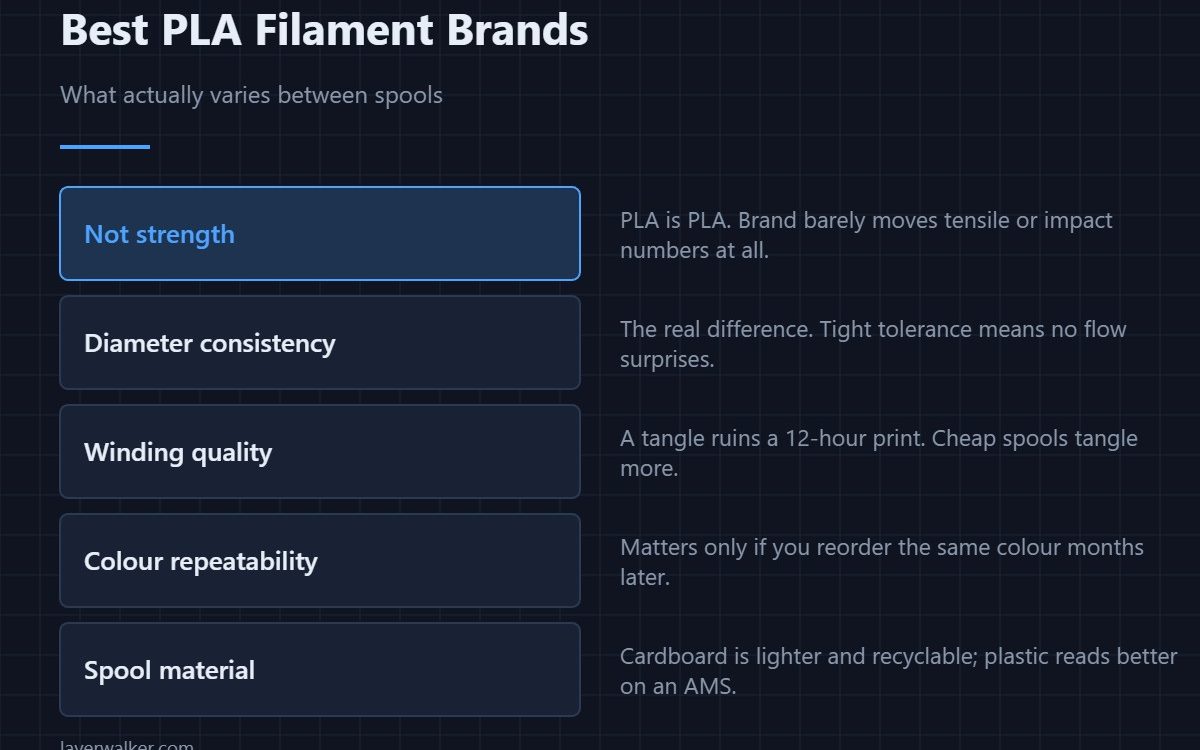
The best PLA filament brands do not give you stronger parts. PLA is PLA, and the polymer comes from a handful of suppliers regardless of the label. What varies is diameter consistency, winding quality and colour repeatability. Buy cheap for prototypes, buy consistent for long prints and parts where dimensions matter.
Brand comparisons usually reach for tensile numbers, which is the least useful figure here because it barely moves. Two spools from opposite ends of the price range will print brackets of essentially the same strength. The differences show up in whether the print finishes, and whether it measures the same as the last one.
Where to buy


eSUN PLA+ Filament 3D Printer Filament PLA Plus 1KG Black
The three things that actually differ
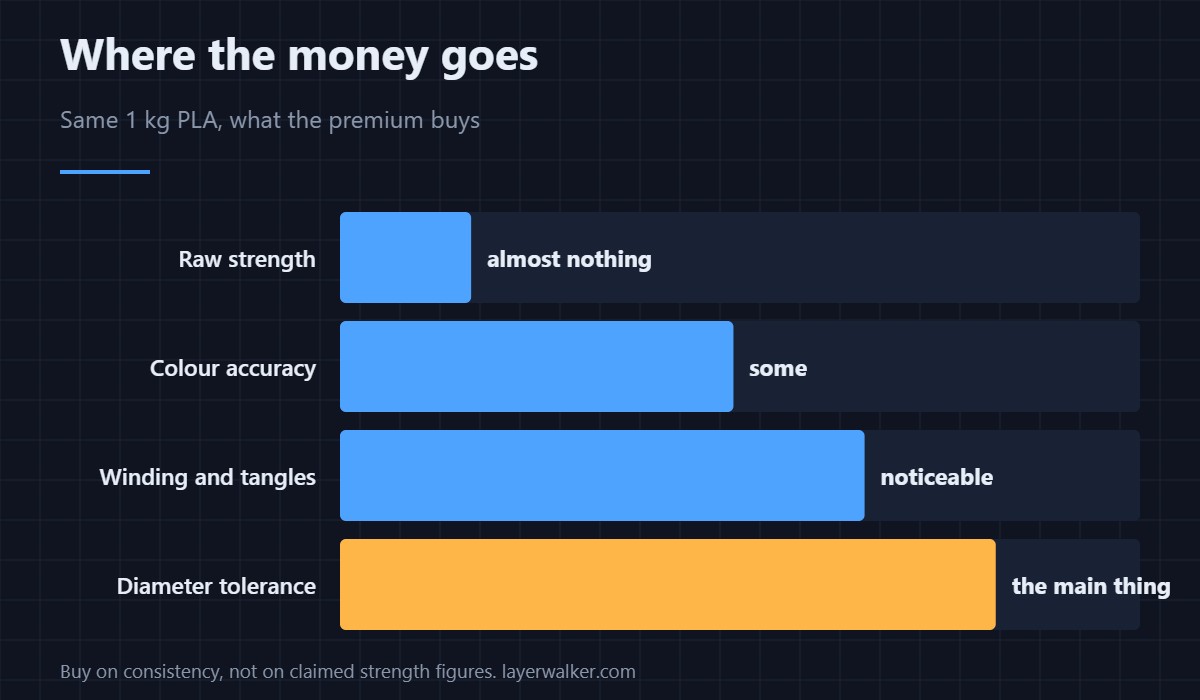
- Diameter tolerance. Budget spools hold roughly ±0.05 mm, good ones ±0.02 mm. That is a flow variation of a few percent, which shows up as inconsistent walls on long prints.
- Winding. A tangle at hour nine wastes the whole plate. Cheap spools are wound faster and tangle more often. This is the failure that actually costs you.
- Colour repeatability. Only matters when you reorder months later and the second batch does not match the first.
How to choose without reading reviews
Match the spool to the job. Iteration and draft parts: the cheapest name you can get, such as Inland. Anything over about eight hours, multi-colour plates, or parts that must fit together: a brand that publishes a tolerance figure, such as Polymaker. Everything in between: the mid-range brands are genuinely fine, and the difference between them is smaller than the difference between a dry spool and a damp one.
The variable that beats brand entirely
Moisture. A wet spool of premium PLA prints worse than a dry spool of the cheapest filament on the shelf, and PLA absorbs water slowly enough that people never suspect it. If your results got worse and nothing else changed, look at drying and storage before you change brand.
Specialty PLA is a different question
Matte, silk, wood-filled and glow PLA vary far more between brands than plain PLA does, because the additive load is where the formulation differs. Silk PLA is weaker than standard, wood PLA clogs, and glow filament eats nozzles. There, brand and datasheet genuinely matter. The wider view across all materials is in best filament brands.
Best PLA Filament Brands FAQ
Is expensive PLA stronger than cheap PLA?
Essentially no. Measured differences in tensile and impact strength between mainstream PLA brands are small compared with the effect of print orientation, wall count and layer adhesion.
Does PLA+ actually do anything?
Usually yes, modestly. PLA+ grades are toughened formulations that survive impact better than plain PLA. How much better varies by brand, and it is one of the few places where the label means something.
What tolerance should I look for?
±0.03 mm is fine for most work; ±0.02 mm is worth having for long or dimensional prints. Anything quoted looser than ±0.05 mm is worth avoiding for anything that matters.
Are cardboard spools worse than plastic ones?
They are lighter, recyclable and cheaper to ship. They also sag if stored damp and usually lack the RFID tag that AMS-style systems read. Neither affects print quality directly.

LayerWalker
Print defect diagnosis, calibration procedures and parts that actually fit. Corrections welcome through the contact page.