Silk PLA: Why It Shines, Why It Is Weaker, and How to Print It Without Strings
LayerWalker is a participant in the Amazon Services LLC Associates Program. We may earn a commission when you buy through links on our site, at no extra cost to you.
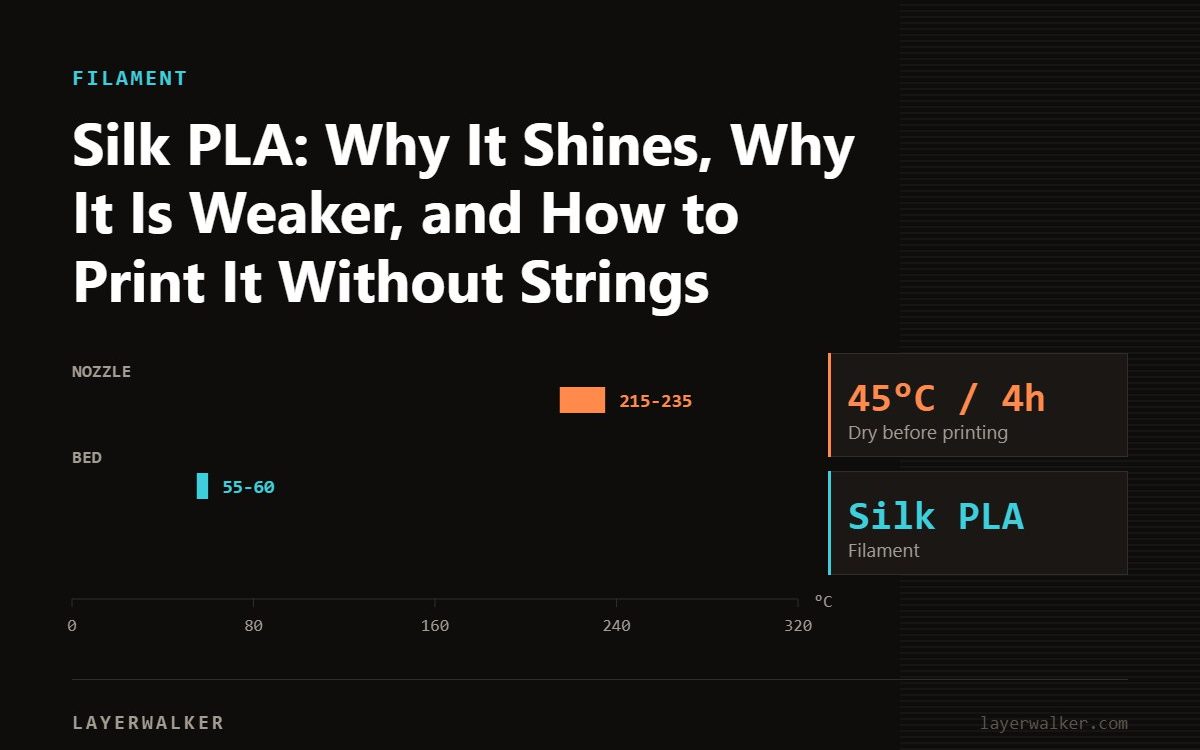
Silk PLA is plain PLA with an additive that gives a metallic, pearlescent surface and hides layer lines. The same additive weakens the bond between layers, so silk parts split under load and are for display only. Print it 5 to 10 °C hotter than the box says, slow the outer wall to 30 to 40 mm/s, and dry the spool, because silk strings more than any other PLA.
Silk filaments are the reason a printed vase can look like polished metal. The effect comes from a polymer additive that makes the surface reflect light in a smooth sheen rather than the flat matte of plain PLA, and it is genuinely impressive on vases, figurines and lithophane frames. It is also the most misunderstood PLA: buyers expect a stronger part because it looks like metal and get one that snaps along a layer line. Know what it is for and it is worth having a spool.
Where to buy


Tri Color Silk PLA Filament 1.75mm, 3D Printer Filament 1kg (2.2lbs) Rose Red Blue Green
What silk changes
- Surface. Glossy, reflective, layer lines nearly invisible. The whole point.
- Layer adhesion. Weaker than plain PLA. A silk hook breaks where a plain PLA hook holds.
- Stringing. The additive oozes; silk strings more at the same settings.
- Temperature. Needs more heat than plain PLA to bond layers, typically 210 to 230 °C.
- Colour depth. Two- and three-colour silk spools shift hue with viewing angle; a rainbow silk changes colour along the length.
What to check on the spool
- Tolerance ±0.03 mm. Loose tolerance plus silk’s oozing is a bad combination.
- Vacuum sealed. Wet silk strings badly and loses its gloss to micro-bubbles. Dry it before printing.
- Single, dual or rainbow. Single colours are the most predictable; rainbow spools give a gradient that looks best on tall parts.
The spools in the box
SUNLU’s Silk PLA is the reference budget silk in a wide colour range; Anycubic’s silk is the direct alternative; the multi-colour silk set covers gold, copper and the dual-tone blends for display prints where one colour per model is the norm.
Settings that work
- Nozzle 210 to 230 °C. Hotter than plain PLA; too cool and layers peel.
- Outer wall 30 to 40 mm/s. The gloss comes from a slow, smooth outer wall; inner walls and infill can run normally.
- Layer height 0.16 to 0.2 mm. Silk hides lines well at these heights.
- Retraction a little longer than plain PLA; enable wipe and coasting if you still see strings.
- Put the seam at a back corner. Silk shows seams more than matte PLA; see seam settings.
- Fan 100 % after the first layer, for the shine.
What not to print in silk
Anything structural, anything with thin walls that flex, anything with threads or snap-fits. Print those in PLA+ or PETG and paint them if the look matters.
Silk PLA FAQ
Is silk PLA more abrasive?
No. Brass nozzles are fine.
Why do my silk prints have dull patches?
Fan turbulence or a wet spool. Dry it, and slow the outer wall.
Can I sand and paint silk?
You can, but sanding removes the sheen. Choose it for the finish or not at all.

LayerWalker
Print defect diagnosis, calibration procedures and parts that actually fit. Corrections welcome through the contact page.