Best Filament for Lithophanes: White PLA, and Why the Spool Matters More Than Usual
LayerWalker is a participant in the Amazon Services LLC Associates Program. We may earn a commission when you buy through links on our site, at no extra cost to you.
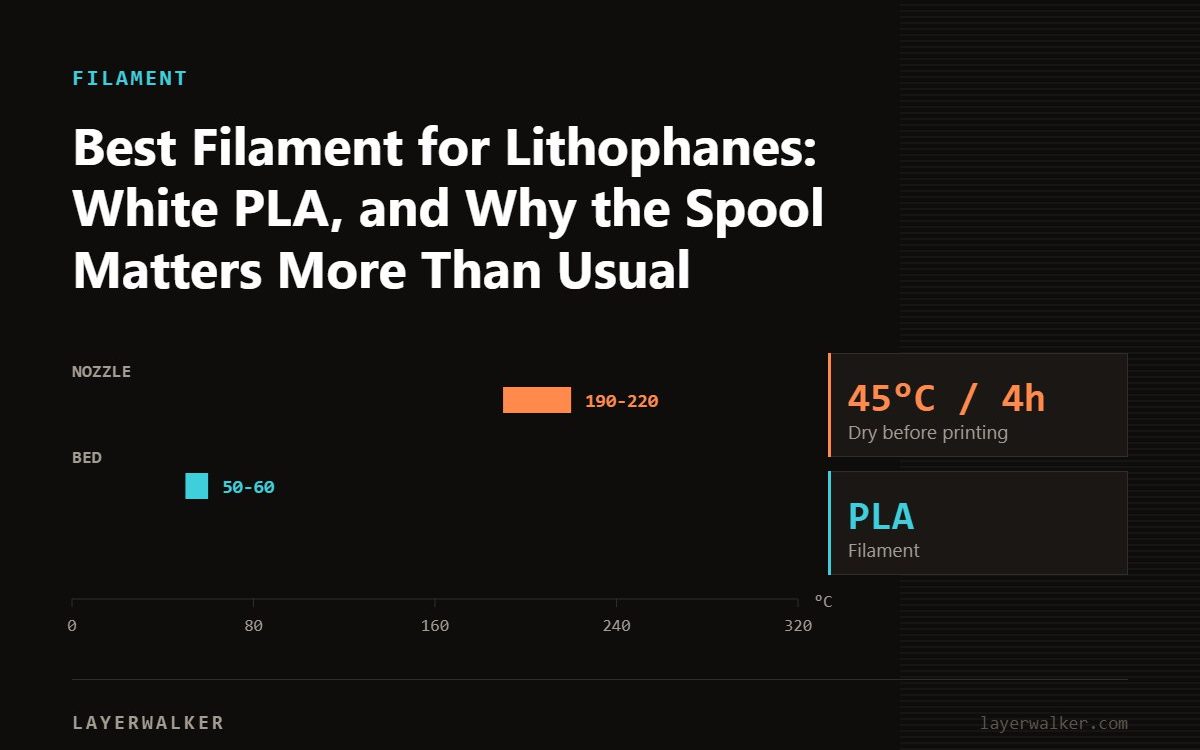
Print lithophanes in a plain white PLA with tight diameter tolerance; the image is made of thickness variations, so any flow inconsistency shows up as bands in the picture. Avoid silk, matte and translucent whites unless you want their specific effect, and print slow with 100 % infill and thin walls.
A lithophane is a picture drawn in thickness: thin areas let light through and read as highlights, thick areas block it and read as shadows. The filament is therefore the whole image. A white PLA whose pigment lets light through evenly gives a clean grey scale; one with uneven pigment or a diameter that wanders prints stripes and blotches you cannot fix in the slicer. It is the one print where a premium spool visibly pays off.
Where to buy


SUNLU PLA+ 3D Printer Filament, 16 Color Bundle Multicolor, 1.75mm
What to look for
- Plain white PLA. Not cold white with blue pigment, not warm cream, not silk. A neutral white gives the most natural tone; warm whites give a sepia look that some people prefer.
- Tolerance ±0.02 to ±0.03 mm. This is the spec. A 0.05 mm swing prints as a visible band.
- Consistent pigment. Reviews that mention lithophanes are the best signal; makers do not publish opacity.
- Dry spool. Micro-bubbles from wet filament scatter light and fog the image.
Colour options
White is the standard. Light grey gives a higher-contrast, cooler image. Translucent or natural PLA gives a soft, glowing look with less contrast. Coloured lithophanes with a colour filament behind a white one are a separate technique.
The spools in the box
The listed white and neutral PLA spools are from makers with stated tolerance and consistent pigment. Print a small test lithophane with a new spool before committing to a large frame; it tells you in twenty minutes whether the spool is even.
Settings that work
- Stand the lithophane vertically on its edge so layers run across the image; flat lithophanes show banding and take forever.
- Nozzle 0.4 mm, layers 0.1 to 0.12 mm. Finer layers mean finer tonal steps.
- 100 % infill, rectilinear, one or two walls; the part is solid by design. See infill.
- Slow: 30 to 40 mm/s, constant speed. Speed changes show as tone changes.
- Temperature constant at 200 to 210 °C; do not use adaptive settings.
- Flow calibrated on this exact spool; see flow calibration. A few percent off shifts the whole tonal range.
- Thickness range 0.8 to 3 mm in the lithophane generator; thicker maximum gives more contrast and a longer print.
Lighting
A lithophane needs backlight. A warm white LED strip or a small panel behind a frame; daylight through a window works for display. Cool LEDs exaggerate blue pigment in some whites.
Best filament for lithophane FAQ
Can I use PLA+?
Yes if it is a neutral white with good tolerance; the additive slightly reduces light transmission.
Why does my lithophane have stripes?
Flow variation from the spool or from speed changes. Try a different spool and lock the speed.
PETG for outdoor lithophanes?
Yes; white PETG works and survives sunlight, with slightly less contrast.

LayerWalker
Print defect diagnosis, calibration procedures and parts that actually fit. Corrections welcome through the contact page.