PLA Warping: Rare Enough to Be a Clue in Itself
LayerWalker is a participant in the Amazon Services LLC Associates Program. We may earn a commission when you buy through links on our site, at no extra cost to you.
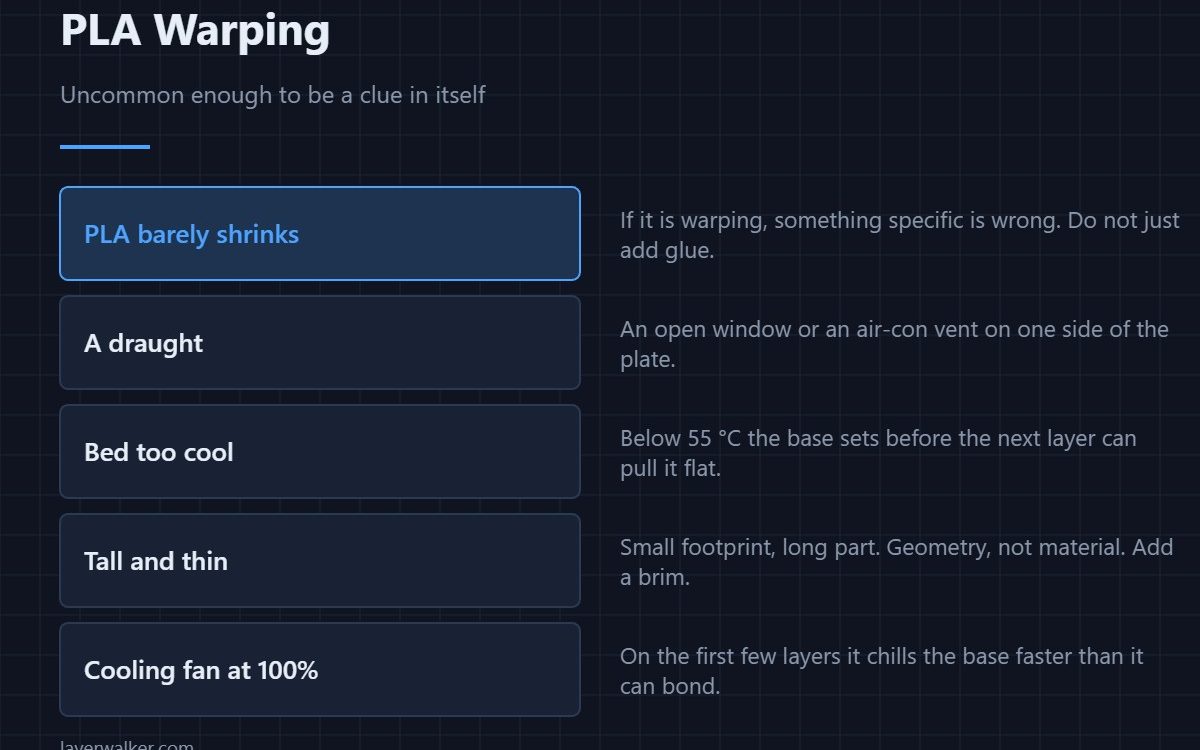
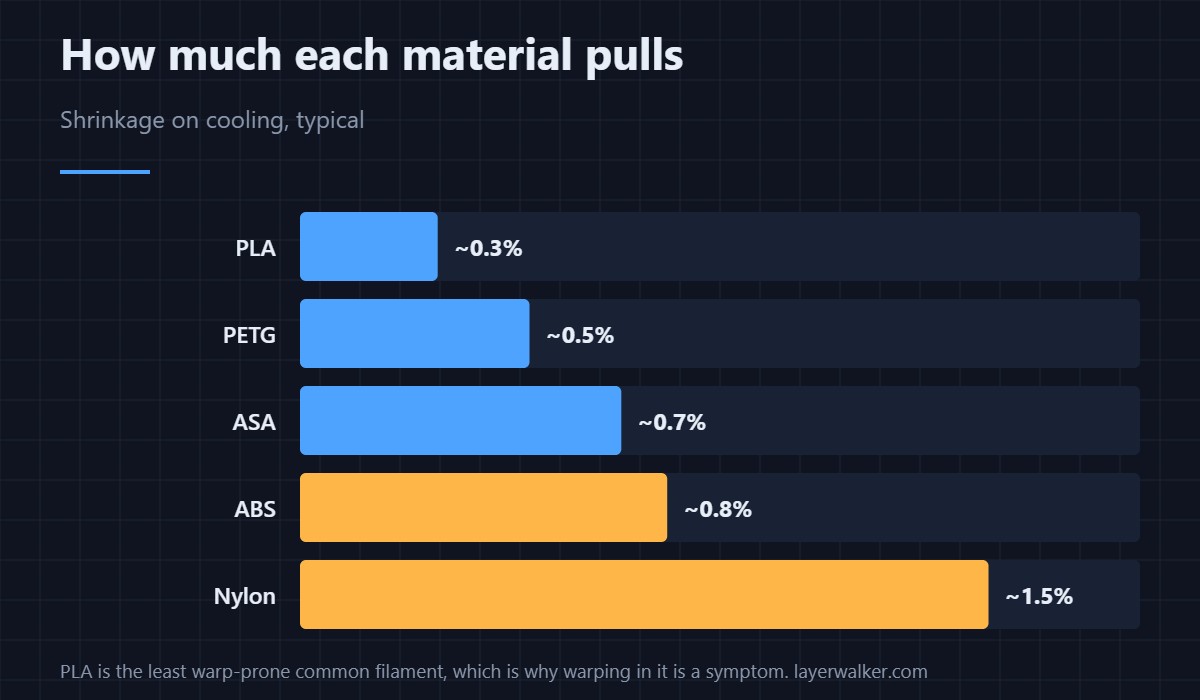
PLA warping is uncommon, and that makes it useful information rather than just a nuisance. PLA shrinks about 0.3% on cooling, against roughly 0.8% for ABS, so when PLA lifts there is usually a specific cause: a draught, a bed below 55 °C, a part with a small footprint and a lot of height, or the cooling fan running flat out from layer one.
The reflex when a corner lifts is to add glue and raise the bed temperature. With PLA that treats a symptom whose cause is nearly always environmental or geometric, and it usually leaves you with a part that is stuck down but still curling internally.
Where to buy


Draughts do most of it
An open window, an air-conditioning vent, or a door that people walk through will cool one side of a part faster than the other, and the difference is enough to lift a corner on PLA. This is the first thing to rule out, and it costs nothing: print the same part with a cardboard box over the printer. If the warping goes away, you have your answer, and a simple enclosure makes it permanent.
Bed temperature and the first few layers
Below about 55 °C the base of the part sets before the layers above can pull it flat, and the contraction has nowhere to go but upward at the corners. 60 °C is the standard answer. Do not go above 70 °C chasing it — past that the base softens and you trade a lifted corner for elephant foot. Numbers for every material are in bed temperature by material.
The cooling fan on layer one
Check that your profile ramps the part fan up rather than starting at 100%. Full cooling on the first two or three layers chills the base faster than it can bond, which produces warping that looks exactly like an adhesion failure. Most stock profiles get this right; imported and community profiles often do not.
Geometry, not material
A tall part on a small footprint concentrates all the contraction force onto a tiny bonded area. Sharp corners concentrate it further. A 5 mm brim, or chamfering the base corners in the model, changes the outcome more than any filament brand will. If the part is still lifting with a brim and no draught, the shape is asking too much and it wants splitting or reorienting.
When it is actually adhesion
If the part comes away cleanly rather than curling, that is PLA not sticking — a different fault with a different fix. Warping curls the corners upward while the centre stays down. Detachment lets the whole thing go. The general treatment across materials is in warping and corners lifting.
PLA Warping FAQ
Does PLA need an enclosure?
Normally no, and a hot enclosure can make PLA worse by softening parts as they print. What PLA benefits from is the absence of draughts, which a box provides without needing to be heated.
Will a brim stop PLA warping?
Often, yes, and it is the cheapest thing to try. A 5 mm brim adds contact area exactly where the peeling starts. It is not a substitute for finding a draught, but it buys you the part in the meantime.
Is cheap PLA more likely to warp?
Diameter consistency and additives vary, but shrinkage is fairly consistent across brands. If one spool warps and another does not on the same profile, suspect moisture or a wildly different additive load such as a filled or silk blend.
Why does only one corner lift?
That is almost always a draught or a cold spot on the bed. Measure that corner with an infrared thermometer, and check what is blowing on it.

LayerWalker
Print defect diagnosis, calibration procedures and parts that actually fit. Corrections welcome through the contact page.