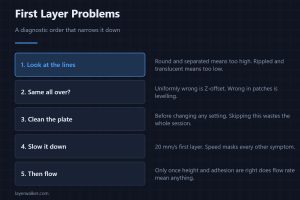
First Layer Problems: A Diagnostic Order That Narrows It Down
First layer problems all look the same and have different causes. A diagnostic order that separates height, adhesion, flow and levelling in about ten minutes.
The procedures that stop problems coming back: Z offset, flow rate, pressure advance, input shaper and bed levelling. Run in the right order, each one takes minutes.
First layer problems all look the same and have different causes. A diagnostic order that separates height, adhesion, flow and levelling in about ten minutes.
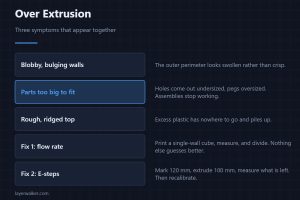
Over extrusion shows up as blobby walls, parts too big to fit, and a rough top surface. How to tell it from other faults, and the two numbers that fix it.
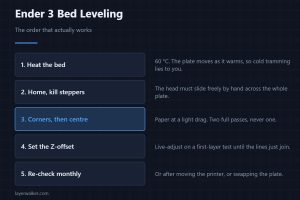
Ender 3 bed leveling, done properly: the paper method, the knob order that works, when a CR Touch earns its money, and the z-offset step most guides skip.
Short answer Slice a tower so each band drops 5 degC, print it, then judge on bridging and stringing rather than on…
What to look for The test models are free. What you need is a way to read them and a filament that…
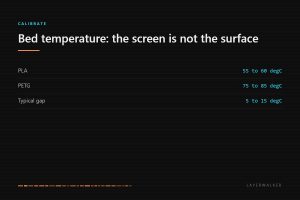
Short answer PLA 55 to 60 degC, PETG 75 to 85, ABS 95 to 110, ASA 90 to 110, TPU 40 to…
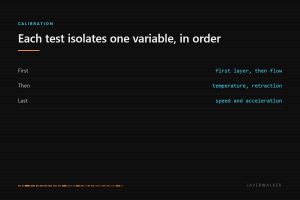
Each calibration step assumes the previous one is already right. Doing them out of order is why tuning feels endless.
A 20 mm cube measures the whole chain at once, so a wrong number tells you little unless you calibrate in the right order first.
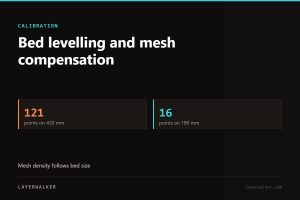
A mesh corrects for a plate that is not flat. It cannot correct for a plate that is dirty or a nozzle that is not clean.
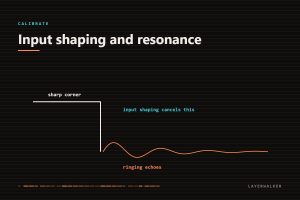
What it corrects, what it cannot, and why running it lets you keep speed without ringing.