Over Extrusion: Blobby Walls, Parts That Do Not Fit, and the Flow Fix
LayerWalker is a participant in the Amazon Services LLC Associates Program. We may earn a commission when you buy through links on our site, at no extra cost to you.
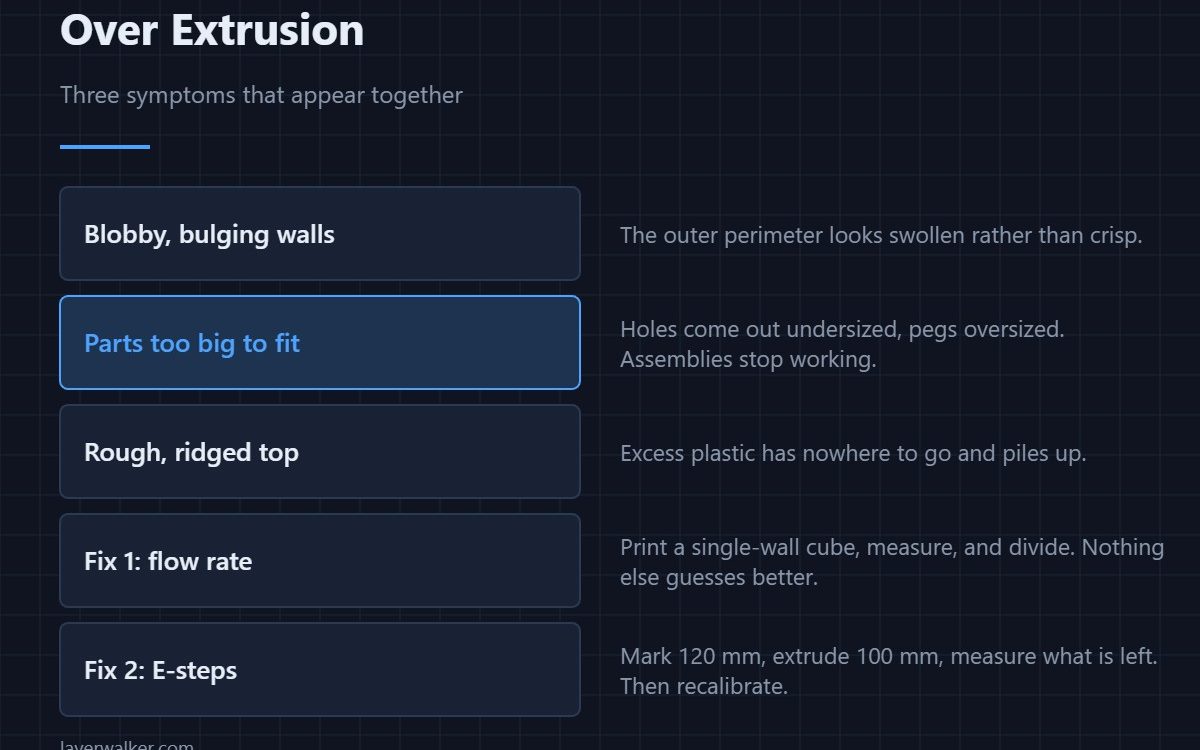
Over extrusion means the printer is pushing more plastic than the model asks for. It shows up as three things together: bulging outer walls, parts that measure oversized and will not assemble, and a rough ridged top surface. The fix is two numbers — flow rate, measured with a single-wall cube, and extruder steps per mm, measured by extruding 100 mm and seeing what you actually get.
Over extrusion is under-diagnosed because it does not look like a failure. Prints finish, they look solid, and they even feel strong. The tell is dimensional: holes come out undersized, pegs oversized, and nothing you design to fit together actually fits.
Where to buy


Telling it apart from other faults
- Over extrusion: walls bulge outward, top surface is rough and raised, dimensions run large, blobs at perimeter starts.
- Under extrusion: gaps between walls, thin and translucent lines, weak parts. Covered in under-extrusion.
- Elephant foot: only the bottom few layers bulge. That is a Z-offset and bed-heat problem, not flow — see elephant foot.
- Blobs and zits: localised, at layer changes. That is a seam and retraction issue, not flow — see blobs and zits.
Fix 1: measure flow with a single-wall cube
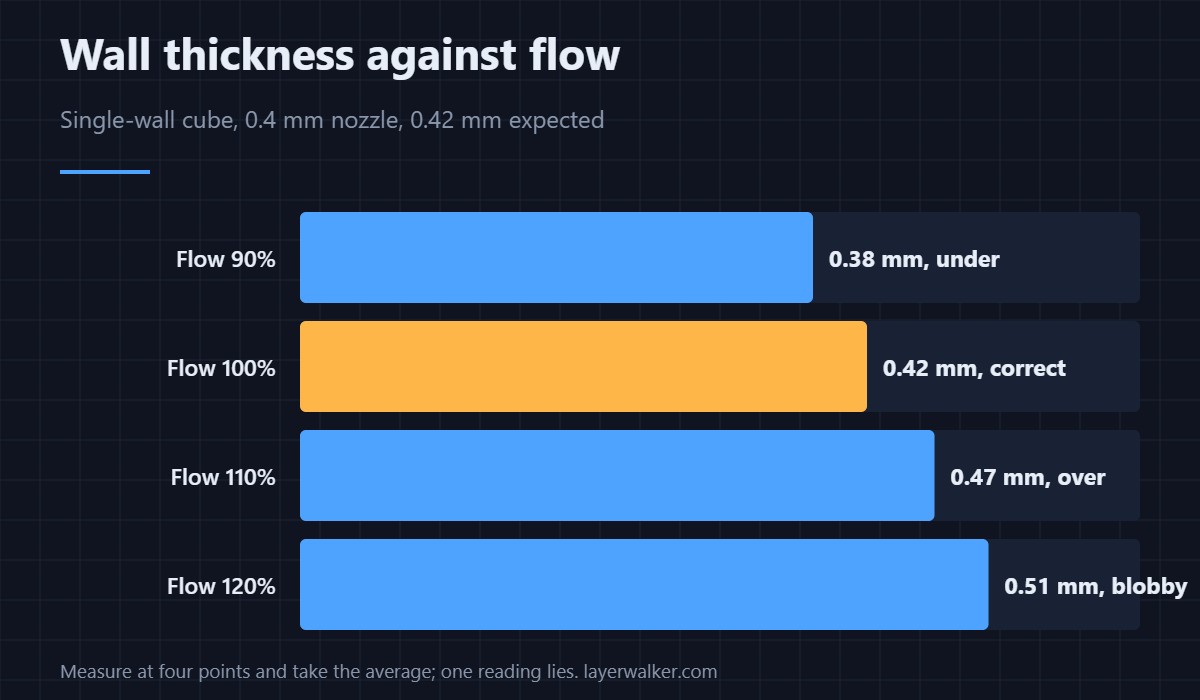
Print a 20 mm cube with one perimeter, no top or bottom layers and no infill. Measure the wall at four points with calipers and average them. With a 0.4 mm nozzle and a typical profile the expected wall is about 0.42 mm. If you measure 0.47 mm, your flow is roughly 0.42 divided by 0.47, so about 89% of what you are currently running. Full method in flow rate calibration.
Fix 2: extruder steps per mm
Flow rate is a slicer-side correction. If the extruder itself is miscalibrated, you are correcting the same error in two places and it will drift. Mark the filament 120 mm above the extruder inlet, command a 100 mm extrusion at low speed, then measure what is left above the mark. If 15 mm remains, the printer pushed 105 mm and the steps value is 5% too high. This matters most after changing the extruder, since gear ratios differ.
The causes people miss
Filament diameter entered as 1.75 mm when the spool is actually 1.70 mm will over-extrude by about 6%, and cheap filament varies more than its label admits — measure it in three places. A worn brass nozzle with a widened bore over-extrudes at every flow setting. And printing PETG on a PLA profile over-extrudes slightly because the materials differ in how much they swell leaving the nozzle.
Over Extrusion FAQ
How do I know if it is over extrusion or just a bad first layer?
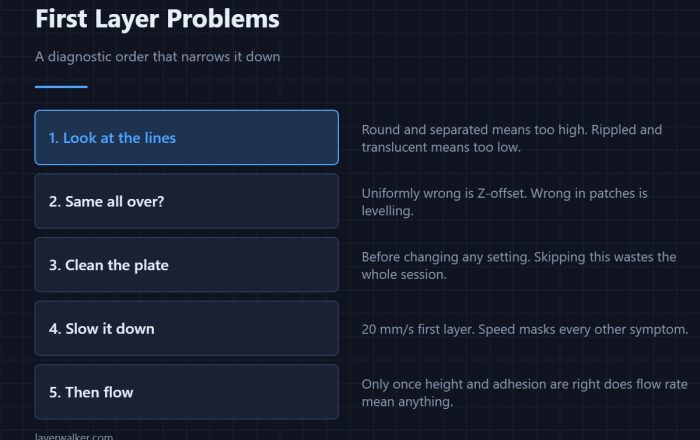
Look at the top surface halfway up the part. Over extrusion produces ridges and a rough finish all the way up. A first-layer problem is confined to the bottom — see first layer problems.
Should I fix flow rate or E-steps first?
E-steps, because that is the hardware truth and flow rate is a correction on top of it. Calibrate the extruder, then measure a single-wall cube and set flow from that.
Can over extrusion make parts stronger?
Slightly, and it is not worth it. You gain a little material and lose all dimensional accuracy, plus the extra plastic has to go somewhere, which is usually into a rough top surface and blobs.
Why did over extrusion appear after I changed filament?
Different actual diameter, or a different material that swells more leaving the nozzle. Measure the new filament with calipers in three places and enter the real average into the slicer.

LayerWalker
Print defect diagnosis, calibration procedures and parts that actually fit. Corrections welcome through the contact page.