Ender 3 Extruder Upgrade: Dual-Gear Bowden or Full Direct Drive
LayerWalker is a participant in the Amazon Services LLC Associates Program. We may earn a commission when you buy through links on our site, at no extra cost to you.
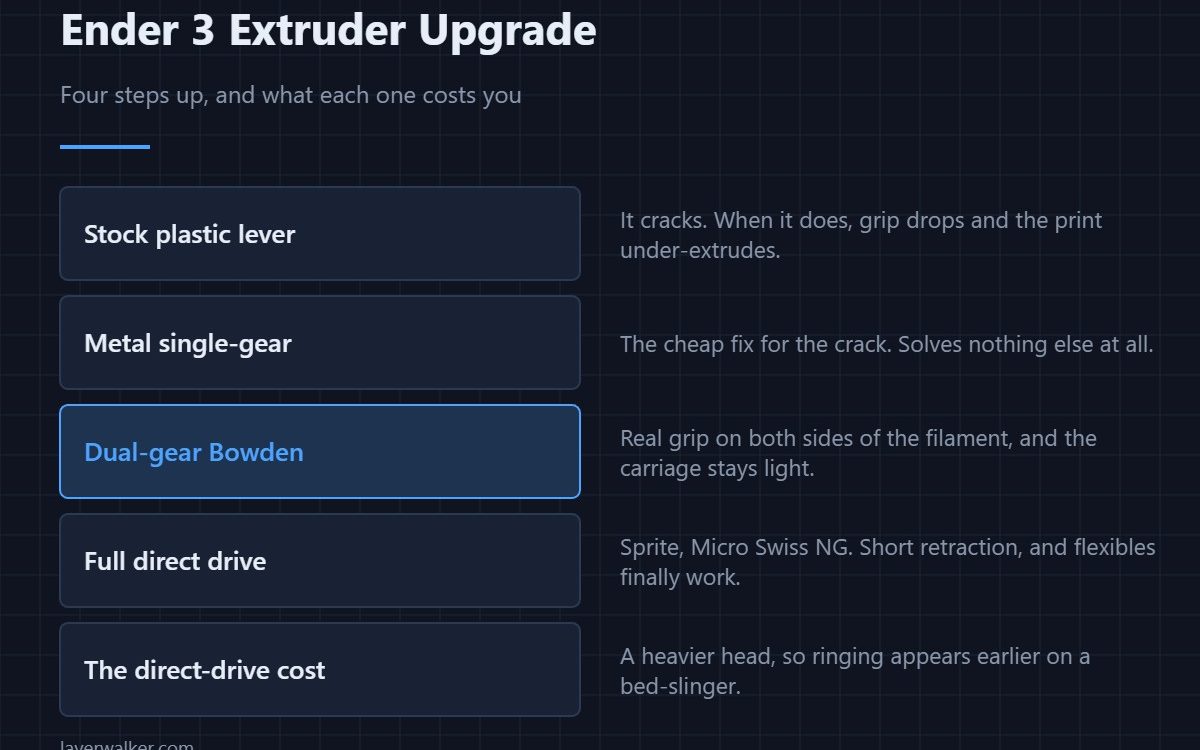
An Ender 3 extruder upgrade fixes two specific faults: the stock plastic arm cracks, and a single drive gear loses grip on the filament. A metal dual-gear Bowden extruder cures both for very little money and keeps the carriage light. A full direct drive conversion is a bigger job that buys you flexible filaments and near-zero retraction, at the cost of a heavier print head and earlier ringing.
The stock extruder on an original Ender 3 is an aluminium-bodied lever with a plastic tensioner arm. The arm cracks — not sometimes, eventually — and when it does the spring pressure drops, the single drive gear starts slipping, and you get gappy walls and under-extrusion that look like a hotend problem.
Where to buy


The four steps up
- Metal tensioner arm. A few pounds. Fixes the crack and nothing else. Worth fitting pre-emptively.
- Metal dual-gear Bowden. Both sides of the filament driven. The genuine grip fix, and the carriage stays light.
- Direct drive kit. Creality’s Sprite or the Micro Swiss NG. The motor moves onto the head, and the filament path shortens from 600 mm to about 40 mm.
- Hotend at the same time. Some direct drive kits include an all-metal hotend, which is cheaper than doing both jobs separately.
What direct drive actually buys you
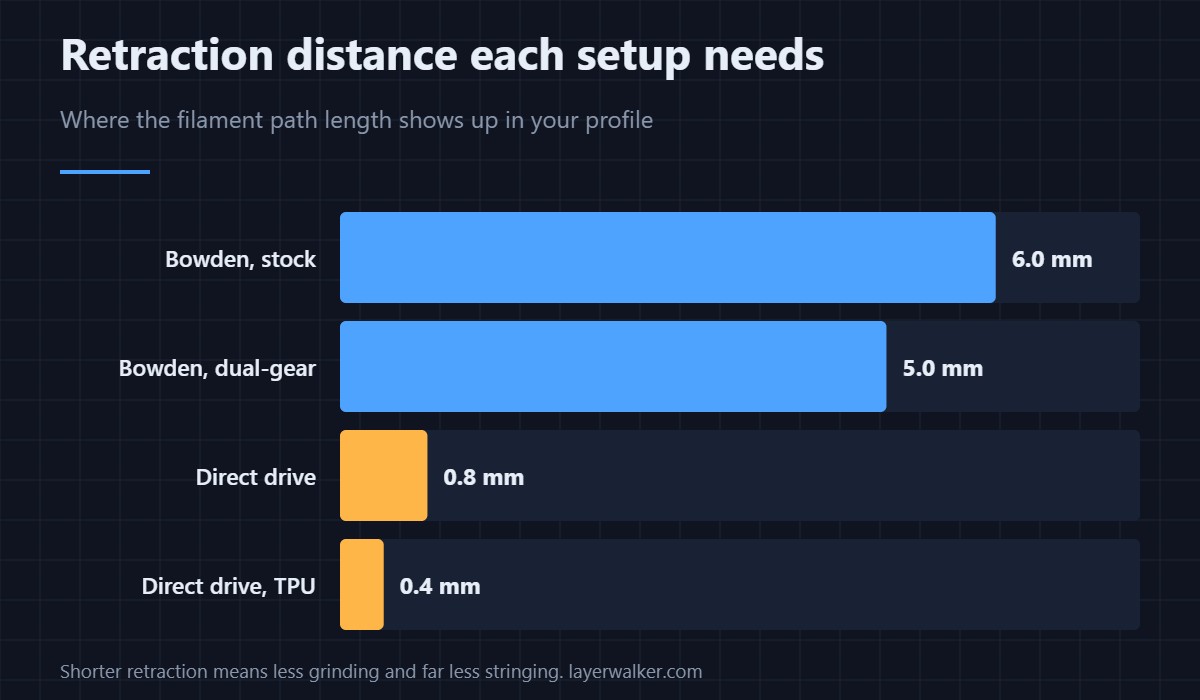
Retraction distance falls from about 6 mm to under 1 mm, which is why direct drive machines string so much less and why flexible filament becomes possible at all. TPU through a long Bowden tube buckles inside the tube instead of advancing; through a direct drive it simply prints. If flexibles are the reason you are reading this, stop comparing and buy the conversion.
The cost is mass. You are adding a stepper motor to a bed-slinger’s moving head, and the frame was not designed for it. Expect different tuning, and expect ringing to appear at lower speeds than before. The full comparison of the two layouts is in direct drive vs Bowden.
Who should stay Bowden
If you print PLA and PETG, want speed, and have no interest in TPU, a dual-gear Bowden extruder is the better upgrade. It costs a fraction as much, it takes twenty minutes, it needs no firmware changes, and it keeps the print head light enough that the Ender 3 frame is the limit rather than the head. Most of the under-extrusion complaints on this platform are solved at this step and go no further.
After the swap
Recalibrate the extruder steps per mm — every aftermarket extruder has a different gear ratio, and skipping this is why people report the upgrade made things worse. Mark 120 mm of filament, command a 100 mm extrusion, measure what is left, and adjust. Then retune retraction from scratch; the old profile is meaningless with a new filament path length. Where this sits against everything else worth doing is covered in the Ender 3 upgrade shortlist.
Ender 3 Extruder Upgrade FAQ
Do I need to reflash firmware for an extruder upgrade?
Not for a Bowden swap — you change steps per mm from the printer menu and save. A direct drive conversion usually needs firmware changes as well, because the extruder direction and the maximum E acceleration differ.
Is the Sprite extruder worth it over a cheap direct drive kit?
The Sprite is lighter than most bolt-on kits and comes with brackets that actually fit, which is most of the work. Cheap kits tend to be heavier and need a printed adapter, and mass is the whole problem with direct drive on a bed-slinger.
Will an extruder upgrade fix stringing?
A dual-gear Bowden will not, much. A direct drive conversion will, dramatically, because retraction distance collapses. If stringing is your only complaint, dry the filament first — it is far more often moisture than hardware.
My prints under-extrude. Is the extruder the cause?
Check the tensioner arm for a crack and the drive gear for packed-in filament dust before assuming anything. Those two account for most cases. If both are clean, look at the nozzle and the PTFE tube next.

LayerWalker
Print defect diagnosis, calibration procedures and parts that actually fit. Corrections welcome through the contact page.