Ender 3 Upgrades That Are Still Worth It: The Short List for Every Ender 3 Variant
LayerWalker is a participant in the Amazon Services LLC Associates Program. We may earn a commission when you buy through links on our site, at no extra cost to you.
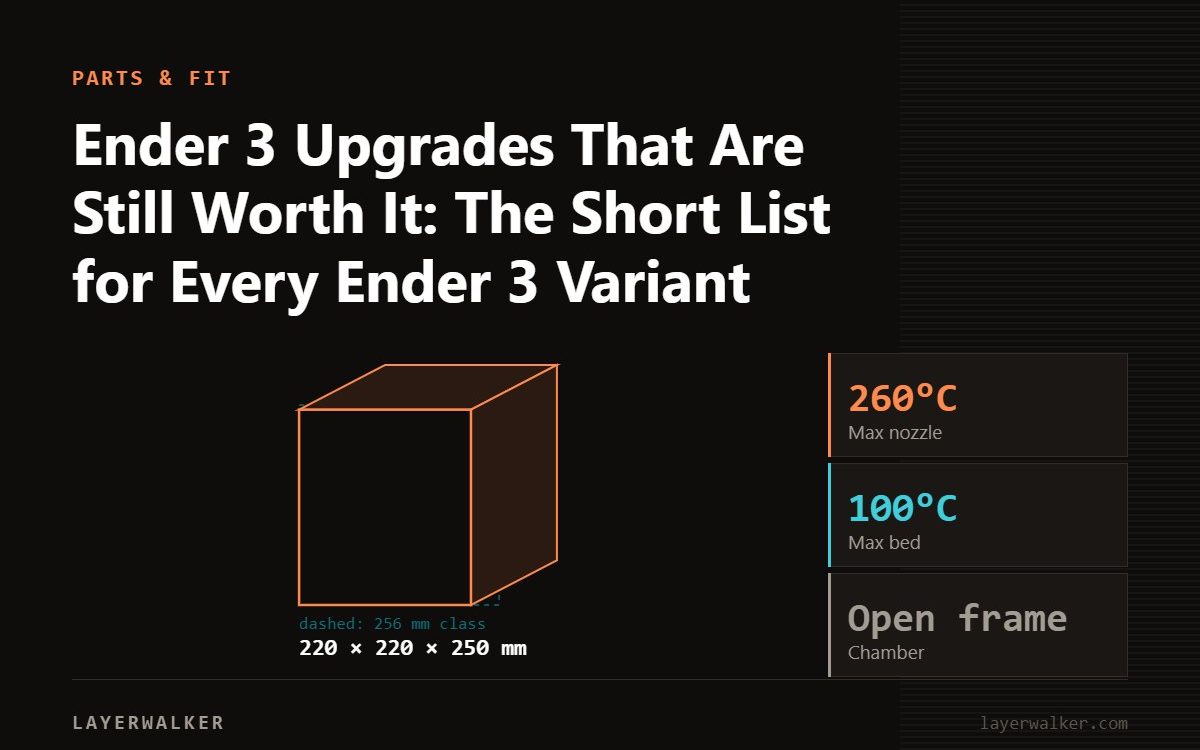
The upgrades that turn an Ender 3, 3 Pro or 3 V2 into a reliable printer, in order: a textured PEI plate, a CR Touch probe, a dual-gear direct-drive extruder, and Klipper on a host pad for input shaping. Add an all-metal hotend only for nylon or polycarbonate. Stop there; beyond that, the money buys a newer printer.
The Ender 3 family sold in the millions because the frame is good and the price was low. Everything bolted to that frame was chosen for cost: a single-gear plastic extruder, a PTFE-lined hotend, a Bowden tube, a bed you level with wheels, an 8-bit board on the early ones. Each of those is the cause of a familiar Ender problem, and each has a cheap fix. The trick is doing them in the order that pays off, and knowing when the total exceeds a newer printer.
Where to buy


The list
- Textured PEI spring-steel plate, 235 mm. Replaces the glass or textured glass with a surface that grips hot and flexes to release. Check the magnetic base sticks flat to your bed.
- CR Touch probe. A mesh follows the bed’s warp. You still tram the wheels once. Needs a firmware build for your board; Creality provides them for common combinations.
- Dual-gear direct-drive kit. Ends the Bowden tube, unlocks TPU, drops retraction to about 1 mm and fixes most stringing. The kits in the box are this upgrade for the Ender 3 family; check the carriage plate matches your exact variant.
- Klipper on a host pad. Input shaping cancels the ringing an Ender frame produces, so acceleration can triple. The stock screen stops working; the web interface replaces it.
- All-metal hotend, only if needed. For 260 °C materials. For PLA and PETG the stock hotend is fine once the direct drive is on.
Fixes that cost nothing
- Replace the Bowden couplers and trim the tube square if you stay Bowden; a leaking coupler causes half of all Ender clogs.
- Square the gantry and tighten the eccentric nuts until the wheels turn with light resistance.
- Stiffer bed springs or silicone spacers so the tram holds between prints.
- Calibrate E-steps and flow. Stock Enders are often 5 % out.
Skip these
Dual-Z on a gantry that does not sag. Metal extruder arms on a working arm. Linear rails. Decorative fan ducts that add weight. A glass bed if you already have one that is flat.
Where to stop
Plate, probe, direct drive and Klipper together cost roughly a third of a new mid-range printer and get most of the way there. Adding an all-metal hotend, rails and a new board passes that line; at that point compare honestly with a printer that ships with everything.
Three of these have a page of their own now: what an Ender 3 hotend upgrade actually buys you, when an extruder upgrade is the real fix for under-extrusion, and which nozzle sizes and materials are worth keeping in the drawer.
One upgrade costs nothing: a current slicer. The bundled one is years old — see best slicer for Ender 3 and the six settings to change on day one.
Ender 3 Upgrades FAQ
Which variant do I have?
Ender 3 and 3 Pro share a carriage; V2 has a different display and board; V3 SE and KE are different machines with direct drive already fitted. Kits list the fit.
Do I need a 32-bit board?
For Klipper, no; the host does the work. For Marlin with a probe and linear advance, a 32-bit board helps.
Is the Ender 3 still worth upgrading?
With the four upgrades above, yes, as a second printer or a learning machine. As a first printer today, a newer machine with them built in is simpler.

LayerWalker
Print defect diagnosis, calibration procedures and parts that actually fit. Corrections welcome through the contact page.