ASA Warping: The Enclosure Is the Fix, Not a Hotter Bed
LayerWalker is a participant in the Amazon Services LLC Associates Program. We may earn a commission when you buy through links on our site, at no extra cost to you.
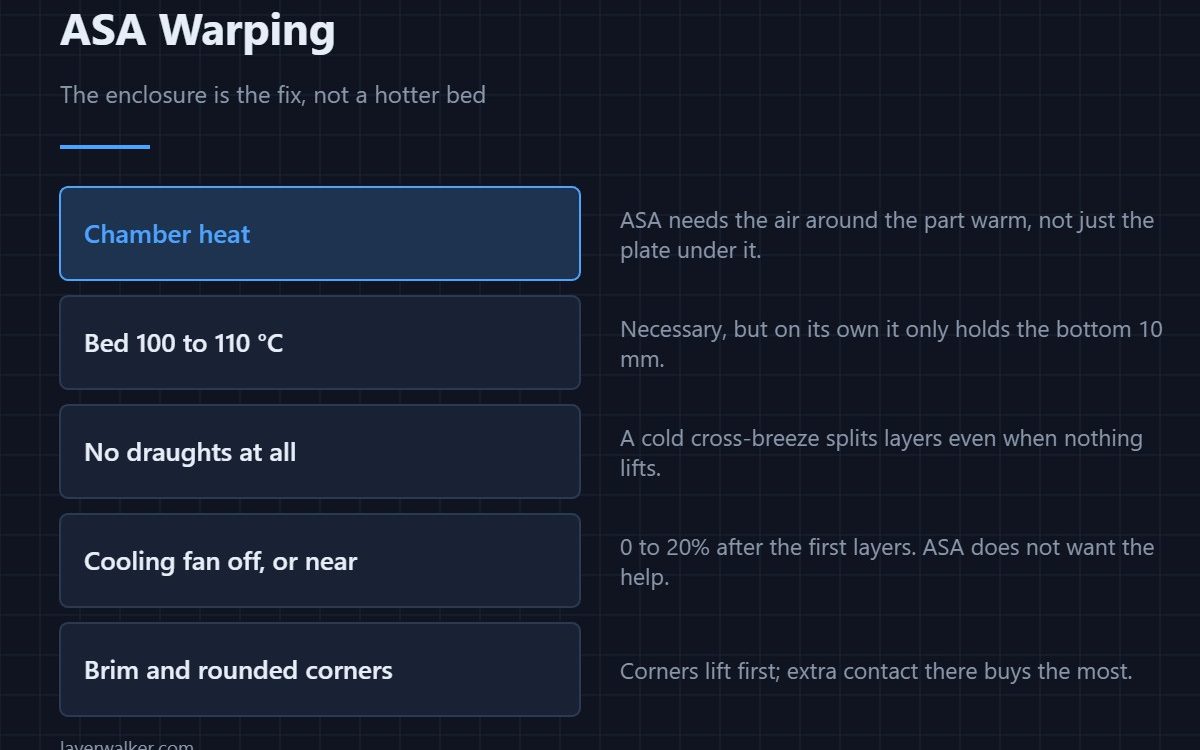
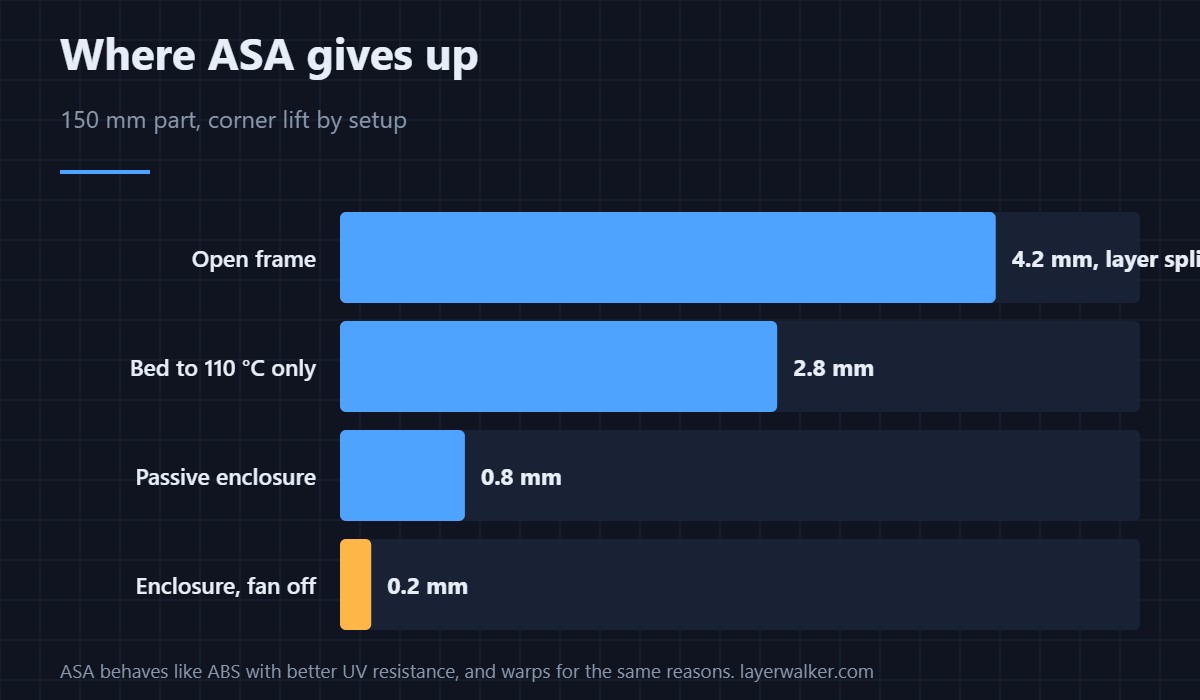
ASA warping is solved by warm air around the part, not by pushing the bed hotter. ASA shrinks roughly 0.7% on cooling, so every layer that cools pulls on the ones below it. Bed at 100–110 °C is necessary but only holds the bottom centimetre; a chamber at 40–50 °C is what actually stops corners lifting and layers splitting.
ASA is ABS with better UV resistance and a slightly wider processing window, and it warps for exactly the same reasons. People often move to ASA hoping it will be easier outdoors and are surprised to find the printing problems unchanged.
Where to buy


Polymaker ASA Filament 1.75mm Black 1KG, UV & Weather Resistant

Chamber first
The mechanism is simple: contraction happens as plastic cools, and warm surrounding air slows that cooling so the difference between layers stays small. A passive enclosure that holds 40 °C transforms ASA; an actively heated chamber at 50–60 °C makes large parts routine. Nothing you put on the plate substitutes for it. Both cheap and proper routes are in building an enclosure.
Turn the cooling fan down
This is where ASA differs most from PLA habits. Run the part fan at 0–20% after the first couple of layers. Cooling is the enemy here: it is what creates the temperature difference that makes the part pull itself apart. The visible symptom of too much cooling on ASA is not a lifted corner but a layer that splits cleanly partway up.
Draughts crack layers even when nothing lifts
A cold cross-breeze on an unenclosed ASA print produces delamination rather than warping — the part stays stuck down and comes apart in the middle. If your ASA parts are failing along a horizontal line rather than at the corners, look for moving air before you change any setting.
Bed, adhesive and brim
100–110 °C, and check the corners actually reach it. Use an adhesive that survives that temperature, because ordinary glue stick cooks off — the detail is in ABS not sticking to bed, which applies unchanged to ASA. Add a 5–8 mm brim and chamfer sharp base corners in the model; corners are where the peeling force concentrates.
If you cannot enclose it
Print small, print with a brim, keep the room still, and accept that anything over about 100 mm will fight you. If the part is going outdoors and that is the only reason you chose ASA, PETG handles moderate outdoor use with far less trouble, though it yellows and softens in strong sun where ASA does not. The trade-offs are in ASA vs ABS.
ASA Warping FAQ
Is ASA easier to print than ABS?
Marginally. It has a slightly wider temperature window and smells less, but the shrinkage is nearly the same and the chamber requirement is identical. Anyone telling you ASA does not need an enclosure is printing small parts.
What chamber temperature does ASA need?
40–50 °C is enough for most parts. Above 60 °C you start to risk the printer’s own electronics and any PLA components in the machine, which is why commercial heated-chamber machines move the boards outside.
Why do my ASA parts split along a layer line?
Too much cooling or a draught, not warping. Turn the part fan down to near zero after the first layers and close the machine in. Layer splitting and corner lifting are the same problem showing up in two places.
Does a hotter bed reduce ASA warping?
Only up to about 110 °C, and then it stops helping. The bed only controls the bottom few millimetres. Above that height, the air temperature is what matters.

LayerWalker
Print defect diagnosis, calibration procedures and parts that actually fit. Corrections welcome through the contact page.