ASA 3D Printer Filament: The Outdoor Material, and What It Demands From Your Printer
LayerWalker is a participant in the Amazon Services LLC Associates Program. We may earn a commission when you buy through links on our site, at no extra cost to you.
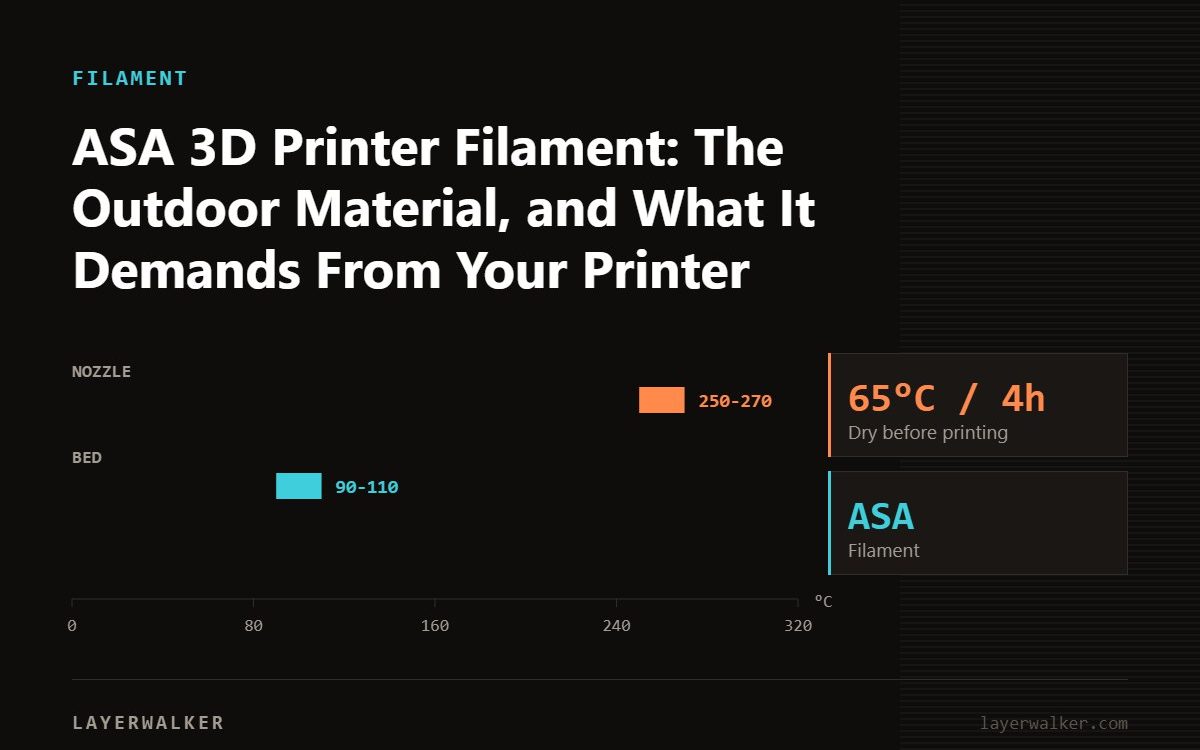
Buy ASA for anything that lives outside or in a hot car: it keeps its colour and strength in sunlight where PETG yellows and PLA sags. It prints like ABS, so you need an enclosure, a bed at 90 to 110 °C, a nozzle at 240 to 260 °C and a vent for the styrene fumes.
ASA is the material that garden fixtures, drone frames, car trim and anything bolted to a wall in the sun should be printed in. Chemically it is ABS with the butadiene swapped for an acrylate, which is why it behaves like ABS on the printer but does not chalk and crack after a summer outdoors. The ASA versus ABS comparison covers the differences; the short version is that if you can print one you can print the other, and ASA is the better default.
Where to buy

Polymaker ASA Filament 1.75mm Black 1KG, UV & Weather Resistant


What your printer needs
- An enclosure. ASA shrinks as it cools and a draught will split a tall part or lift a corner. A fabric tent holding 40 °C is enough.
- A bed that reaches 100 °C and a plate that grips: textured PEI or glass with a liquid bed adhesive.
- A hotend rated for 260 °C. Most all-metal and modern PTFE-lined hotends are fine; older PTFE-lined hotends degrade above 245 °C.
- Ventilation. ASA emits styrene. A duct to a window or a carbon filter on the enclosure, and not in a bedroom.
What to look for on the spool
- Stated UV and weather resistance. That is the whole point; a spool that only says “ASA” without it may be a blend.
- Tolerance ±0.03 mm. ASA is already fussy about flow; loose tolerance adds under-extrusion to the list.
- Colour range. ASA pigments are stable, so a colour you buy this year matches next year’s spool better than PLA does. Black and white are the workhorse colours; bright colours cost more.
- Vacuum sealed. ASA absorbs water more slowly than PETG but wet ASA still pops and prints weak.
The spools in the box
Polymaker’s ASA is the reference spool: consistent, well documented, and the one most slicer profiles were tuned on. It appears twice for black and for orange, the two colours most outdoor parts get printed in. The iSANMATE four-kilogram bundle is for a farm or a project that will eat several spools; buy one spool of it first and check the tolerance on a caliper before you commit to the bundle.
Settings that work
- Nozzle 240 to 260 °C. Start at 250 °C; go up if layers are weak, down if the surface is shiny and rough.
- Bed 90 to 110 °C. Bare textured PEI at 100 °C holds most parts; add a brim for anything with a large flat base.
- Part cooling 0 to 20 %. More than that inside the enclosure and you will see layer cracks.
- Warm the chamber 15 minutes before starting. Corners lifting in the first ten layers means the chamber was cold.
- Print speed 40 to 80 mm/s. ASA rewards patience on the outer wall.
When ASA is the wrong choice
Indoor parts that never see sun or heat: PETG is easier and needs no enclosure. Anything printed on an open printer in a cold room: ASA will fail; use PETG or wait for the enclosure. Food contact: no ABS-family material is suitable.
ASA 3D printer filament FAQ
Can I print ASA on a Bambu Lab A1 or other open printer? Small parts in a warm room, sometimes. Reliably, no; ASA needs an enclosed chamber.
Does ASA smell?
Yes, a sweet plastic smell from styrene. Ventilate; do not print it where you sleep.
Can I glue and sand ASA?
Yes. Acetone welds it and smooths it, the same as ABS.

LayerWalker
Print defect diagnosis, calibration procedures and parts that actually fit. Corrections welcome through the contact page.