3D Printer Bed Adhesive: Glue Stick, Spray or Liquid, and When You Need Any of Them
LayerWalker is a participant in the Amazon Services LLC Associates Program. We may earn a commission when you buy through links on our site, at no extra cost to you.
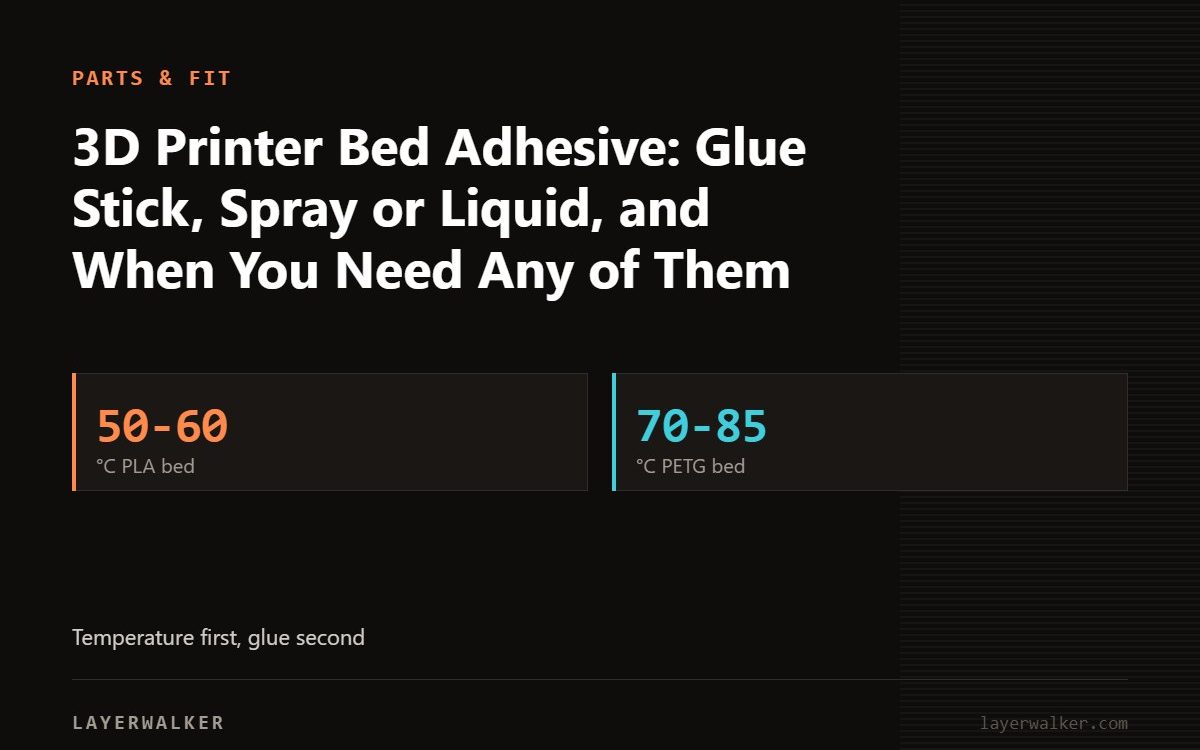
On a clean, textured PEI plate most filaments need no adhesive at all. Buy a bed adhesive for two jobs: a release layer so PETG and TPU do not weld to smooth PEI, and a grip layer for ABS, ASA or nylon on glass or on a cold corner of the bed. A thin, even coat matters more than the brand.
Adhesives get blamed for, and credited with, a lot of first-layer behaviour that is really about the plate surface and its cleanliness. A textured PEI sheet at the right temperature holds PLA and PETG with nothing added, and lets go when cold. Adhesive earns its place in three cases: a surface that grips too hard, a material that grips too little, and a bed that is not perfectly flat where a tacky film buys back a tenth of a millimetre of tolerance.
Where to buy


The three types
- Glue stick. Cheap PVA school glue. Works as a release layer on smooth PEI for PETG and TPU and as a mild grip layer on glass. Washes off with water. Streaky if applied dry; wipe with a damp cloth to even it out.
- Spray. A fine aerosol film that dries in seconds and covers a whole plate evenly; the classic use is ABS and PETG on glass. Overspray lands on rails and belts, so spray the plate off the printer.
- Liquid bed weld. A brushed-on polymer that grips hot and releases as the bed cools. Strongest hold of the three, made for ABS, ASA and nylon on glass or bare aluminium, and it lasts several prints per coat.
What to look for
- Matched to your surface. Nothing is needed on textured PEI for PLA or PETG. On smooth PEI you want a release layer. On glass you want grip.
- Water clean-up. Alcohol-based sprays and glue sticks come off with water or IPA; some liquids need scraping. Read the label for removal.
- Applicator. A foam pad or brush spreads a thinner, more even coat than fingers or a bottle lip.
- Odour and ventilation. Spray adhesives are solvent based; use them away from the printer and the hot bed.
The products in the box
3DLAC is the spray: a 400 ml can covers a plate in two passes and is the standard for PETG and ABS on glass. Layerneer Bed Weld is the liquid: brushed on, it grips ABS, ASA and nylon at printing temperature and releases the part when the bed cools, which is exactly the behaviour you want for materials that otherwise warp off a corner. The Black Magic kit is a liquid with a precision foam applicator for a thin, even coat on PEI or glass, and it is the one to pick if you have been fighting streaks from a glue stick.
How to apply it so it helps
- Clean the plate first with dish soap and hot water, then dry. Adhesive over finger grease does nothing.
- Apply thin. One pass of spray, one light brushed coat, or one layer of glue stick smoothed with a damp cloth. Thick coats print into the part’s bottom and cause elephant’s foot.
- Apply to a cold or warm plate, not a hot one, so it levels before it dries.
- Reapply only where the last part sat; the rest of the coat is still good.
- Strip and re-clean every five to ten prints when the layer goes cloudy.
Adhesion is a chain, and the adhesive is one link
A bed adhesive changes how strongly the first layer grips the plate. That is a real effect, and it is also the last link in a chain: plate cleanliness, first layer height, plate material and draughts all sit ahead of it, and a failure in any of those cannot be bought away. The common pattern is someone applying more product every time a print lifts, when the cause was a fingerprint or a nozzle sitting a tenth of a millimetre too high.
Use a product to solve a problem you have identified, not to avoid identifying one. Prints that lift in the same corner every time point at levelling or a draught. Prints that lift anywhere, at random, point at contamination. Prints that only lift with one material point at a plate mismatch. Our page on bed adhesion and first layer failures works through those three in order.
When a product is the wrong answer
If the first layer does not stick anywhere on the plate, the fix is Z-offset, bed temperature or a dirty plate, and adhesive only hides it for a print or two. If corners lift on ABS, the enclosure and the draught matter more than the glue.
3D printer bed adhesive FAQ
Hairspray?
It works on glass for PLA and ABS, which is why 3DLAC exists as a purpose-made version. Avoid it on PEI; the additives build up.
Does adhesive damage PEI?
Glue stick and water-based liquids do not. Prying a PETG part off bare smooth PEI does; the adhesive is there to prevent that.
Do I need any of this on a Bambu, Creality or Prusa textured plate?
For PLA and PETG, no. For ABS and ASA on a cool corner, a little glue stick helps.

LayerWalker
Print defect diagnosis, calibration procedures and parts that actually fit. Corrections welcome through the contact page.