Which 3D Printer Filament to Buy: Pick by the Part, Not the Brand
LayerWalker is a participant in the Amazon Services LLC Associates Program. We may earn a commission when you buy through links on our site, at no extra cost to you.
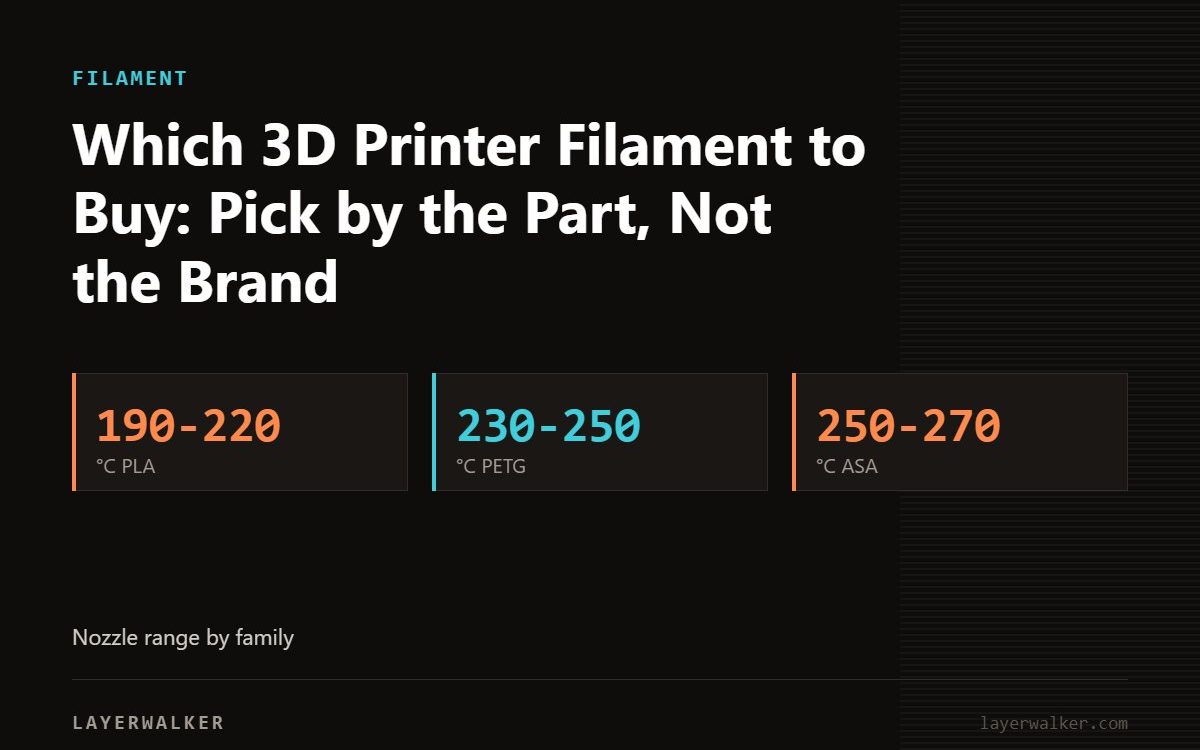
There is no best filament, only the right one for the part: PLA for models and prototypes, PLA+ for everyday parts that get handled, PETG for anything that sees heat or needs to flex, ASA for outdoors, TPU for rubber-like parts. Pick the material first, then a spool with a stated tolerance of ±0.03 mm or better.
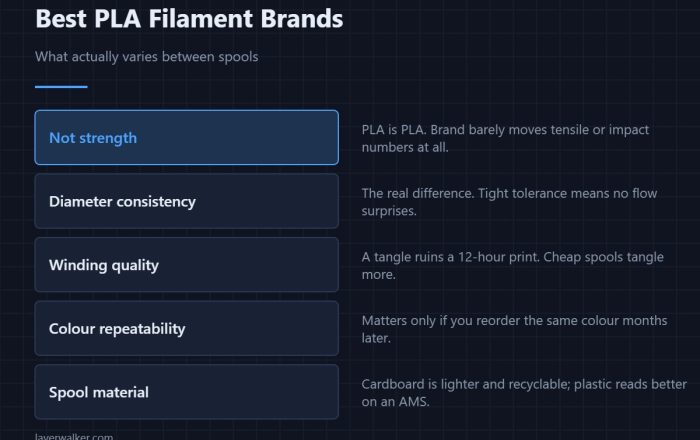
The question behind every “best filament” search is really “what should I print this in”. Brand matters less than most reviews suggest: two spools of PLA from different reputable makers print almost the same, while PLA and PETG from the same maker behave completely differently. So choose the material for the job, then choose a spool that meets a few measurable standards.
Where to buy


SUNLU PLA+ 3D Printer Filament, 16 Color Bundle Multicolor, 1.75mm
Match the material to the part
- Models, prototypes, anything decorative: PLA. Easiest to print, sharpest detail, no enclosure. Brittle and softens at 55 °C.
- Parts you handle, drop or screw together: PLA+. The impact modifier makes the difference between a hook that lasts and one that snaps.
- Parts that see heat, water or repeated bending: PETG. Survives a car interior, does not go brittle, bends before breaking. Strings if wet; read the PLA versus PETG comparison.
- Outdoor parts in sun: ASA. UV stable where PETG yellows and PLA sags. Needs an enclosure; see ASA versus ABS.
- Flexible parts: TPU 95A. Phone cases, feet, gaskets.
- Stiff, strong, dimensionally stable engineering parts: carbon-fibre PETG or nylon, which need a hardened nozzle.
What a good spool has, whatever the material
- Stated diameter tolerance of ±0.03 mm or better. The single most important number. Loose tolerance causes under- and over-extrusion the slicer cannot fix.
- Vacuum-sealed bag with desiccant. Filament that arrives loose is already wet.
- Published print settings. A temperature range and a bed temperature on the label mean the maker has tested it.
- Consistent colour between batches. Matters only if you print multi-part assemblies over months; check reviews.
- Spool that fits your dryer and your printer’s holder. Most dryers accept a 1 kg spool up to about 75 mm wide.
Why these three spools are in the box
They are the three PLA grades most people actually need, from makers with consistent tolerance. SUNLU’s plain PLA is the calibration and prototype spool. Creality’s 2 kg black and white bundle covers the two colours every workshop burns through fastest. SUNLU’s PLA+ multicolour set is the parts spool: tougher than plain PLA, and a colour for every job without buying sixteen separate rolls.
Three mistakes to avoid
- Buying an exotic blend as a first spool. Silk, glow, wood and marble all print worse than plain PLA; learn on plain.
- Buying a 5 kg bundle of a material you have not printed. One spool first, always.
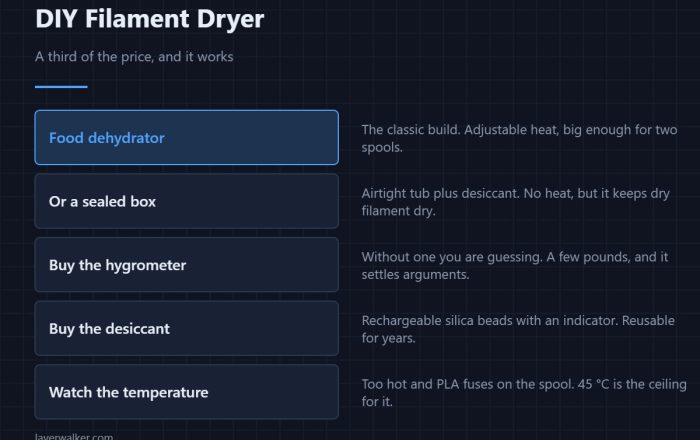
- Skipping the dryer. A cheap spool that has been dried prints better than a premium spool that has sat open for a month.
Best 3D filaments FAQ
Is expensive filament worth it?
For fine models and multi-part assemblies, a premium spool’s tighter tolerance and colour consistency show. For brackets and prototypes, a well-reviewed budget spool with stated tolerance is indistinguishable.
1.75 mm or 2.85 mm?
Whatever your printer takes. Almost every consumer printer sold today uses 1.75 mm.
Can one filament do everything?
PETG comes closest for functional parts, PLA+ for general use. Nothing does miniatures and outdoor brackets both well.

LayerWalker
Print defect diagnosis, calibration procedures and parts that actually fit. Corrections welcome through the contact page.