3D Printer Enclosures: When You Need One and What to Buy
LayerWalker is a participant in the Amazon Services LLC Associates Program. We may earn a commission when you buy through links on our site, at no extra cost to you.
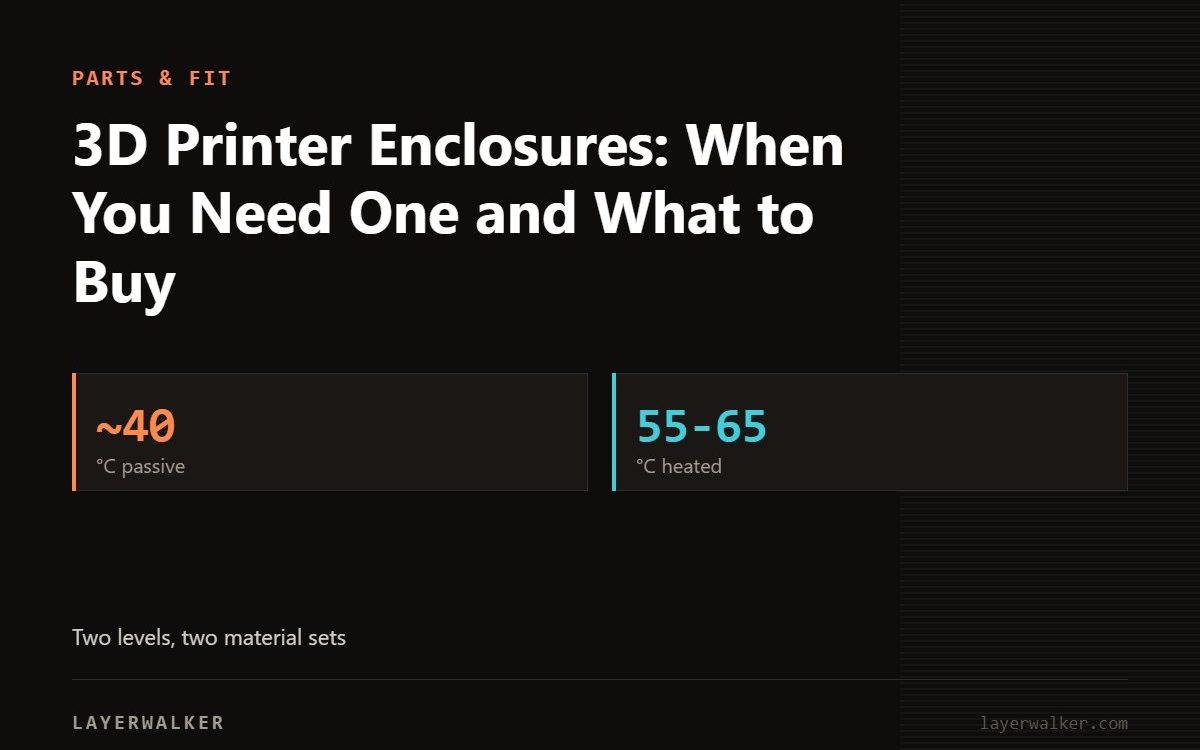
You need an enclosure if you print ABS, ASA, nylon or polycarbonate: it holds the air around the part at 40 to 60 °C so layers stop cracking and corners stop lifting. For PLA and most PETG an enclosure is optional and, without a vent, can cause heat-creep clogs.
An enclosure does one job well: it stops the room air from cooling the print unevenly. Materials that shrink a lot as they cool (ABS about 0.8 %, ASA similar, nylon more) pull on the layer below them, and a draught across the bed is enough to split a tall part. Trapping the printer’s own bed heat is the cheap way to fix that. Everything else an enclosure gets sold on, such as noise, dust and fumes, is secondary and depends on the design.
Two families exist. Fabric tents with an aluminium-film liner and a zip front are light, cheap and fold flat; they hold about 35 to 45 °C from a 100 °C bed. Rigid boxes in acrylic or polycarbonate hold heat better, look better, and can carry a fan-and-filter kit, but they cost more and cannot fold away.
Where to buy


YOOPAI 3D Printer Enclosure for Creality Ender 3 with Ventilation Kit & LED

What to look for
- Internal size, not printer size. A bed-slinger moves its bed forward and back, so measure the footprint with the bed at the front stop and the spool holder fitted, then add 5 cm on each side for cable clearance. A CoreXY printer only needs its outer box plus door swing.
- Ventilation port. ABS and ASA release styrene; you want a 4-inch or 100 mm duct port so a small inline fan can push the air to a window or a carbon filter. Tents without a port are fine for PLA and PETG only.
- Cable and filament pass-throughs. A flap for the power lead and a grommet for the filament path let you keep the spool and a filament dryer outside, where it is cooler.
- Clear front panel. You will open a zip a hundred times to check a first layer; a large clear window saves most of those.
- Fire safety. The liner must be a flame-retardant fabric. Put a smoke detector inside or directly above the enclosure and never disable thermal-runaway protection to stop a heater fault warning.
The options in the box, and why they are there
The YOOPAI medium enclosure is the general-purpose tent: liner, LED strip and a zip front, sized for the common 220 to 235 mm bed-slingers once you check the depth against your printer’s bed travel. The Ender-3-sized variant adds a ventilation kit, which is the version to pick if ABS or ASA is on your list. The large resin enclosure is the same idea in a taller, deeper shell for resin printers and their wash-and-cure station; resin fumes are the reason it ships with a vent kit as standard.
Setting it up so it actually helps
- Warm the chamber before you print: start the bed at its ABS temperature, close the zip and wait 15 minutes. A thermometer hung at part height should read at least 40 °C.
- Turn the part cooling fan down. Inside a warm chamber ABS needs 0 to 20 % fan; the same fan speed you used in open air will still crack the part.
- Keep the electronics cool. If your mainboard or power supply sits under the bed inside the tent, cut a vent for it or move the PSU outside. Stepper drivers that overheat skip steps and show up as layer shifts.
- Do not print PLA with the door shut unless the tent has a vent open. Heat creep above 35 °C ambient softens PLA inside the hotend and you get clogs mid-print.
When you do not need to buy one
If you print PLA and PETG only, spend the money on a filament dryer instead; dry filament fixes far more prints than a tent does. A cardboard box or an IKEA Lack table with acrylic sides also works for occasional ABS, and many people run ABS successfully on a CoreXY printer that already ships enclosed.
3D printer enclosures FAQ
Is a 3D printer with an enclosure better for beginners?
Not for the first months. Beginners print PLA, and PLA prefers open air. Buy the enclosure when you commit to ABS or ASA.
Does an enclosure make the printer quieter?
A fabric tent cuts perhaps 3 to 5 dB. A rigid box with foam does more. Neither replaces quiet stepper drivers.
Can I leave the printer running in a closed enclosure overnight?
Only with a smoke detector, a printer that has thermal-runaway protection enabled, and a chamber temperature you have measured. Heat that helps ABS also stresses cheap PSUs.

LayerWalker
Print defect diagnosis, calibration procedures and parts that actually fit. Corrections welcome through the contact page.