Support Material for PLA: PETG Interfaces, PVA, and When Plain PLA Supports Are Enough
LayerWalker is a participant in the Amazon Services LLC Associates Program. We may earn a commission when you buy through links on our site, at no extra cost to you.
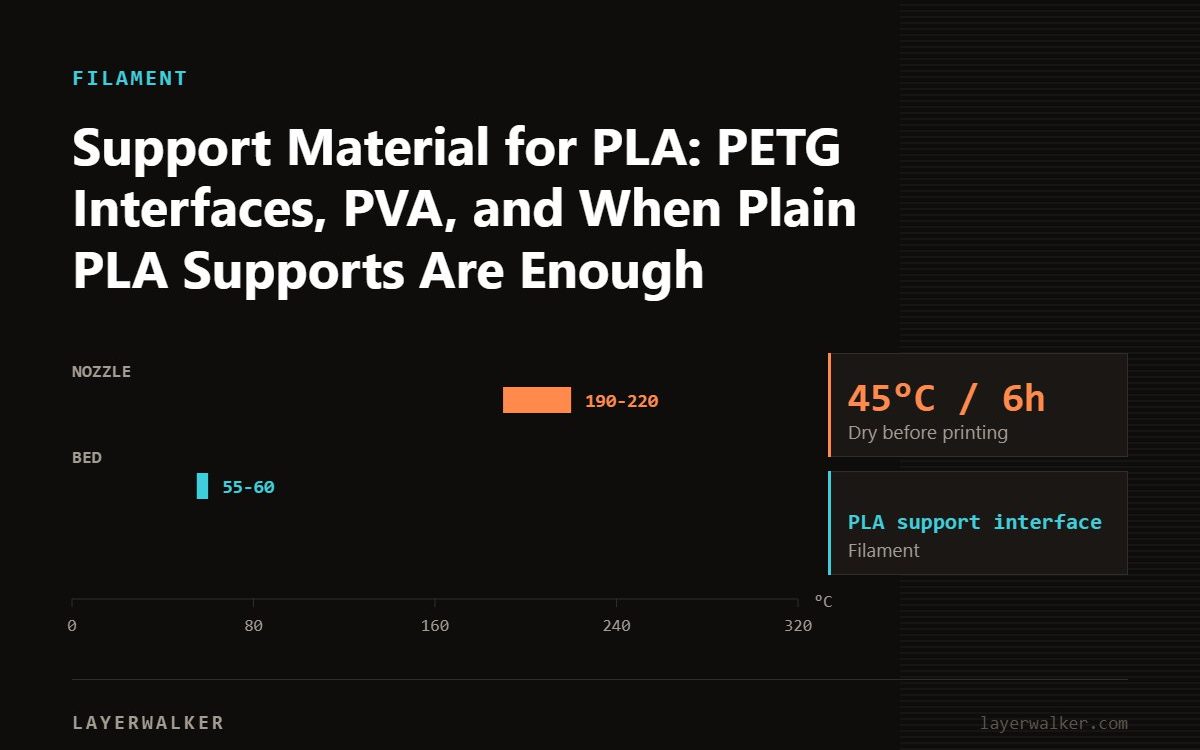
If you have a multi-material system, print PETG as the support interface under PLA: the two barely bond, so the support snaps off and leaves a smooth surface. Water-soluble PVA works for enclosed cavities but is expensive and must stay bone dry. On a single-nozzle printer, skip special materials and tune PLA supports and their gap instead.
Support material is only worth buying when a second filament can be printed in the same job. Then the trick is to choose a material that sticks to PLA just enough to hold it up and not enough to bond, so the support falls away and takes no surface with it. PETG does that for PLA and PLA does it for PETG, which is why the pairing has replaced dissolvable supports for most people with a multi-material printer. Dissolvable PVA still has one job: supports inside cavities you cannot reach with pliers.
Where to buy


The options
- PETG interface under PLA. Two or three interface layers in PETG, the rest of the support in PLA. Snaps away by hand, glassy surface underneath, uses cheap filament. The default on any multi-material printer.
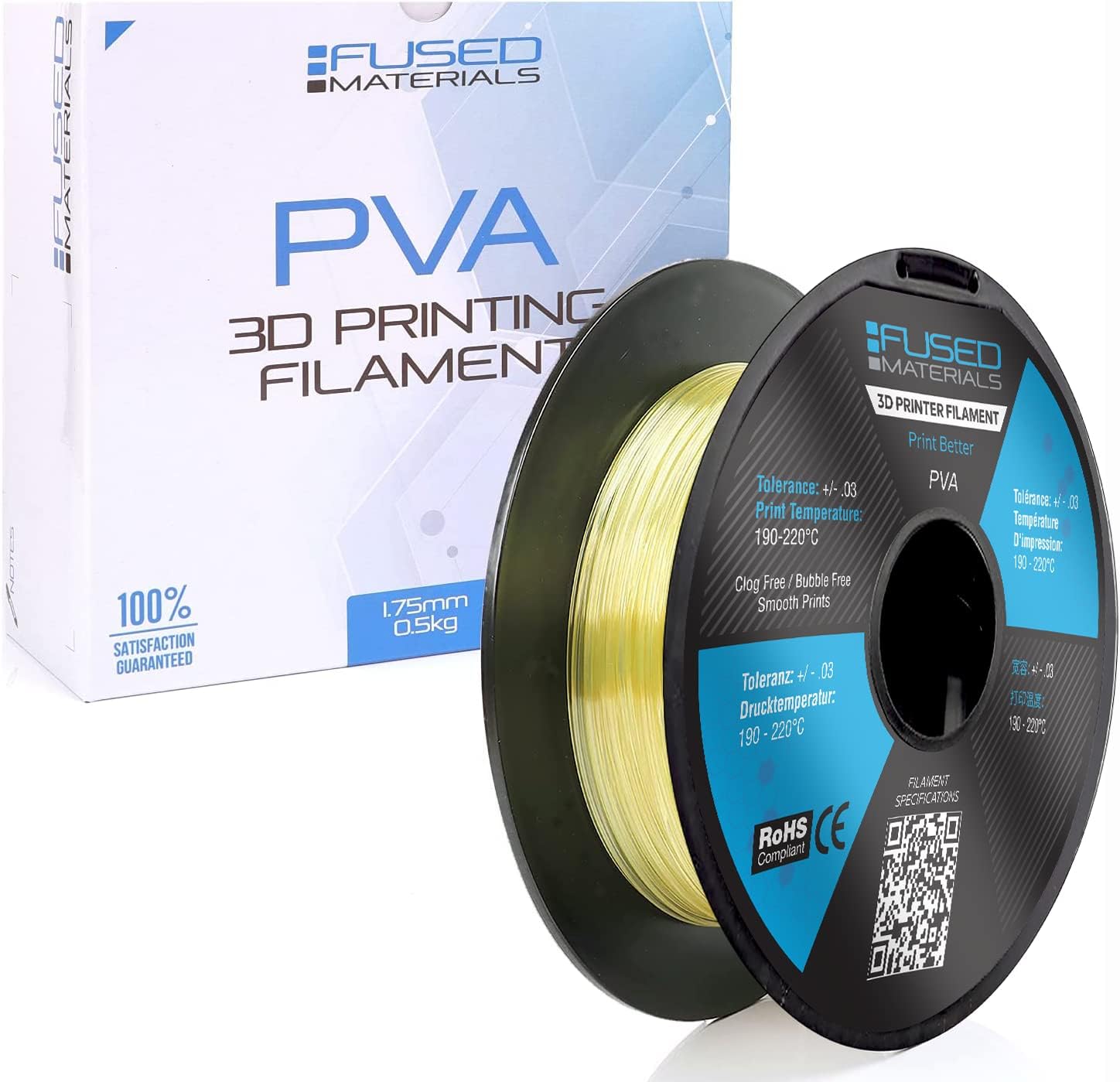
- PVA. Dissolves in warm water over hours. Reaches internal channels and undercuts nothing else can. Absorbs water from the air in minutes, prints stringy, jams if left in a hot nozzle, and costs several times what PLA does.
- Dedicated break-away support filaments. Formulated to peel from PLA; similar result to PETG at a higher price, sometimes with better adhesion during the print.
- Plain PLA supports, tuned. On a single-nozzle printer this is the answer: a 0.2 mm Z gap, two interface layers at 90 % density, and tree supports for organic shapes.
The spools in the box
The listed spools are water-soluble PVA support filaments and a break-away support, for printers with a second extruder or a multi-material unit. Buy the smallest spool that covers the job; PVA left open on a shelf is unusable within weeks.
Using PETG as an interface
- Set the support interface material to PETG and the support body to PLA; the body in PLA keeps filament changes to a minimum.
- Two or three interface layers, 100 % density, Z gap zero. The materials themselves provide the release.
- Print the PETG interface at 235 to 245 °C so it bonds to itself but not to the PLA above.
- Expect a longer print from the material swaps; purge towers eat filament.
Using PVA
- Dry it at 45 to 50 °C for six hours and print from a dry box. Wet PVA is the reason most people give up on it.
- Keep the standby temperature low; PVA cooks and clogs if it sits hot.
- Dissolve in warm water with gentle agitation; overnight for thick supports.
When none of this is needed
Most parts. Orient the model to minimise overhangs, use bridging where you can, and tune plain PLA supports so they come off clean. Special support material is for the last 10 % of geometries.
Best support material for PLA FAQ
Can I use PLA as the interface under PETG?
Yes; the pairing works both ways.
Is PVA food safe or waterproof?
Neither, and it is not a printing material for parts.
Does the Bambu AMS handle PVA?
It feeds it, but PVA’s moisture sensitivity means a dry box or heated AMS is strongly advised.

LayerWalker
Print defect diagnosis, calibration procedures and parts that actually fit. Corrections welcome through the contact page.