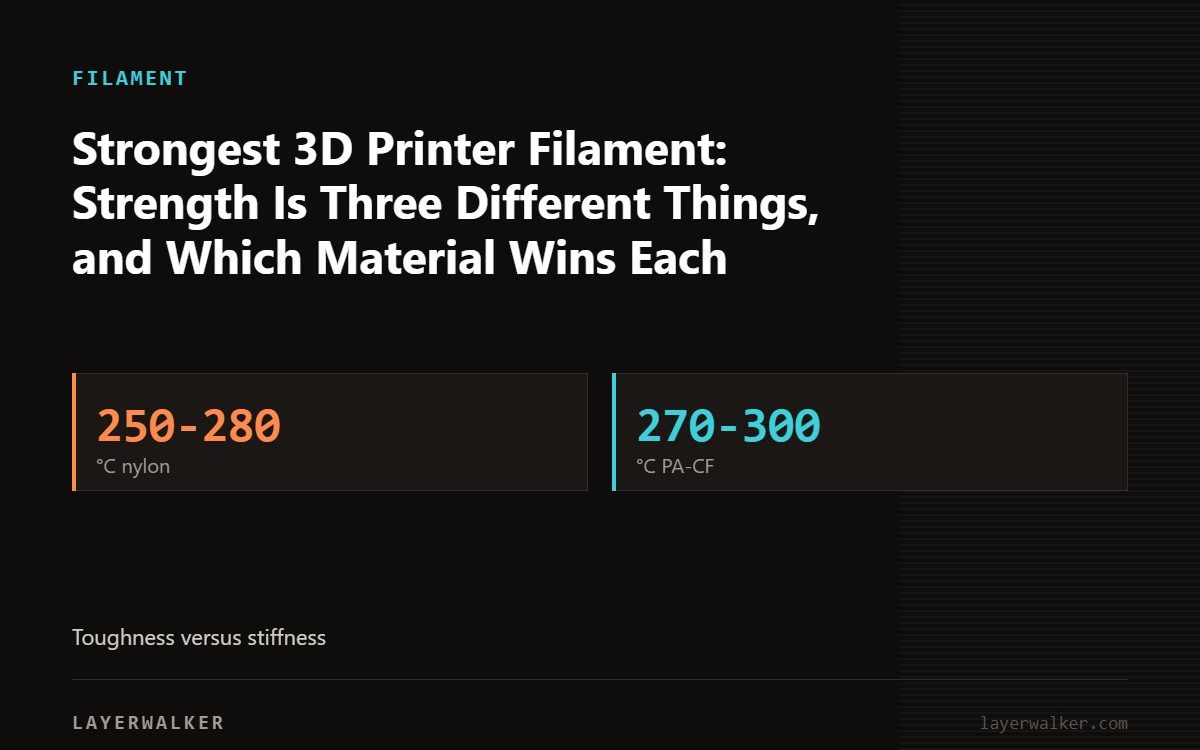
Strongest 3D Printer Filament: Strength Is Three Different Things, and Which Material Wins Each
LayerWalker is a participant in the Amazon Services LLC Associates Program. We may earn a commission when you buy through links on our site, at no extra cost to you.
Decide which strength you need. For a part that must not snap when dropped, PETG or unfilled nylon. For a part that must not bend under load, a carbon-fibre PETG or nylon. For a part that must hold up hot, nylon or polycarbonate. And whichever you pick, more perimeters and the right print orientation add more strength than switching materials does.
Every filament maker calls something strong. The word hides three properties that pull in different directions. Stiffness is resistance to bending; carbon-fibre blends win. Toughness is resistance to cracking under impact; unfilled PETG and nylon win, and fibre-filled materials lose. Heat resistance is holding shape under load when warm; nylon, polycarbonate and ASA win, PLA loses badly. Pick the property the part needs, then pick the material.
Where to buy



Official CREALITY PETG Filament, 3D Printer Filament 1.75mm 1KG Black
By the kind of strength
| You need | Best choice | Runner-up | Avoid |
|---|---|---|---|
| Impact toughness (drops, knocks) | Unfilled nylon | PETG, PLA+ | Plain PLA, any CF blend, silk |
| Stiffness (no bending under load) | PA-CF | PETG-CF, PLA-CF | TPU, PETG |
| Heat resistance under load | Polycarbonate, PA-CF | ASA, ABS | PLA, PLA+ |
| Fatigue (repeated flexing) | Nylon | PETG, TPU | PLA, CF blends |
| Wear (gears, sliding) | Nylon | PETG | PLA |
| Easy to print and reasonably strong | PETG | PLA+ |
Why settings matter more than material
- Perimeters. Four to six walls add more strength than any infill change. Infill above 40 % mostly adds weight; see infill patterns.
- Orientation. Layer lines are the weak direction. Print so the load runs along the layers, not across them.
- Temperature. Printing at the top of the material’s range fuses layers better. A hot PETG part is tougher than a cold one in the same material.
- Dry filament. Wet PETG or nylon can lose a large share of its layer strength to steam voids.
The spools in the box
Elegoo’s Rapid PETG and Creality’s PETG are the tough, easy-to-print baseline for parts that get handled. Flashforge’s carbon-fibre PETG is the stiff option for brackets and frames. Together they cover the two most common meanings of strong without needing an all-metal hotend.
A quick decision path
- Will it be dropped or hit? Unfilled PETG or nylon.
- Must it stay rigid under a steady load? A CF blend, PETG-CF first.
- Will it get hotter than 70 °C in use? Nylon, PC or ASA; see PLA versus PETG for why PLA is out.
- None of the above? PETG, more walls, printed hot.
Best filament for strength FAQ
Is carbon fibre filament the strongest?
Stiffest, yes. Toughest, no; it is more brittle than the unfilled base.
Is PLA+ strong?
Tough for PLA, and fine indoors at room temperature. It softens at 55 °C like any PLA.
Does 100 % infill make the strongest part?
Rarely worth it. Six walls at 30 % infill is usually as strong and much lighter.

LayerWalker
Print defect diagnosis, calibration procedures and parts that actually fit. Corrections welcome through the contact page.