Transparent Filament: Which Materials Actually Print Clear, and the Settings That Make Them
LayerWalker is a participant in the Amazon Services LLC Associates Program. We may earn a commission when you buy through links on our site, at no extra cost to you.
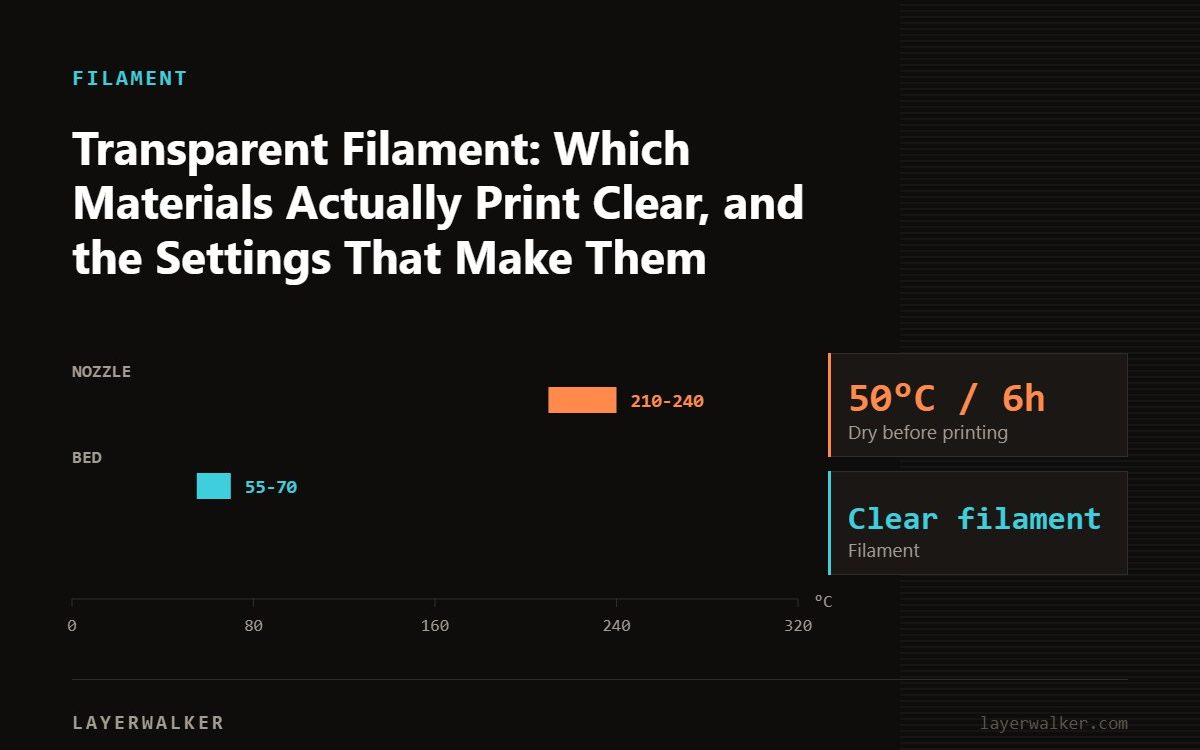
For see-through parts buy a clear PETG or a clear PLA and accept that a normal print will come out translucent, not glass-clear. True transparency needs a specific technique: 100 % infill or single walls, slightly over-extruded, printed slow and hot so layers fuse without air. Polycarbonate is clearer still but hard to print.
Every filament sold as transparent is clear in the spool and cloudy in the part. The cloudiness is air: tiny gaps between lines and layers scatter light. Getting a clear print is therefore not about the filament so much as about eliminating those gaps, which means fusing every line to its neighbours. That is achievable for windows, light pipes and lamp shades with a few settings changes; it is not achievable for complex shapes with infill.
Where to buy

Geeetech Clear PLA Filament 1.75mm, Transparent, 1KG

GIANTARM Clear PLA Filament, 1.75mm Transparent PLA 1kg Spool (2.2lbs), 3D Printer Filament with Vacuum Packaging

Which materials
- Clear PETG. The usual choice. Good clarity when fused, tough, easy to print, slightly yellow in thick sections.
- Clear PLA. Slightly clearer than PETG in thin walls, more brittle, easier to fuse at lower temperature.
- Polycarbonate. Clearest and toughest; needs 260 to 300 °C, an enclosure and a dry spool. For experienced printers.
- Not TPU, not ABS. Clear TPU stays hazy; clear ABS is rare and yellows.
What to check on the spool
- Natural or clear, not tinted. Tinted transparents look good in single walls and dark in thick ones.
- Tolerance ±0.03 mm. Fusing lines depends on even flow.
- Vacuum sealed and dry. Moisture is the enemy of clarity: micro-bubbles turn a clear part white. Dry it before every clear print.
The spools in the box
The listed clear PETG and clear PLA spools are natural, untinted transparents from makers with stated tolerance. PETG is the default for anything handled; PLA for a lamp shade or a display piece.
The technique
- Design for it. Single-wall vase mode for shades and light pipes, or solid parts with 100 % rectilinear infill aligned in one direction. Avoid sparse infill; see infill patterns.
- Hot. Top of the material’s range: PETG at 250 to 260 °C, PLA at 225 to 235 °C.
- Slow. 20 to 30 mm/s, well under the hotend’s flow limit, so each line fully wets the last.
- Over-extrude. Flow 1.05 to 1.10 so lines press into each other and leave no air.
- Thick layers. 0.28 to 0.3 mm; fewer layer boundaries means fewer scattering surfaces.
- Little or no fan. Slow cooling keeps the surface glossy and lets lines fuse.
- Finish. A coat of clear lacquer or a wet-sand and polish fills the surface texture and doubles apparent clarity.
What to expect
A single-wall vase in clear PETG done this way is genuinely see-through with a frosted look. A 5 mm solid window is translucent until polished, then usable. Nothing will match cast acrylic; for that, cut acrylic and print the frame.
Best transparent filament FAQ
Why is my clear print white?
Wet filament, too much fan, or sparse infill. Fix in that order.
Does a bigger nozzle help?
Yes; 0.6 mm at thick layers has fewer boundaries and fuses better.
Can I print clear parts on a Bowden printer?
Yes; the slow speed suits it.

LayerWalker
Print defect diagnosis, calibration procedures and parts that actually fit. Corrections welcome through the contact page.