Rainbow PLA: How Gradient Filament Works, and How to Control Where the Colours Fall
LayerWalker is a participant in the Amazon Services LLC Associates Program. We may earn a commission when you buy through links on our site, at no extra cost to you.
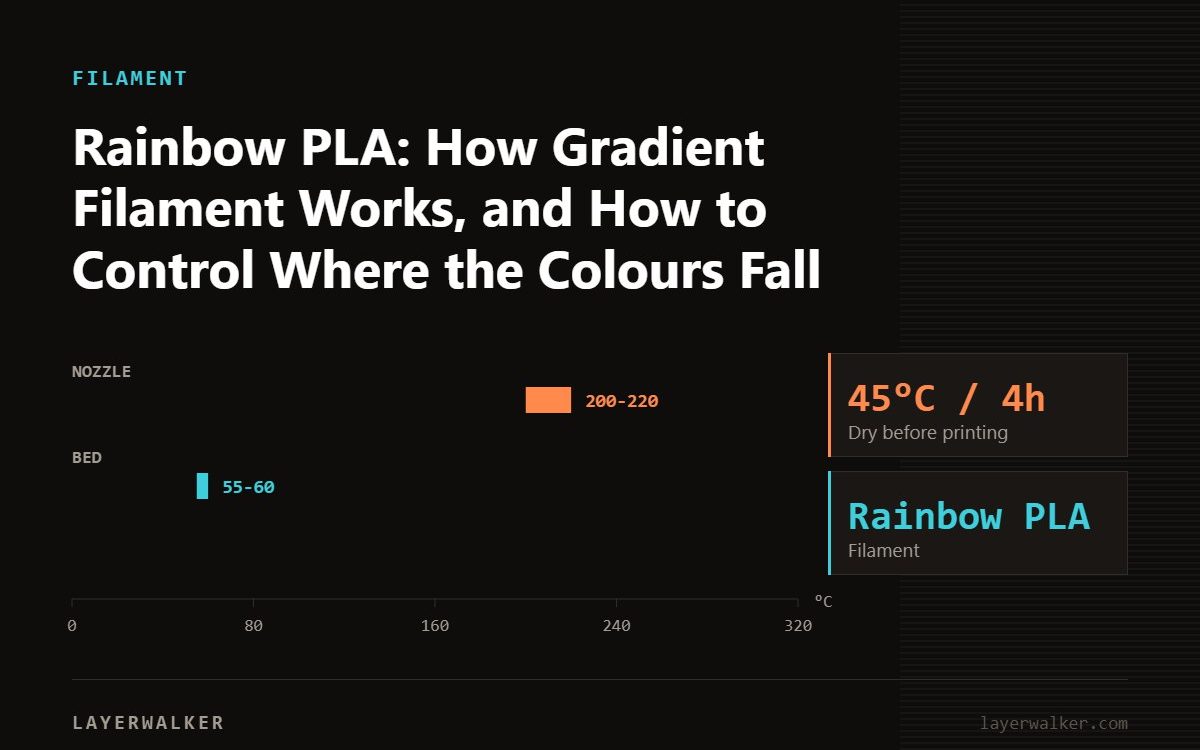
Rainbow PLA shifts colour along the length of the spool, typically every 5 to 15 metres, so a part shows horizontal bands whose width depends on how much filament each layer uses. Tall, thin parts and vases show the full spectrum; small parts come out one colour. Most rainbow spools are silk, so print them hot and slow like any silk.
A rainbow spool is one continuous filament that changes hue gradually along its length. The printer does not know that; it just prints, and the colour on the part is whatever section of filament was passing through the nozzle at that height. That makes the effect predictable once you understand it: the more filament a layer uses, the faster it moves through the colours, and a part that uses the whole spool shows every colour on it.
Where to buy


SUNLU Silk Rainbow PLA Filament, Multicolor Silk 3D Printer Filament 1.75mm +/- 0.02mm, Fast Color Change Each 8 Meters, 330 Meters, 1kg/2.2lbs, Silk Rainbow Filament(Lilac-Violet)

SUNLU Rainbow PLA Filament 1.75mm, 250g Spool Bundle, 3D Printer Filament
What to check
- Transition length. Makers state the metres per colour or the full cycle length. Short cycles suit small parts; long cycles need a tall vase to show.
- Silk or matte base. Most rainbow filament is silk, with silk’s sheen and silk’s weaker layers and stringing. Matte rainbow exists and is tougher and easier.
- Colour set. Full-spectrum rainbows, two- or three-colour gradients, and pastel sets behave differently on a part; look at printed examples, not the spool.
- Tolerance and sealing as usual; silk rainbow strings badly when wet.
The spools in the box
The three listed rainbow PLA spools cover a full-spectrum silk, a matte gradient and a pastel set. Pick by the look of printed samples and by whether you want silk’s shine or matte’s toughness.
Controlling where the colours fall
- Print one part at a time, not a plate of many, or every part gets a slice of the same band.
- Vase mode for the cleanest gradient: one wall, continuous flow, colour climbs evenly.
- Purge to a colour boundary before starting if you want a specific colour at the base; extrude until the filament changes.
- Bigger parts, more spectrum. A 200 mm vase in 0.2 mm layers uses enough filament per layer that each band is a few centimetres tall.
- Seams matter on silk; put them at the back. See seam settings.
Settings
Silk rainbow: 210 to 230 °C, outer wall 30 to 40 mm/s, full fan, longer retraction and wipe to control strings, and dry the spool first. Matte rainbow: standard matte PLA settings.
What rainbow is not for
Small parts, functional parts, and anything you need in a predictable colour. It is a display filament; treat it as one.
Rainbow PLA filament FAQ
Can I print multiple parts and get different colours on each?
Yes, by printing them sequentially rather than together; each will start on whatever colour is at the nozzle.
Why does my rainbow print look one colour?
The part is too small relative to the transition length. Print taller or buy a shorter-cycle spool.
Does rainbow work in a Bambu AMS?
Yes, as a single filament; the colour change happens on its own.

LayerWalker
Print defect diagnosis, calibration procedures and parts that actually fit. Corrections welcome through the contact page.