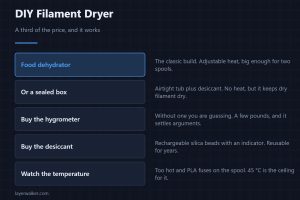
DIY Filament Dryer: A Third of the Price, and It Works
A DIY filament dryer costs a third of a bought one and works just as well. What temperature each material needs, and the two parts actually worth buying.
Print and bed temperatures, drying times, enclosure requirements, and how to choose between PLA, PETG, ABS, ASA and the filled variants.
A DIY filament dryer costs a third of a bought one and works just as well. What temperature each material needs, and the two parts actually worth buying.
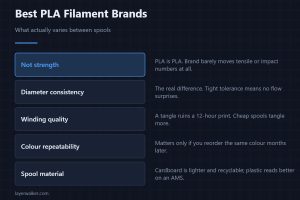
The best PLA filament brands differ in diameter consistency and colour, not in strength. What actually varies between spools, and which is worth paying for.
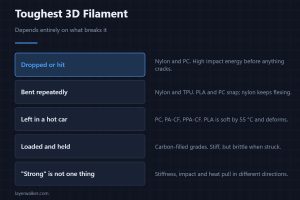
The toughest 3D filament depends on what breaks it: impact, heat, or repeated bending. Four candidates, the numbers that matter, and what each one demands.
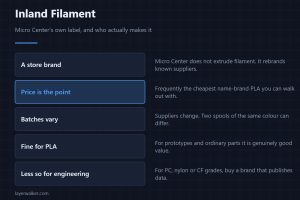
Inland filament is Micro Center's own label, priced low and made by known suppliers. What it is good for, what varies between batches, and when to avoid it.
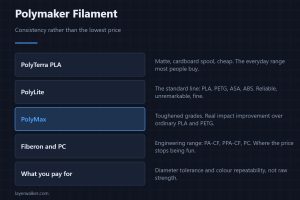
Polymaker filament is the reference brand for consistency rather than price. What each range is for, which spools are worth it, and where to save money.
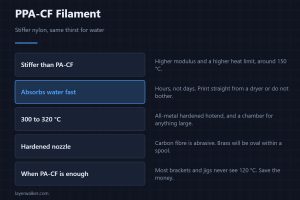
PPA-CF filament is stiffer and more heat resistant than PA-CF, and it drinks water just as fast. The hardware it needs, and how the two compare in practice.
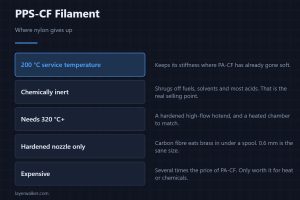
PPS-CF filament resists chemicals and 200 degree heat where nylon gives up. What hardware it demands, what it costs, and when PA-CF is the saner choice.
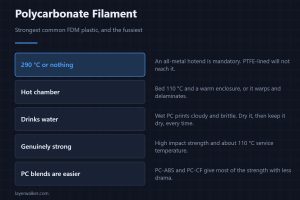
Polycarbonate filament is the strongest common FDM plastic and the fussiest. It needs 290 degrees, a hot chamber and dry storage, or it turns brittle.
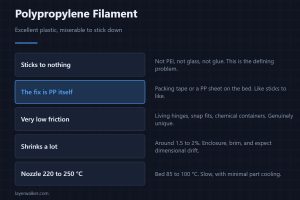
Polypropylene filament is the hardest common plastic to make stick, and the fix is packing tape. What PP is genuinely good at, and what it costs you in return.
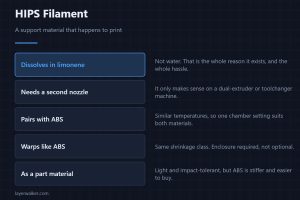
HIPS filament is a dissolvable support material first and a printing material second. What limonene does, why it needs a chamber, and when ABS is better.