PPS CF Filament (PPS-CF): Where Nylon Gives Up
LayerWalker is a participant in the Amazon Services LLC Associates Program. We may earn a commission when you buy through links on our site, at no extra cost to you.
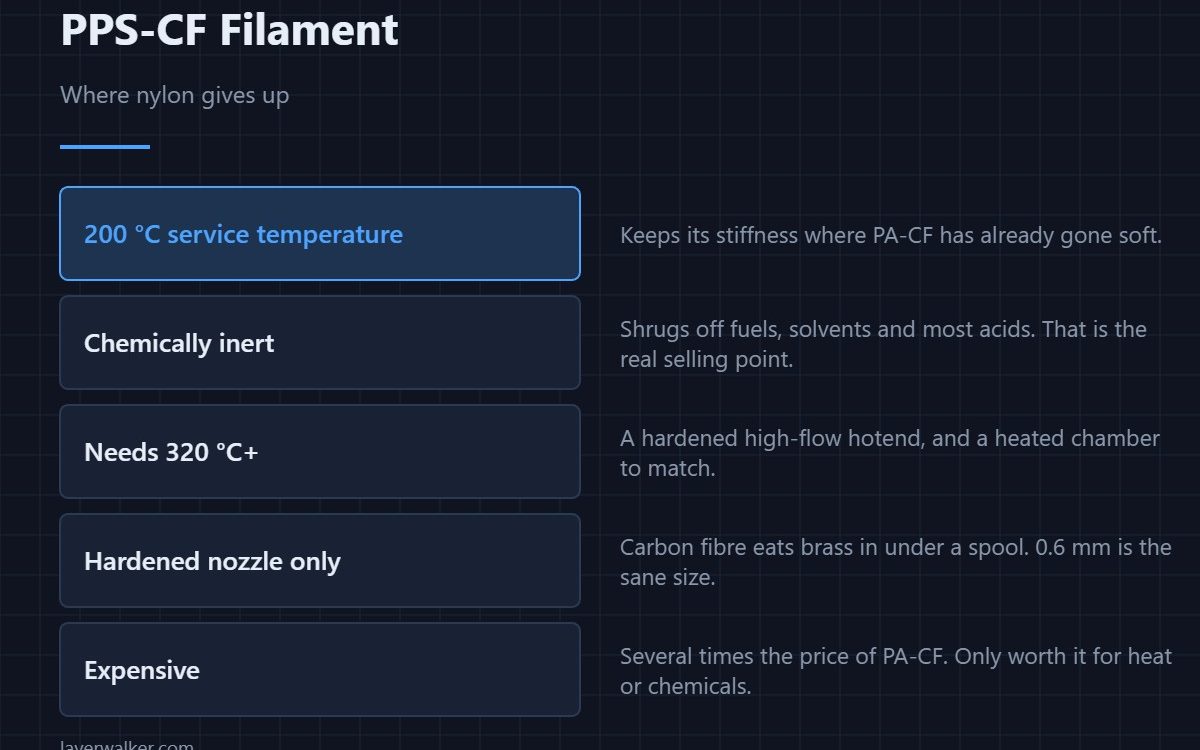
PPS CF filament, written PPS-CF on most spools, is carbon-filled polyphenylene sulphide, and you buy it for two things: it keeps working at around 200 °C, and it shrugs off fuels, solvents and most acids. It needs 320 °C or more, a hardened nozzle, and a heated chamber. It costs several times what PA-CF does, so unless heat or chemicals are the actual requirement, PA-CF is the saner purchase.
This is a genuine engineering material that happens to be printable on a handful of consumer machines. The question worth answering before buying is not whether it is good — it is — but whether your part actually needs what it offers.
Where to buy


What PPS CF filament is actually for
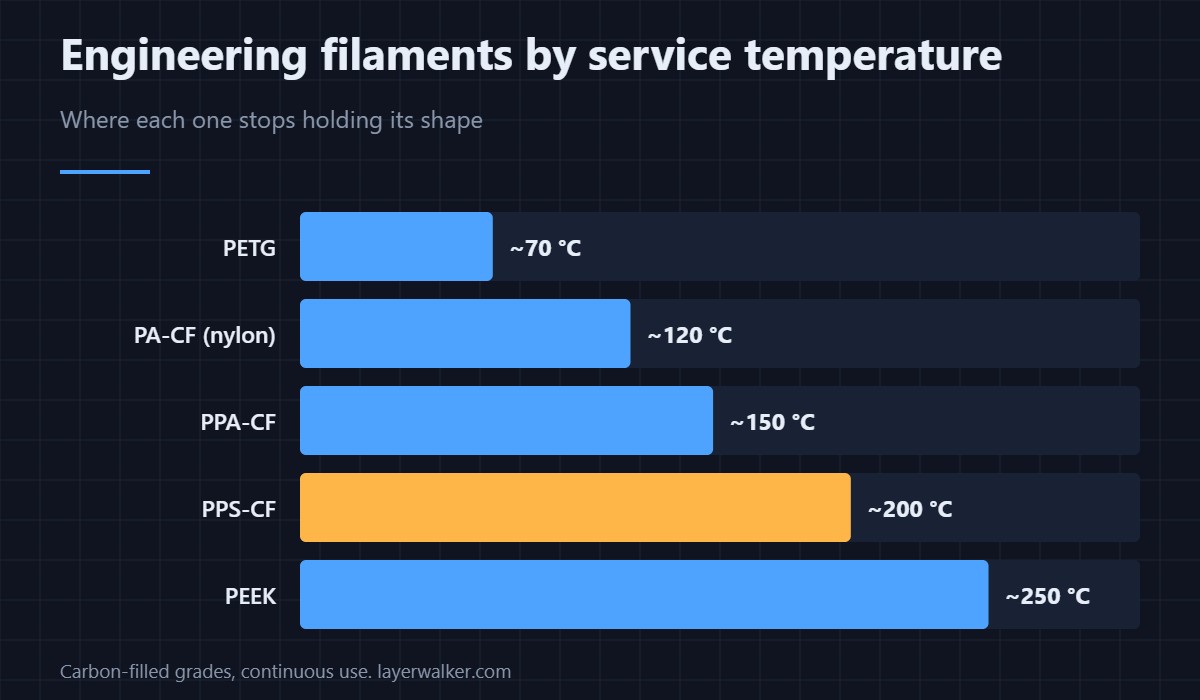
Under-bonnet automotive parts, pump and valve components, jigs that see a heat gun or a solder pot, and anything that lives in contact with fuel or industrial solvents. It is dimensionally stable when hot in a way that PA-CF is not, because carbon-filled nylon starts losing stiffness well before 150 °C.
The hardware bar
- Hotend to 320–350 °C. All-metal, high-flow, with a heater and thermistor rated for it. Most consumer hotends top out below this.
- Hardened nozzle. Carbon fibre destroys brass in under a spool — see hardened steel nozzles. A 0.6 mm is the practical size; 0.4 mm clogs more with filled material.
- Heated chamber. Not just an enclosure. PPS is semi-crystalline and warps hard without one.
- Bed 120 °C and a real adhesive. Ordinary glue stick is irrelevant at these temperatures.
It still needs drying
Less desperately than nylon, but it needs it. Dry at 90–100 °C for several hours and print from a heated dry box if your printer supports one. At this price, a ruined print costs more than the dryer.
When to buy something else
If the part will never exceed 120 °C, PA-CF does the job for a fraction of the cost. If you need higher still and have the machine for it, PEEK is the next step up and another large step in price and difficulty. If the requirement is stiffness at room temperature, carbon-filled PETG or PLA is far cheaper and prints on anything. The broader comparison is in toughest 3D filament.
PPS CF Filament FAQ
What printers can actually run PPS-CF?
Machines with a 350 °C hotend and an actively heated chamber — the Qidi Plus 4 class and above, and industrial machines. An enclosed CoreXY without chamber heating will struggle on anything but small parts.
Is PPS-CF stronger than PA-CF?
Stiffer and far more stable when hot, and much more chemically resistant. PA-CF is tougher under impact and handles repeated flexing better. They fail differently.
Why is PPS-CF so expensive?
The base polymer is a specialty engineering plastic made in small volumes, and the carbon fill adds cost. It is priced as an industrial material that happens to come on a spool.
Does it need a hardened nozzle even at 0.6 mm?
Yes. Nozzle size changes clog frequency, not abrasion. Any carbon-filled filament will wear a brass nozzle out quickly regardless of the bore.

LayerWalker
Print defect diagnosis, calibration procedures and parts that actually fit. Corrections welcome through the contact page.