PEEK Filament: What It Takes to Print It, and Whether You Need It
LayerWalker is a participant in the Amazon Services LLC Associates Program. We may earn a commission when you buy through links on our site, at no extra cost to you.

PEEK needs a hotend near 400 degC, an actively heated chamber and a hardened nozzle. If your printer does not have all three, no setting will make it work. For almost every job where people reach for PEEK, a carbon-filled nylon does enough for a tenth of the trouble.
Where to buy


Why it is hard
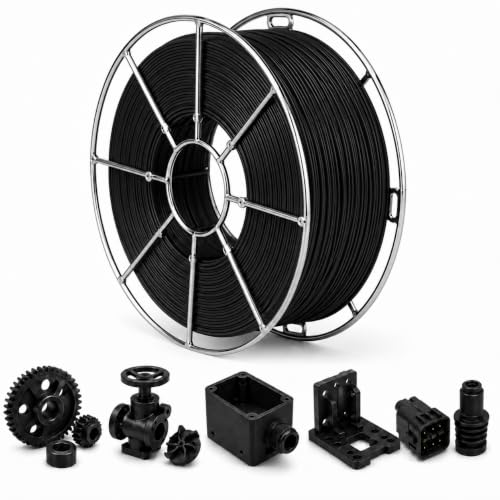
PEEK is a semi-crystalline thermoplastic that melts around 340 degC and is printed hotter than that. Three consequences follow, and all three are hardware problems rather than slicer problems.
The hotend has to reach and hold roughly 400 degC. That rules out any hotend with PTFE in the melt path, because PTFE degrades well below that and releases fumes you do not want. It needs an all-metal path and usually a higher-wattage heater than a standard machine ships with.
The chamber has to be hot, not merely enclosed. PEEK crystallises as it cools, and if that happens unevenly the part warps or delaminates. A passive box is not enough; the machine needs active chamber heating well above what a printer designed for ABS provides.
And the bed has to hold the part against that shrinkage for the whole print, at temperatures where most adhesion tricks stop working.
What it costs, and what that buys
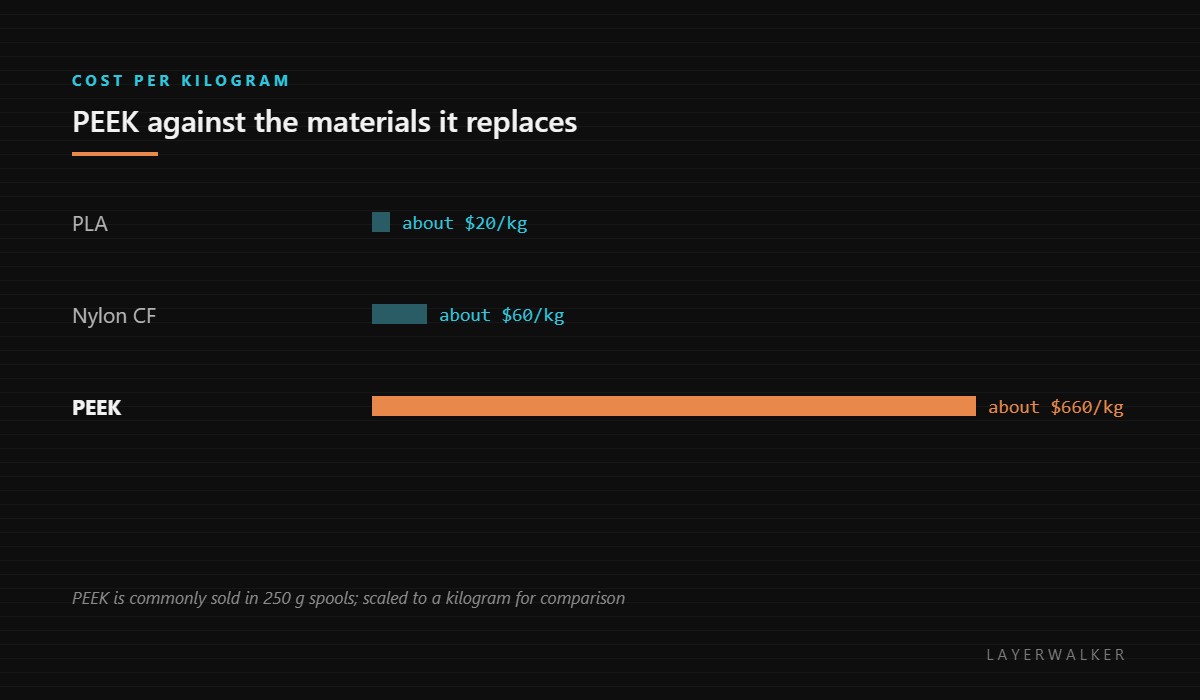
PEEK is sold in 250 g spools, which disguises the price. Scaled to a kilogram it costs more than thirty times what a good PLA costs, and that multiplier applies to every failed print as well as every good one. A first attempt that warps off the bed is an expensive way to learn the chamber is not hot enough.
What you get is genuinely exceptional: continuous service temperature far above any common printing material, chemical resistance, low outgassing, and strength that holds at temperatures where nylon has gone soft. In aerospace, medical tooling and semiconductor handling those properties justify the price. In a workshop making brackets, they usually do not.
The cheaper materials that solve the same problem
Most people asking about PEEK have a part that gets hot, or a part that must be stiff, or a part exposed to solvents. Those are three different problems and PEEK is rarely the cheapest answer to any of them.
| Problem | Reach for | Why it is enough |
|---|---|---|
| Part sags in a hot car | ASA or PETG | Well above the temperature a car interior reaches |
| Part must be stiff | Carbon-filled nylon or PETG-CF | Fibre fill raises stiffness far more than the base polymer choice |
| Part must resist solvents | Nylon or PP | Chemical resistance without the chamber requirement |
| Part runs above 150 degC continuously | PEEK, genuinely | Nothing cheaper holds there |
Our pages on nylon and carbon-filled filament cover the two that replace PEEK most often.
If you are going to try it
Dry it properly first; PEEK absorbs moisture and prints badly wet, and the drying temperature is above what a standard filament dryer reaches. Fit a hardened nozzle, because filled grades are abrasive and brass will round off within a spool, and see our page on hardened nozzles. And plan the first print as a test coupon rather than a part, because the money at stake per attempt changes how you should experiment.
FAQ
Can I print PEEK on a normal enclosed printer? No. Enclosed is not the same as actively heated, and the hotend temperature is usually the harder limit.
Is PEEK stronger than carbon fibre nylon? At room temperature they are closer than the price suggests. PEEK wins on heat and chemicals, not simply on strength.
Why is it sold in 250 g spools? Because a kilogram would be a very large sum, and because most users need small quantities for specific parts.
Does PEEK need a hardened nozzle? Unfilled PEEK is not abrasive, but the filled grades most people buy are. Fit one anyway.

LayerWalker
Print defect diagnosis, calibration procedures and parts that actually fit. Corrections welcome through the contact page.