Carbon Fiber 3D Printing at Home: What CF Filament Actually Does, and What Your Printer Needs
LayerWalker is a participant in the Amazon Services LLC Associates Program. We may earn a commission when you buy through links on our site, at no extra cost to you.
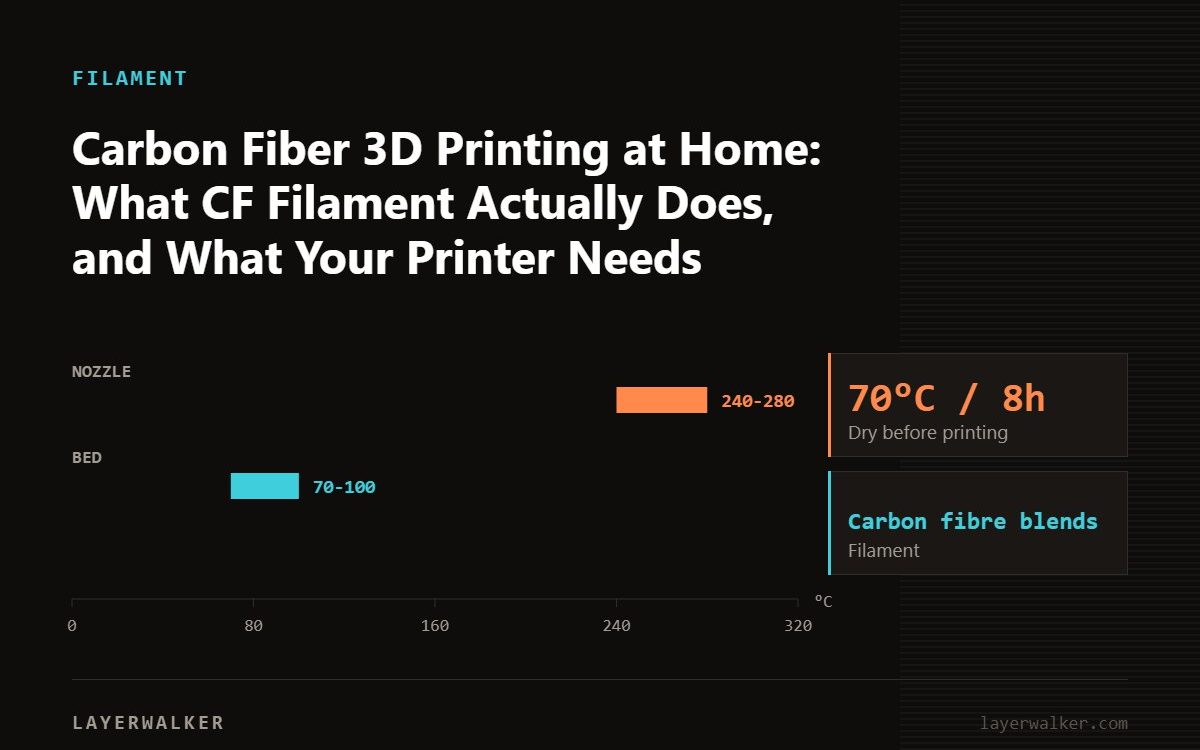
Carbon-fibre filament is PLA, PETG or nylon with 10 to 20 % chopped fibre. The fibre makes parts stiffer and dimensionally stable with a matte finish; it does not make them dramatically stronger, and it wears a brass nozzle out in a spool. Fit a hardened steel nozzle, pick the base polymer for the job, and dry the spool.
Carbon fibre in filament is short chopped strand, not the continuous fibre in a bicycle frame. It changes the material in a specific way: stiffness goes up, shrinkage and warp go down, the surface goes matte and hides layers, and the part holds its dimensions better under heat. Tensile strength changes little and impact resistance often drops. So CF filament is the right choice for brackets, mounts, jigs and frames that must stay flat and stiff, and the wrong choice for anything that needs to survive a drop.
Where to buy

ELEGOO PLA-CF 3D Printer Filament 1.75mm Black 1KG 1.75mm


Pick the base polymer
- PLA-CF. Easiest. Prints like PLA at 210 to 230 °C, no enclosure, matte and stiff. Still softens at 55 °C.
- PETG-CF. The practical everyday engineering filament: stiff, low-warp, heat to about 75 °C, no enclosure, tolerant of moisture compared to nylon.
- PA-CF (nylon). The real engineering option: stiff, tough, heat to 120 °C and more. Needs a dryer feed, a 260 °C hotend and ideally an enclosure.
- ASA-CF. Outdoor stiffness with UV stability; needs an enclosure like ASA.
What your printer needs
- A hardened steel nozzle, 0.4 or 0.6 mm, fitted before the first spool. This is not optional; see brass versus hardened.
- A hotend rated for the base polymer. PLA-CF and PETG-CF run on any hotend; PA-CF needs all-metal.
- A dryer. All CF filaments are hygroscopic; PA-CF extremely so.
- Extruder gears that grip. CF filament is stiff and slippery; dual-gear extruders feed it reliably.
The spools in the box
Elegoo’s PLA-CF is the easy entry: matte, stiff, prints like PLA. Flashforge’s carbon-fibre PETG is the everyday engineering spool for brackets and enclosures. The iSANMATE ASA-CF bundle is the outdoor-rated option for anything that lives in sunlight and must stay stiff.
Settings that work
- Base polymer temperature plus 5 to 10 °C; the fibre and the steel nozzle both slow heat transfer.
- 0.6 mm nozzle if you print CF often; fewer clogs and faster.
- Speed 10 to 20 % lower than the unfilled base.
- Fan as for the base polymer; CF filaments tolerate a little less cooling.
- Dry before every print of PA-CF; before the first print of PLA-CF and PETG-CF.
When CF is the wrong choice
Parts that need impact toughness: unfilled PETG or nylon. Parts that need to flex: TPU. Anything printed on a brass nozzle you do not want to replace. Cosmetic parts where the matte grey-black finish is not wanted.
Carbon fiber 3D printing FAQ
Is CF filament stronger than regular filament?
Stiffer, yes. Stronger in tension, marginally. Tougher, usually no.
Can I print CF filament through a Bambu AMS?
Yes with a hardened nozzle and hardened extruder gears; Bambu sells both for this reason.
Does CF filament conduct electricity?
Slightly, at the surface. Do not rely on it as an insulator or a conductor.

LayerWalker
Print defect diagnosis, calibration procedures and parts that actually fit. Corrections welcome through the contact page.