Hatchbox PLA: The Reference Budget Spool, and What Its Reputation Rests On
LayerWalker is a participant in the Amazon Services LLC Associates Program. We may earn a commission when you buy through links on our site, at no extra cost to you.
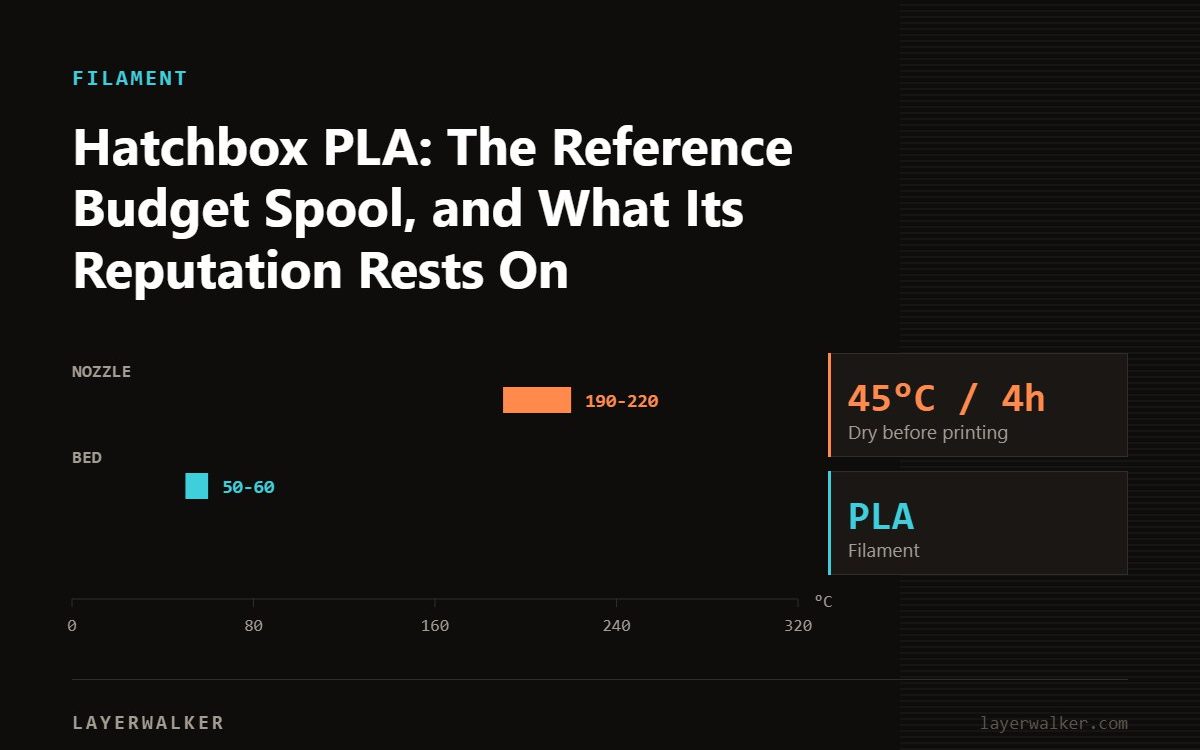
Hatchbox PLA is the spool a lot of slicer profiles were tuned on: consistent ±0.03 mm diameter, colours that match between spools, and a plain PLA formulation that prints at 190 to 210 °C on any printer. It is not the cheapest or the toughest, but it is the least likely to surprise you.
Hatchbox became the default recommendation in the early years of consumer printing because its spools arrived the same every time. That mattered when printers were fussy and a 0.05 mm diameter swing ruined a print. Printers are more forgiving now and the field is crowded, but the reasons to buy Hatchbox have not changed: consistency between spools and between batches, and a plain PLA that behaves the way every PLA profile expects.
Where to buy


What you are paying for
- Diameter consistency. Stated ±0.03 mm and, in practice, tighter. Top surfaces come out even without touching flow.
- Colour consistency. A Hatchbox black from this year matches one from two years ago. For multi-part assemblies over months that is the whole value.
- A plain, predictable PLA. No additives, so it is stiff, detailed and a little brittle, exactly like the PLA your profiles were built for.
- A standard plastic spool that fits every dryer and multi-material unit.
The wood PLA variant
Hatchbox Wood is PLA with fine wood fibre. It prints with a matte, sandable surface and a faint wood smell, and it is mildly abrasive: a brass nozzle will wear over a few spools, and a 0.4 mm nozzle can clog on the fibres if the temperature drops. Print at 190 to 210 °C, consider a 0.5 or 0.6 mm nozzle, and treat it as a display material; it is weaker than plain PLA.
The spools in the box
Hatchbox black and white PLA are the two workhorse colours and the spools to keep a profile for. The wood PLA is the decorative option for boxes, frames and anything you want to stain and sand.
Settings that work
- Nozzle 190 to 210 °C. Hatchbox runs slightly cooler than many modern PLAs; 200 °C is the usual sweet spot.
- Bed 50 to 60 °C on textured PEI.
- Fan 100 % after the first layers.
- Retraction as for any PLA. It strings little when dry; dry it if the spool has been open a month.
- Run a flow calibration once; you will rarely need to touch it again for this brand.
When to buy something else
Parts that get dropped: a PLA+ from any reputable maker is tougher. Parts that see heat: PETG. Bulk colours for a print farm: cheaper spools with stated tolerance exist, and the consistency premium matters less when parts are not assembled together.
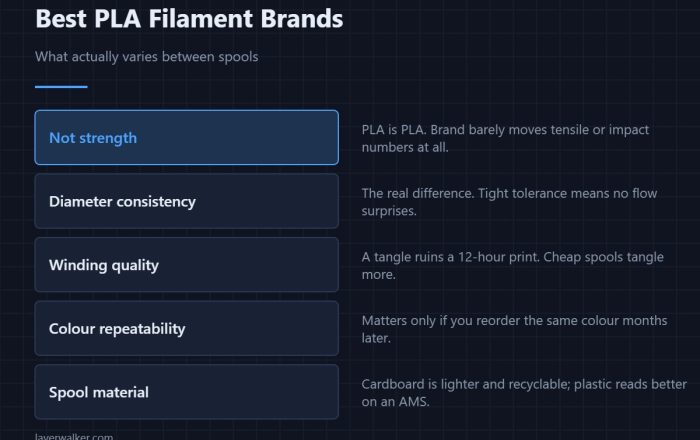
How this compares with the rest of the shelf, and what a filament premium actually buys, is in best PLA filament brands.
Hatchbox PLA filament FAQ
Is Hatchbox still made to the same standard?
Reviews over the last few years still report tight diameter and matching colour. Check recent reviews rather than the brand’s history.
Does Hatchbox work in a Bambu AMS?
Yes, on its standard plastic spool.
Is the wood PLA food safe or waterproof?
No to both.

LayerWalker
Print defect diagnosis, calibration procedures and parts that actually fit. Corrections welcome through the contact page.