eSUN PLA+ (PLA PRO): What the Plus Buys You, and How It Differs From Plain PLA
LayerWalker is a participant in the Amazon Services LLC Associates Program. We may earn a commission when you buy through links on our site, at no extra cost to you.
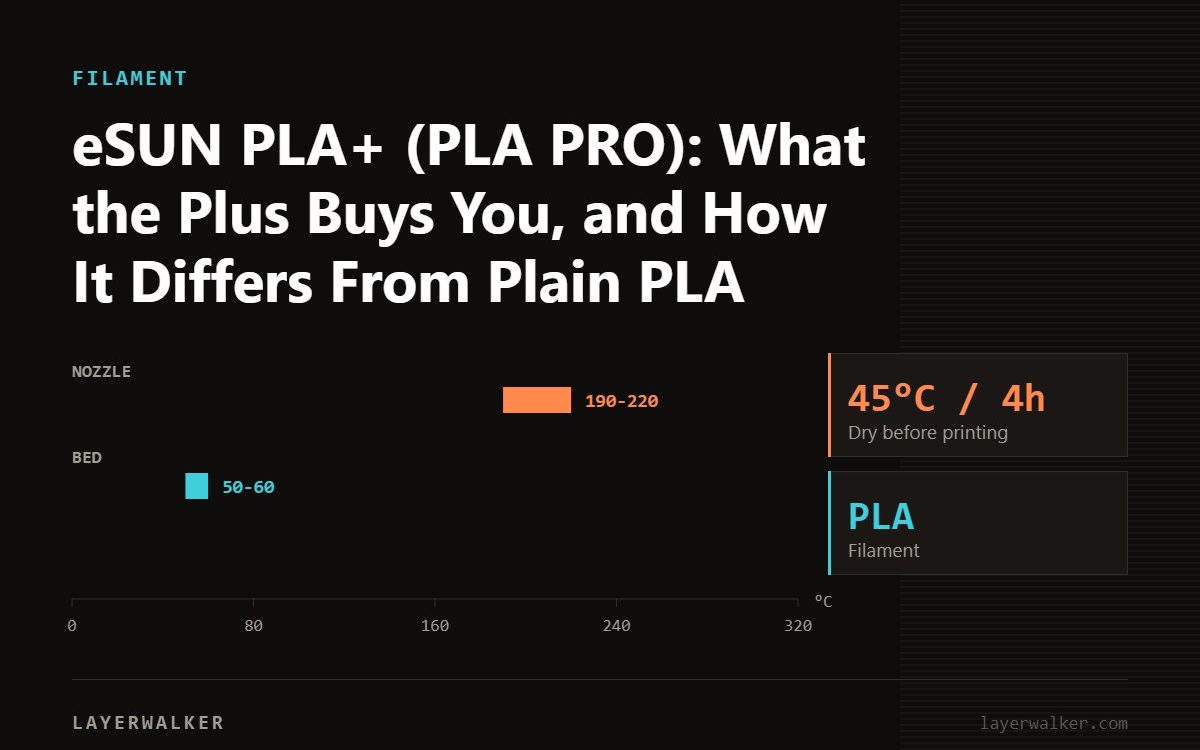
eSUN PLA+ is plain PLA with impact modifiers: a part in PLA+ survives a drop that would shatter the same part in standard PLA, at the cost of a slightly softer look and a higher printing temperature of 215 to 235 °C. Use it for anything that gets handled; use plain PLA for models where crisp detail matters more.
eSUN’s PLA+ was one of the first widely sold toughened PLAs and it is still the one many people mean when they say PLA+. The recipe is a PLA base with a modifier that stops cracks propagating, so hooks, clips and enclosures made from it flex a little instead of snapping. It costs slightly more than plain PLA, it prints almost as easily, and for functional parts it is the better default. The trade is a little less stiffness, a slightly matte surface, and a need for more heat.
Where to buy


eSUN PLA+ Filament 1.75mm, 3D Printer Filament PLA Plus, Dimensional Accuracy +/- 0.03mm, 1KG Spool (2.2 LBS) 3D Printing Filament for 3D Printers, Dark Blue

PLA+ versus plain PLA
- Toughness. Noticeably better; thin walls and snap-fits survive.
- Stiffness. Slightly lower. A PLA+ bracket flexes a hair more under load.
- Temperature. 215 to 235 °C against 200 to 215 °C for plain PLA. Print it too cold and layers do not bond, which hides the toughness you paid for.
- Surface. A little less glossy; fine layer detail is slightly softer. Models and figurines: plain PLA.
- Heat resistance. The same as PLA, around 55 °C. PLA+ is not a substitute for PETG in a hot car.
What to check on the spool
- Tolerance ±0.03 mm, which eSUN states on the label.
- Vacuum sealed with desiccant. PLA+ absorbs water slightly faster than plain PLA and gets brittle when wet, which people mistake for a bad batch. Dry it first.
- Spool type. eSUN ships on plastic spools that fit dryers and multi-material units.
- PLA PRO naming. eSUN labels the same product PLA+ and PLA PRO in different markets; it is one filament.
The spools in the box
eSUN’s PLA PRO and PLA+ are the same material under two labels; the 1 kg spool is the standard buy. Creality’s PLA+ four-pack is the direct alternative from a different maker at a bundle price, useful if you have already tuned for Creality’s blend. Tune one spool, then buy the multi-pack.
Settings that work
- Nozzle 215 to 235 °C. Start at 225 °C. If layers split when you flex a test part, go hotter.
- Bed 60 °C on textured PEI. No glue needed.
- Fan 100 % after the first layers.
- Speed as for PLA. Toughness does not change the flow limit.
- Run a flow calibration; PLA+ typically wants 2 to 4 % less flow than plain PLA at the same nozzle.
When plain PLA is the better buy
Figurines, lithophanes, anything with fine text, and anything printed in a colour where gloss matters. PLA+ is a parts material.
At the other end of the price range, Inland is the cheapest branded PLA worth buying, with the batch-to-batch caveats that come with a store label.
eSUN PLA+ FAQ
Is PLA+ stronger than PETG?
Stiffer and more impact resistant at room temperature, yes. PETG wins on heat, chemicals and outdoor use.
Can I mix PLA+ and PLA settings?
Not the temperature. Everything else transfers.
Why does my PLA+ string more than PLA?
Higher temperature and slightly more moisture uptake. Dry it and drop 5 °C.

LayerWalker
Print defect diagnosis, calibration procedures and parts that actually fit. Corrections welcome through the contact page.