ABS 3D Printer Filament: Still Worth Printing, and What It Needs to Succeed
LayerWalker is a participant in the Amazon Services LLC Associates Program. We may earn a commission when you buy through links on our site, at no extra cost to you.
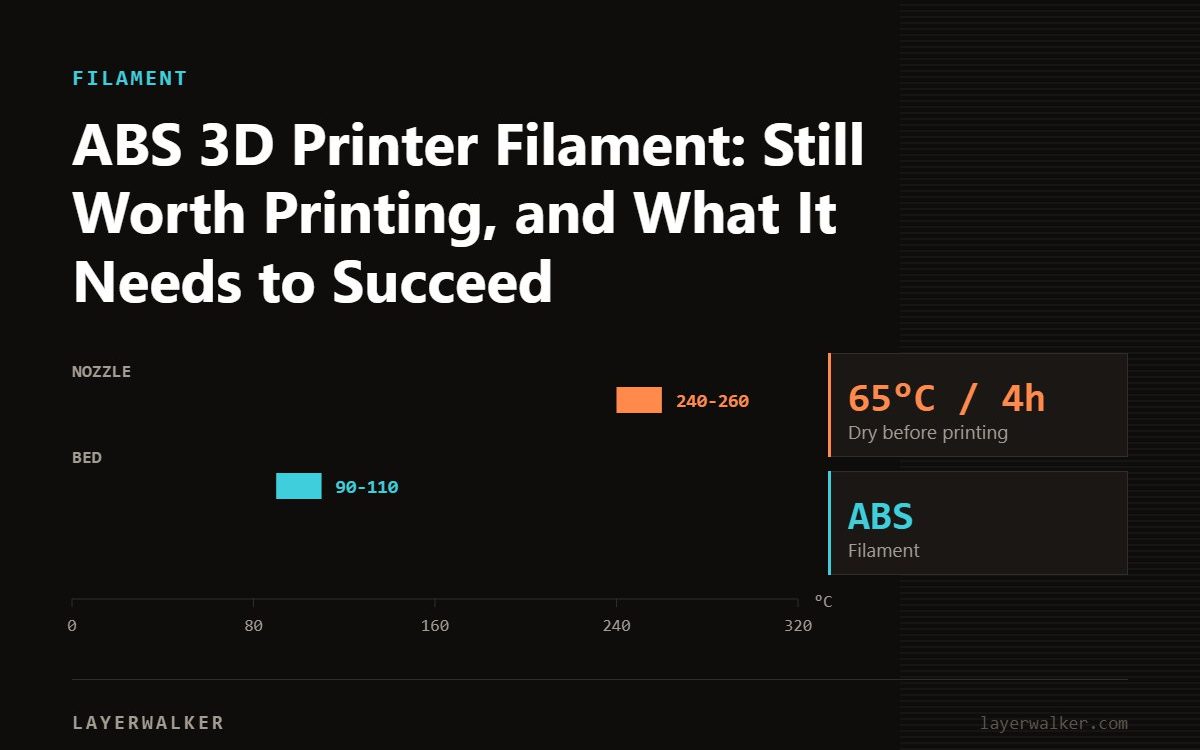
Print ABS when you need acetone smoothing or vapour welding, or a specific ABS-matched colour; otherwise ASA does everything ABS does and survives sunlight too. Either way you need an enclosure holding 40 °C or more, a bed at 95 to 110 °C, a nozzle at 230 to 250 °C, and ventilation for the styrene.
ABS was the engineering filament before PETG and ASA existed. It is tough, takes heat to about 95 °C, machines and sands well, and dissolves in acetone, which means you can weld parts together and smooth a surface to a gloss no other common filament manages. What it does not do is print on an open desk: it shrinks as it cools, lifts corners, splits layers in a draught, and releases styrene while it melts. The ASA versus ABS guide explains why ASA has taken most of its jobs; here is what remains and how to print it.
Where to buy

Polymaker ABS Filament Black 1KG 1.75mm, Heat Resistant, Strength


SUNLU 4KG High Speed ABS Filament, 1KG Spool, (Black+White+Klein Blue+Red)
When ABS is still the right pick
- Acetone smoothing or vapour welding. ASA also dissolves in acetone but less predictably; ABS is the material the technique was built for.
- Matching an existing ABS part, such as a repair on an appliance housing.
- Price. ABS is often a little cheaper than ASA for the same grade.
What your printer needs
- An enclosure. Not optional for anything taller than a few centimetres. A fabric tent at 40 to 45 °C is enough.
- A bed to 100 °C and a surface ABS holds: textured PEI, or glass with a liquid adhesive.
- A hotend happy at 250 °C. Most are.
- Ventilation to a window or a carbon filter. Not in a bedroom.
What to check on the spool
- Tolerance ±0.03 mm and a vacuum seal. ABS absorbs water slowly but wet ABS pops and prints weak.
- Standard or high-speed grade. High-speed ABS blends keep up with CoreXY printers; standard grades print best at 40 to 80 mm/s.
- Stated heat deflection or Vicat figure. A maker that publishes it has tested it.
The spools in the box
Polymaker’s ABS is the well-documented reference spool with published data and consistent behaviour. SUNLU’s ABS is the budget single spool for trying the material, and the SUNLU high-speed four-pack is for a fast enclosed printer that will get through it.
Settings that work
- Warm the chamber 15 minutes first. Corners lifting in the first layers means it was cold.
- Nozzle 230 to 250 °C, bed 95 to 110 °C.
- Fan 0 to 15 %. Any more and you get layer cracks.
- Brim of 5 mm on flat parts; rounded corners in the model where you can.
- Let the part cool inside the enclosure before opening it.
If you print ABS with supports on a dual-nozzle machine, HIPS is the material that dissolves away afterwards and shares the same chamber settings.
ABS 3D printer filament FAQ
ABS or PETG for a bracket?
PETG if it stays indoors and below 70 °C, because it needs no enclosure. ABS or ASA above that.
Is ABS food safe?
No printed part is, and ABS adds styrene to the list of reasons.
Can I print ABS on a Bambu Lab A1 or other open printer? Small parts in a warm room, sometimes. Reliably, no.

LayerWalker
Print defect diagnosis, calibration procedures and parts that actually fit. Corrections welcome through the contact page.