HIPS Filament: A Dissolvable Support That Happens to Print
LayerWalker is a participant in the Amazon Services LLC Associates Program. We may earn a commission when you buy through links on our site, at no extra cost to you.
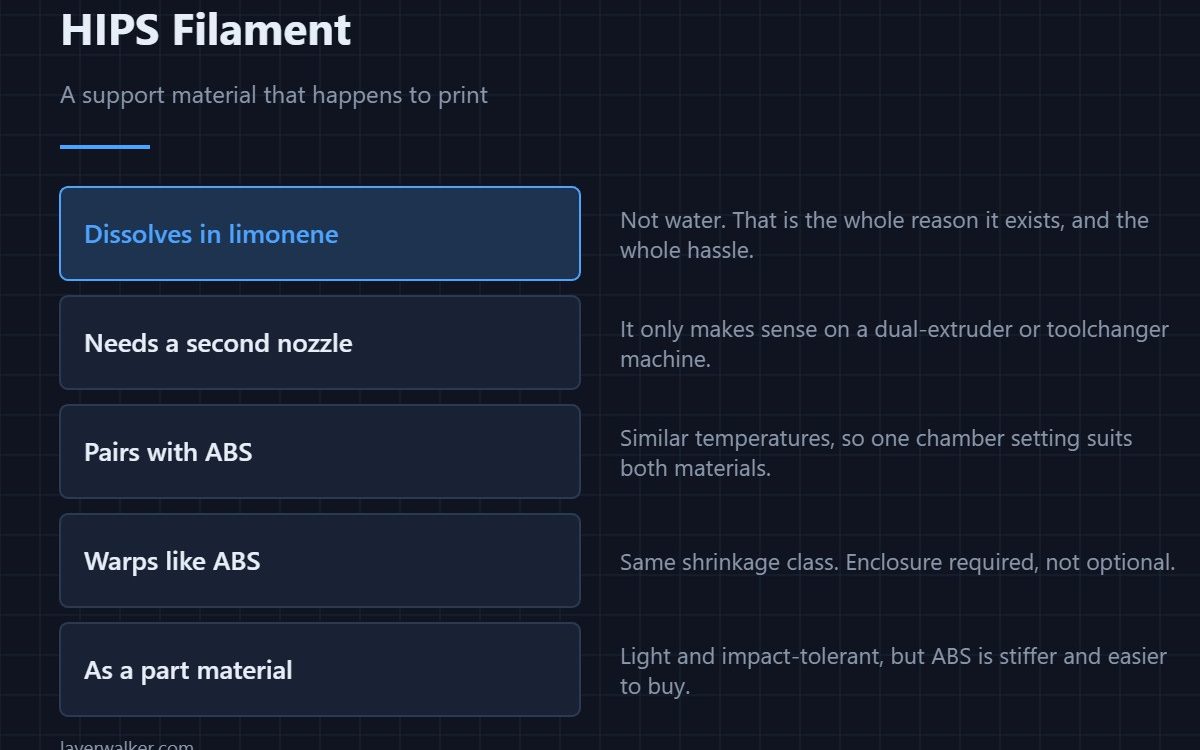
HIPS filament exists mainly as a dissolvable support material for ABS, not as something to print parts from. It dissolves in limonene rather than water, so it needs a solvent bath and ventilation, and it only makes sense on a printer with a second nozzle. It also warps like ABS, so it needs the same enclosure.
High-impact polystyrene is a perfectly decent plastic in its own right — it is what disposable cutlery and fridge liners are made of — but on a 3D printer almost nobody buys it to make the part. They buy it to hold up the overhangs on an ABS part and then make it disappear.
Where to buy


Why HIPS and ABS go together
They print at similar temperatures, around 230–245 °C with a 100 °C bed, so one chamber and one bed setting serves both. They bond to each other well enough to support an overhang but not so well that removal tears the surface. And limonene dissolves HIPS while leaving ABS completely untouched, which is the whole trick. Pairing it with ABS is the only common use.
Limonene is not water
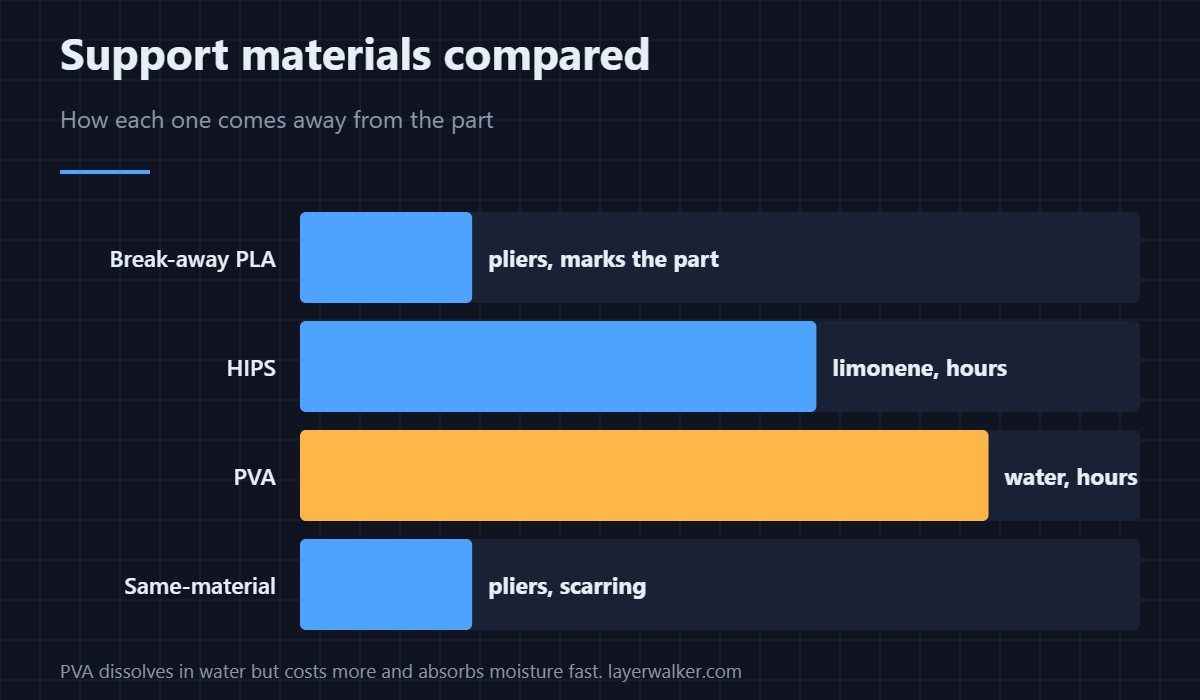
This is the practical catch, and it is why PVA outsells HIPS despite costing more. Limonene is a citrus solvent: it works, it smells strongly of oranges, it takes hours, and it needs ventilation and a sealed container. You cannot just drop the part in the sink. Budget for the solvent as an ongoing cost, because a bath gets saturated and stops working.
You need a second nozzle
Support material only makes sense if the printer can lay down two materials. That means a dual extruder, an IDEX machine or a toolchanger. On a single-nozzle printer with an AMS-style changer it is technically possible but wasteful, because every material swap purges filament. If you do not have two nozzles, break-away supports in the same material are the realistic answer.
It warps like ABS, because it is a styrene
Roughly the same shrinkage class as ABS, so an enclosure is required rather than optional, the bed wants 100 °C, and draughts will lift it. All the advice in ABS not sticking to bed applies unchanged. It is also hygroscopic enough to need sealed storage, though far less thirsty than nylon.
Printing parts from it
If you do want HIPS parts: it is lighter than ABS, takes impact well, and machines and glues cleanly. It is also less stiff than ABS and much harder to buy in a range of colours. For most people ABS or ASA is the better choice for the part and HIPS is the thing holding it up.
HIPS Filament FAQ
Does HIPS dissolve in water?
No. That is PVA. HIPS needs limonene, a citrus-based solvent, and the process takes hours in a sealed, ventilated container.
Can I use HIPS supports with PLA or PETG?
Not usefully. HIPS needs ABS-range temperatures and a hot chamber, which PLA does not tolerate. For PLA, PVA is the sensible dissolvable support.
Is HIPS stronger than ABS?
It takes impact comparably well but is less stiff and has a slightly lower heat tolerance. For a structural part, ABS or ASA is the better pick.
Do I need an enclosure for HIPS?
Yes, for anything beyond a small part. It shrinks in the same range as ABS and will lift its corners and split layers on an open frame.

LayerWalker
Print defect diagnosis, calibration procedures and parts that actually fit. Corrections welcome through the contact page.