Dual Extruder 3D Printer: Four Designs, One Choice
LayerWalker is a participant in the Amazon Services LLC Associates Program. We may earn a commission when you buy through links on our site, at no extra cost to you.
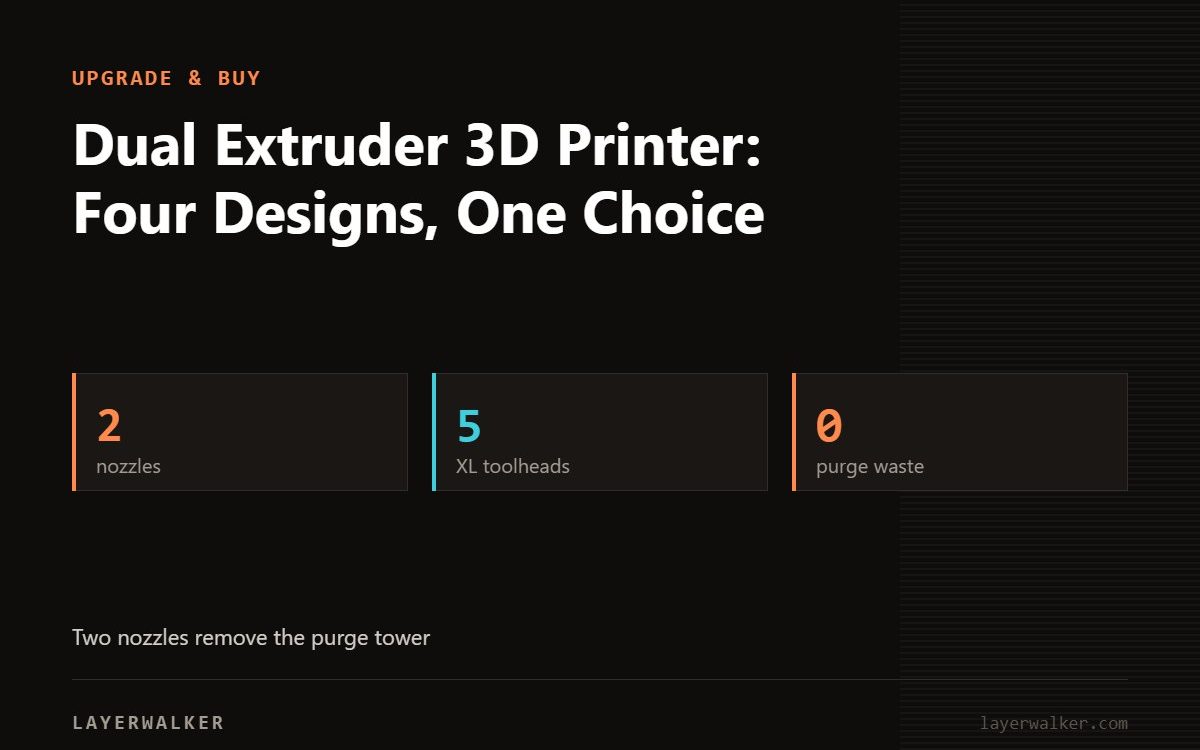
“Dual extruder” now covers four different designs, and picking the wrong one is the usual mistake. A filament changer feeds many spools into one hotend, cheap and good for colour but it purges at every change. A dual-nozzle machine keeps two materials loaded permanently, which is what you want for support material. An IDEX printer puts two extruders on independent carriages, which adds duplicate and mirror modes. A tool changer swaps whole toolheads, up to five, so every material keeps its own temperature. Decide which problem you are solving first.
The term survives from an era when two extruders on one carriage was the only option. Today the question is not whether a machine has two extruders but how it handles the second material, and the four answers behave very differently.
Where to buy


The four designs
| Design | How it works | Best for | Weakness |
|---|---|---|---|
| Filament changer | Several spools feed one hotend via a hub | Multi-colour models | Purges material at every change; all filaments share one temperature |
| Dual nozzle | Two nozzles on one toolhead, held under 25 microns apart on the Bambu H2D | Build plus support material, two materials at once | Costs build volume; the auxiliary nozzle is often more limited |
| IDEX | Two extruders on independent carriages | Duplicate and mirror printing, soluble supports | Wider machine; calibration between carriages |
| Tool changer | Whole toolhead swapped, up to five on the Prusa XL | Several materials each at its own temperature, no purge | Most expensive; several hotends to maintain |
Match the design to the job
You want multi-coloured models. A filament changer is the right answer and the cheapest. Bambu’s AMS chains four units for sixteen filaments on P1 and X1 machines; Creality’s CFS does the same on the K2 and Hi. Accept the purge waste, which is real: every change discards material.
You want dissolvable or snap-away supports. This is where a shared hotend hurts, because support material and build material rarely want the same temperature. A dual-nozzle or tool-changing machine keeps them separate. The Bambu H2D holds its two nozzles under 25 microns apart and reaches 350 degC, with a 65 degC heated chamber; the Prusa XL swaps toolheads entirely with no purge block at all.
You want two of the same part at once. That is IDEX territory: independent carriages allow duplicate mode, where both extruders print the same object simultaneously, and mirror mode. See our IDEX page.
You want several engineering materials in one part. Tool changing, because each toolhead keeps its own nozzle, its own temperature and its own wear profile. The Prusa XL takes one to five toolheads on a 360 x 360 x 360 mm plate.
The purge question, in numbers you can reason about
Every colour change on a single-hotend system flushes the old material through. On a model with a hundred colour changes, that adds up to a visible pile of waste, and in an expensive filament it is the dominant cost of the print. That is the single strongest argument for a dual-nozzle or tool-changing machine if your second material is functional rather than decorative.
Conversely, if you print mostly single-colour and want colour occasionally, a changer is far cheaper and the waste is an occasional annoyance rather than a running cost. Our page on multi-colour printing covers the practicalities.
What about older twin-extruder machines
Classic designs put two hotends side by side on one carriage. It worked, but the idle nozzle oozes, collides with the part and drags material, and the offset between nozzles has to be calibrated by hand. That is why the market moved on. If you are looking at a used machine of that type, know that the modern designs above exist specifically because of those problems, and that older enclosed workhorses such as the Flashforge Creator Pro are no longer sold; see our Creator Pro page.
Our dual-nozzle page covers the current two-nozzle machines in detail.
Beyond two extruders
Dual extrusion is a compromise worth naming: two nozzles share one gantry, so the idle nozzle stays in the print area, still oozes, and still has to be parked and wiped. Most of the firmware complexity in a dual machine exists to manage that.
The Original Prusa XL removes the compromise rather than managing it, with up to five toolheads that physically dock out of the way. It costs several times what a dual-extruder printer does. Buy it only if material changes are the job itself — for occasional two-material work, a dual setup at a fraction of the price is the rational choice.
Dual extruder 3D printer FAQ
Is a filament changer a dual extruder?
No. It feeds several filaments into one extruder, so all of them share one nozzle and one temperature.
What is best for dissolvable supports?
A dual-nozzle or tool-changing machine, so the support material keeps its own hotend and temperature.
What is duplicate mode?
Two independent carriages printing the same object at the same time, an IDEX-only capability.
Which wastes the least filament?
A tool changer, because there is no purge between materials.

LayerWalker
Print defect diagnosis, calibration procedures and parts that actually fit. Corrections welcome through the contact page.