MSLA 3D Printer: The Process You Actually Buy
LayerWalker is a participant in the Amazon Services LLC Associates Program. We may earn a commission when you buy through links on our site, at no extra cost to you.
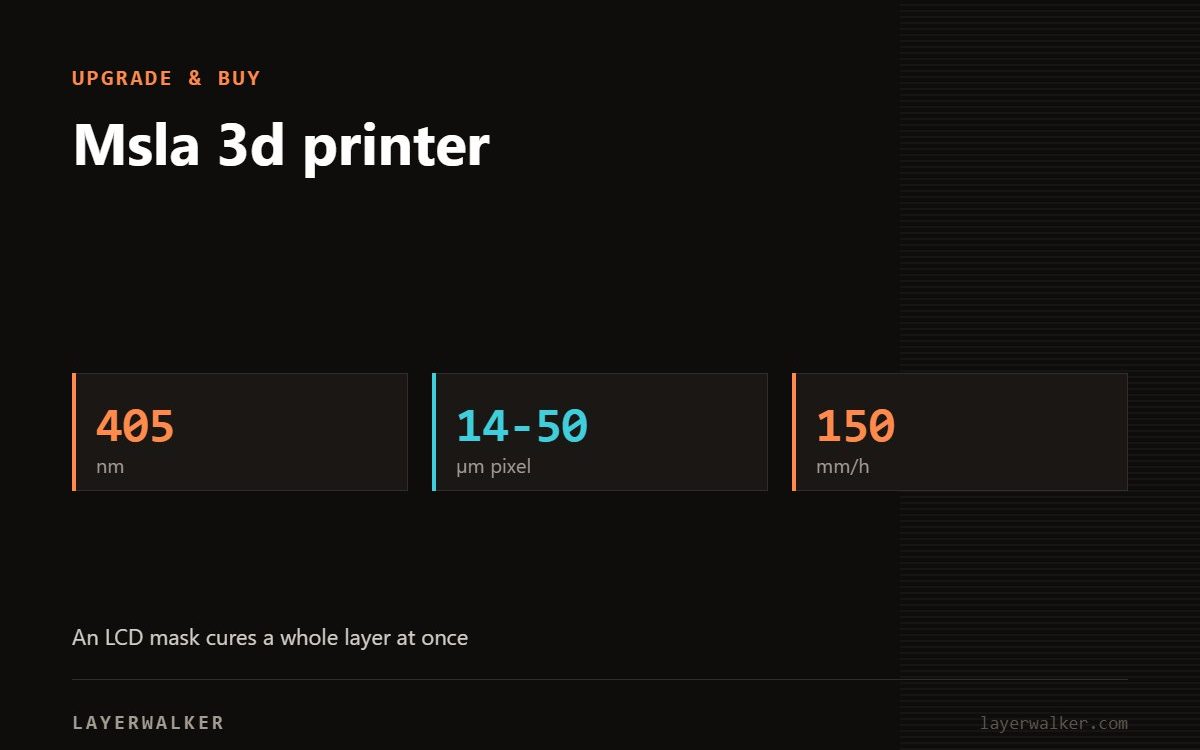
MSLA means masked stereolithography: a monochrome LCD sits between a UV light source and the resin tank and masks each layer, so the whole layer cures in one exposure. Every affordable resin printer sold today is MSLA, not laser SLA and not DLP. The practical consequence is that print time depends on height only, and resolution is set by the panel: a 7-inch 9K panel at 8520 x 4320 gives 18 micron pixels, and 10-inch 12K panels reach 11520 x 5120.
The three acronyms get used interchangeably in listings, which is unhelpful because they describe genuinely different hardware. This page is about the one you will actually buy.
Where to buy


MSLA against SLA and DLP
| MSLA | Laser SLA | DLP | |
|---|---|---|---|
| Light source | UV LED or COB array, 405 nm | Single UV laser | Projector lamp or LED |
| How a layer forms | LCD masks the whole layer, one exposure | Laser traces the outline and fill | DMD mirror chip projects the layer |
| Resolution set by | LCD pixel pitch | Laser spot size and optics | Projector chip and throw distance |
| Time per layer | Fixed, regardless of area | Grows with area | Fixed |
| Consumable | The LCD panel itself wears out | Laser and galvos | Projector lamp |
| Desktop price | Low | High | Mid to high |
The reason MSLA won the desktop market is that a mono LCD is cheap and a whole layer cures at once. The reason it is not the end of the story is that the panel is a wear item: it is in the light path, it heats, and it degrades. Budget for a replacement in the machine’s lifetime.
Our SLA page and DLP page cover the other two processes.
Reading an MSLA specification properly
Four numbers matter, in this order.
Panel resolution and size, together. A 9K panel means nothing on its own; what matters is pixels divided by screen width. A 7-inch 9K panel at 8520 x 4320 works out to 18 micron pixels in XY. A 10-inch 12K panel at 11520 x 5120 spreads more pixels over more area. Always compute the pixel pitch rather than trusting the K number.
Build volume. Directly tied to panel size: a 7-inch class machine gives roughly 153 x 78 x 165 mm, a 10-inch class machine roughly 219 x 123 x 220 mm.
Layer thickness and Z accuracy. 0.01 to 0.2 mm layers and 0.02 mm Z accuracy are current figures for a good machine.
Vertical speed. Quoted in mm per hour, because that is the honest unit for a process where area is free. 150 mm/h is a strong figure; some machines quote different numbers for standard and high-speed resin, such as 130 mm/h against 170 mm/h.
The light engine and the release mechanism
Two features separate current machines from older ones. A COB light source with a Fresnel collimating lens gives more even, more parallel light than a bare LED array, which shows up as consistent detail at the edges of the plate rather than just the middle.
And tilt release, where the tank tilts to peel the part off the film instead of pulling straight down, reduces the suction force on every layer. That is what allows high vertical speeds without tearing parts off supports.
Where the K number finally earns its keep
The pixel-pitch rule has an awkward consequence: on a large screen, a high K number is not a luxury, it is the minimum for the machine to be usable at all. The Photon Mono M7 Max spreads a 7K panel across 13.6 inches and lands near 46 micron pixels, which is coarser than the 18 micron pitch of a 7-inch 9K machine. Buy it for the envelope and you accept detail closer to a fine FDM print than to a miniature printer.
That is the gap the Elegoo Jupiter 2 is built to close. It offers 302.4 × 161.98 × 300 mm — essentially the same plate width as the M7 Max — but drives it with a 16K panel rather than a 7K one, which is what pulls the pitch back down into useful territory. Two machines in the same size class, and the panel is the only thing separating detail work from rough shells. That is the rule in its clearest form: divide pixels by screen width, and ignore the K number on its own.
Whether the trade is worth it depends entirely on what you put on the plate. If your parts are under 150 mm, a 7-inch or 10-inch machine gives you the same pitch for far less. The large panels are for people who need the area and the detail at once, which is a narrower group than the marketing suggests. Our large-format printer page covers the same decision on the filament side, where the economics work out very differently.
What owning one is really like
The printer is the cheap part. Every print ends with draining, washing in isopropyl alcohol, UV curing, support removal and disposal of contaminated alcohol, all in nitrile gloves, because uncured resin is a sensitiser. Add tank film as a consumable alongside the LCD panel.
Plan ventilation from the start. Our pages on getting started with resin and resin enclosures cover the bench you need around the machine, and SLA vs FDM is the comparison to read if you have not settled on resin at all.
MSLA 3D printer FAQ
Is MSLA the same as SLA?
No. MSLA masks a whole layer with an LCD; laser SLA traces it with a beam. Almost all affordable resin printers are MSLA.
Does a full plate print slower?
No. Each layer cures in one exposure, so time tracks height only.
What does 9K or 12K actually mean?
Pixel count, which is meaningless without the screen size. Compute pixel pitch: a 7-inch 9K panel gives 18 microns.
What wears out?
The LCD panel and the tank film, both in the light and mechanical path.

LayerWalker
Print defect diagnosis, calibration procedures and parts that actually fit. Corrections welcome through the contact page.