SLA, MSLA and DLP Resin Printers Explained, and Which to Buy
LayerWalker is a participant in the Amazon Services LLC Associates Program. We may earn a commission when you buy through links on our site, at no extra cost to you.
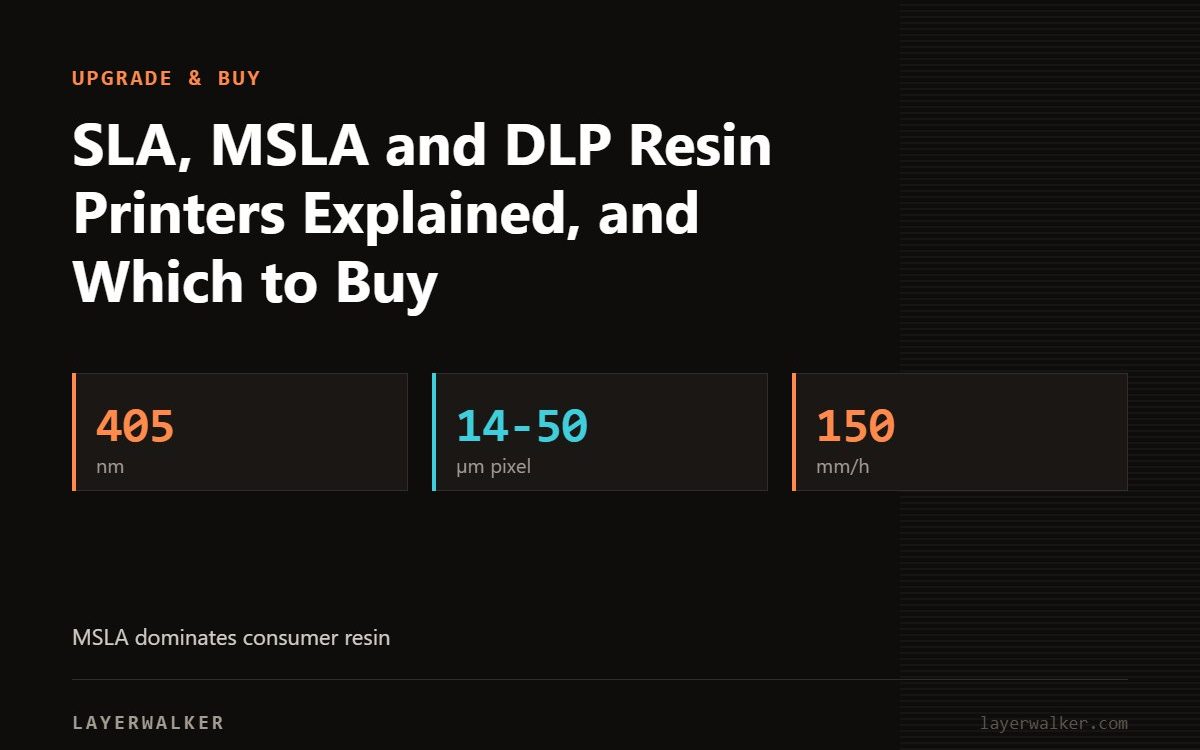
“SLA printer” in consumer use almost always means MSLA: a UV LED array shining through a monochrome LCD that masks each layer, curing resin in a vat. True SLA scans a laser point (Formlabs); DLP projects each layer with a micromirror chip. All three produce the same class of part: fine detail, smooth surfaces, brittle standard resins. The mainstream buys are MSLA: Elegoo Mars 5 Ultra (7-inch), Saturn 4 Ultra (10-inch) and Anycubic M7 Max (13.6-inch). Every one needs wash, cure and ventilation.
Uncured resin is a skin and respiratory irritant. Wear nitrile gloves and eye protection, ventilate the room or vent the printer outdoors, wash parts in IPA in a covered container, and fully cure before handling. Never pour resin or IPA wash down a drain.
Where to buy


The three technologies
| Technology | Light source | Layer exposure | Resolution | Consumer availability | Notes |
|---|---|---|---|---|---|
| SLA | UV laser, galvo mirrors | Traced point by point | Spot size ~85 µm; very smooth | Formlabs class; expensive | Slow on large solid layers; best surface |
| MSLA | UV LED array through mono LCD | Whole layer at once | Pixel: 14 to 50 µm | Elegoo, Anycubic, Phrozen, Creality | Dominant; LCD is a consumable (1000+ hours) |
| DLP | UV projector, DMD chip | Whole layer at once | Pixel size grows with build area | Few consumer models | No screen wear; voxel edges visible at size |
Why consumer printers are MSLA
Mono LCDs became cheap and fast: 2 to 3 second layer exposures, 8K to 16K resolution, and tilt-release mechanisms pushing 150 mm/h. DLP holds its own in small dental-class machines; laser SLA remains a professional choice. For a hobbyist the question is not which technology but which size of MSLA. See resin vs filament first if you are unsure resin suits your parts.
MSLA printers by size
| Printer | Build volume | Screen | XY pixel | Notes |
|---|---|---|---|---|
| Elegoo Mars 5 Ultra | 153 × 78 × 165 mm | 7-inch 9K | 18 µm | Tilt release, auto level |
| Phrozen Sonic Mini 8K S | 165 × 72 × 180 mm | 7.1-inch 8K | 22 µm | Manual level; miniature reputation |
| Anycubic Photon Mono 4 | About 153 × 87 × 165 mm | 7-inch 10K | About 17 µm | Budget |
| Elegoo Saturn 4 Ultra | 218.88 × 122.88 × 220 mm | 10-inch 12K | 19 × 24 µm | The default 10-inch |
| Anycubic Photon Mono M7 Pro | 223 × 126 × 230 mm | 10.1-inch 14K | 16.8 × 24.8 µm | Heated vat |
| Anycubic Photon Mono M7 Max | 298 × 165 × 300 mm | 13.6-inch 7K | About 46 µm | Large; coarser pixels |
| Elegoo Jupiter 2 | 302.4 × 161.98 × 300 mm | 16K | — | Large format; heated tank, auto resin feed |
When the 10-inch class runs out
The three machines above are one per size class, and for most people the 10-inch class is the end of the line. The step past it is not a slightly bigger 10-inch machine but a different category. The Elegoo Jupiter 2 puts 302.4 × 161.98 × 300 mm on the plate: roughly two and a half times the volume of a Saturn 4 Ultra, and a plate area close to double.
That envelope is worth paying for in exactly two situations. The first is a single part that genuinely does not fit — a helmet shell, a bust, a terrain piece you would otherwise cut and glue. The second is batch work, because an MSLA layer cures in one exposure regardless of how much of the plate is covered: filling a plate twice the size costs nothing in time. That is the whole argument for large-format resin in a production setting, and the Jupiter 2 leans into it with a heated tank, automatic resin feeding from the bottle and cluster control over Wi-Fi.
What large format does not do is make resin cheaper or more forgiving. A failed print on a plate that size wastes several times the resin, the tank film costs more to replace, and the wash and cure stations have to grow to match. The bench, not the printer, is what usually stops people. If you print miniatures and nothing else, the money is better spent on the right resin than on plate area you will never fill.
What every resin printer needs
A wash station, a cure station, IPA or water-washable resin, gloves, and a ventilation plan. See the Saturn 4 Ultra page and resin types.
The units in the box
The listings are the Mars 5 Ultra, the Saturn 4 Ultra and the Photon Mono M7 Max, one per size class, plus the Jupiter 2 for the large-format case above.
SLA 3D printer FAQ
Is a Formlabs true SLA better?
Smoother surfaces and better material library, at many times the price.
How long does an LCD last?
Manufacturers quote about 1000 to 2000 hours; it is a replaceable part.

LayerWalker
Print defect diagnosis, calibration procedures and parts that actually fit. Corrections welcome through the contact page.