Resin vs Filament 3D Printer: Which One to Buy for What You Actually Print
LayerWalker is a participant in the Amazon Services LLC Associates Program. We may earn a commission when you buy through links on our site, at no extra cost to you.
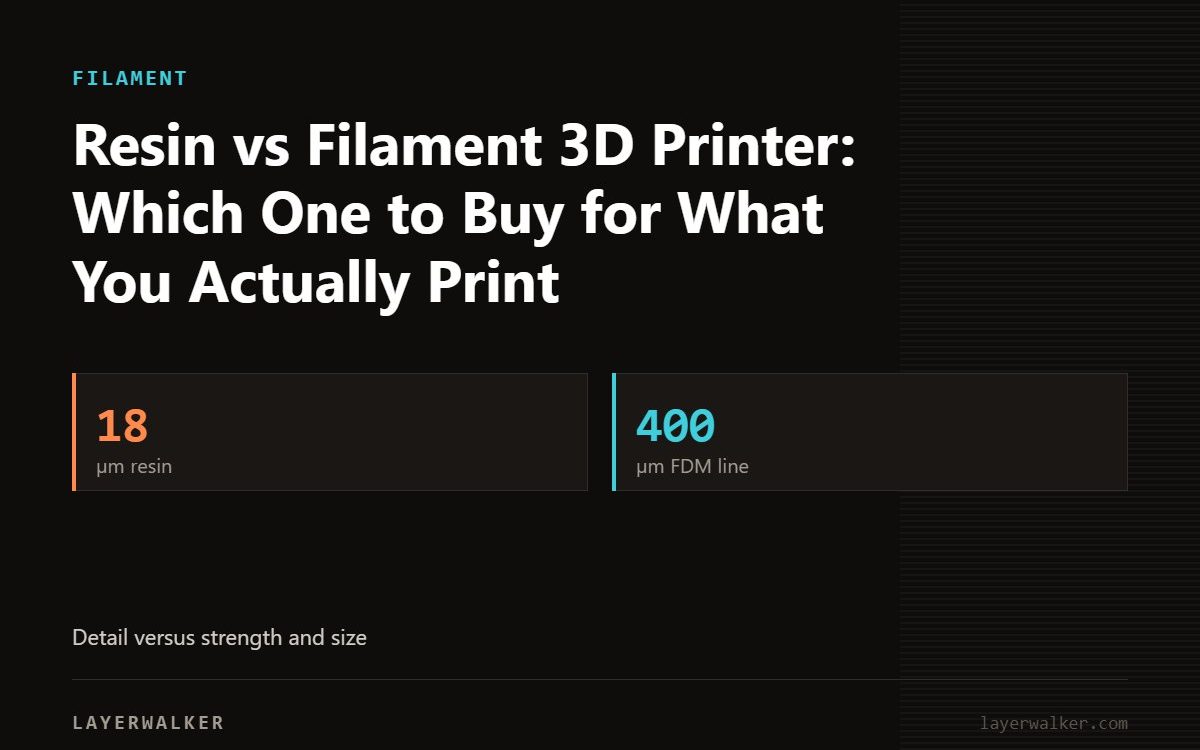
Buy a filament (FDM) printer if you want functional parts, anything larger than a fist, low running cost and a machine you can leave in a living space. Buy a resin (MSLA) printer if you print miniatures, jewellery masters or anything where detail below 0.1 mm matters, and you have a ventilated space and tolerance for gloves and alcohol.
The two technologies are not competitors so much as different tools. A filament printer melts a plastic strand and draws the part in 0.1 to 0.3 mm lines; a resin printer hardens a liquid with a UV screen in 0.02 to 0.05 mm layers. That gap in layer height is why resin miniatures look cast and filament miniatures look printed, and it is also why resin parts are small, brittle and messy to make.
Where to buy


Where each one wins
| Filament (FDM) | Resin (MSLA) | |
|---|---|---|
| Detail | Layer lines visible; fine for parts, poor for 28 mm miniatures | Cast-quality surface; the reason it exists |
| Part size | 220 to 350 mm cubes are normal | Most consumer units print under 200 mm tall and 130 mm wide |
| Strength | PETG, ASA and nylon make usable mechanical parts | Standard resin is brittle; tough resins help but do not match filament |
| Running cost | Filament by the kilogram; almost no consumables | Resin, isopropyl alcohol, gloves, FEP film, paper towels |
| Mess and safety | Fumes from ABS/ASA only; otherwise a living-room machine | Skin sensitiser, alcohol wash, UV cure, hazardous waste; needs its own space |
| Post-processing | Snap off supports, done | Wash, cure, remove supports, sand marks; 20 to 40 minutes per batch |
| Materials | Rigid, flexible, fibre-filled, heat-resistant; wide range | Standard, tough, flexible, castable, dental; all rigid-ish photopolymers |
Decide by what you will print
- Miniatures, busts, jewellery, dental, display models: resin. A filament printer will disappoint you at this scale.
- Brackets, enclosures, replacement parts, cosplay armour, large props: filament. Resin cannot print the size and the parts would shatter.
- A first printer for a household: filament. Lower risk, fewer consumables, and PLA is safe to handle.
- Both eventually: most serious hobbyists end up with one of each. Start with the one your first three projects need.
What people underestimate about resin
The printer is the cheap part. Budget for a wash-and-cure station, a litre of 91 % isopropyl alcohol every few weeks, nitrile gloves by the box, replacement FEP film, a ventilated room and a place for curing waste in sunlight. The support and exposure tuning also takes a few evenings. None of this is hard; all of it is time and money the spec sheet does not show.
What people underestimate about filament
Moisture. Every material except PLA needs drying before it prints well, and the first month of a filament printer is mostly learning first-layer adhesion. After that it is the more forgiving machine.
The two machines this comes down to
Once the technology question is settled the shortlist gets short, because each side has a machine that has become the default answer. On the filament side it is an enclosed CoreXY with multi-material feeding: enclosed because that is what lets you run ABS and ASA rather than only PLA, and multi-material because the moment you have it you stop designing around single colours. On the resin side it is a Saturn-class MSLA with tilt release, the mechanism that peels each layer off the film instead of pulling it straight down, which is what lets current machines run fast without tearing parts loose.
Two things are worth knowing before you compare what they cost. The first is that the resin machine is not the whole bill: a wash station, a cure station, gloves, alcohol and a ventilation plan are not optional extras, and together they close much of the gap between the two. The second is that resin is sold by the kilogram like filament but behaves nothing like it once opened, which is why a bottle sits next to the machines below rather than as an afterthought. Our process comparison covers the engineering differences, and the resin page covers what to actually pour in.
Resin vs filament 3D printer FAQ
Can a filament printer do miniatures at all?
With a 0.2 mm nozzle and 0.08 mm layers, passable 54 mm figures. At 28 mm, resin is the only option that looks right.
Is resin printing dangerous?
With gloves, ventilation and cured waste, it is manageable. Without them, sensitisation to resin is real and permanent.
Which is cheaper per part?
Filament, by a wide margin, once you count alcohol, gloves and failed resin prints.

LayerWalker
Print defect diagnosis, calibration procedures and parts that actually fit. Corrections welcome through the contact page.