SLA vs FDM 3D Printer: Accuracy or Strength?
LayerWalker is a participant in the Amazon Services LLC Associates Program. We may earn a commission when you buy through links on our site, at no extra cost to you.
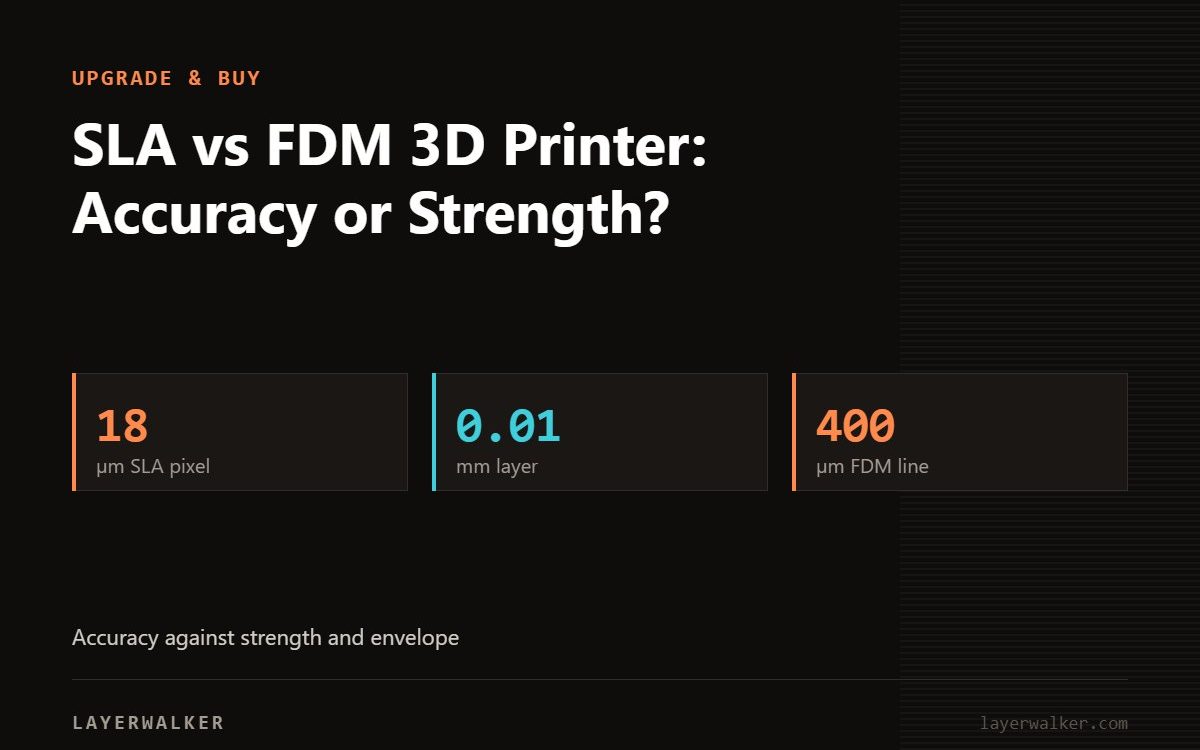
SLA resolves features a nozzle cannot: 18 micron pixels in XY and layer thickness down to 0.01 mm, with the same print time whether the plate holds one part or twelve. FDM gives you isotropic-enough parts in tough engineering materials, a far bigger envelope, and no wet post-processing. Pick SLA for accuracy and surface finish on small parts; pick FDM for mechanical properties, size and throughput per hour of your own labour.
This is the process-level comparison: what each technology can hold to, where each one fails, and how to choose when you have a drawing with tolerances on it rather than a model you liked on Printables. If you are deciding which machine to buy for a hobby, our resin printer versus filament printer guide is the shopping version of this page.
The two processes differ in one fundamental way, and every practical consequence follows from it: FDM builds a layer with a moving nozzle, SLA builds a layer all at once with light.
Where to buy


How each process forms a layer
FDM extrudes molten thermoplastic through a nozzle, usually 0.4 mm, and draws the layer as a path. Bond strength between layers depends on the previous layer still being hot enough to fuse, which is why chamber temperature matters so much for ABS, ASA and nylon. Modern enclosed machines hold a 60 degC chamber and reach 300 to 350 degC at the nozzle for that reason.
Modern SLA is really MSLA: a monochrome LCD masks UV light from a COB source and cures an entire layer in one exposure, then the plate separates and lifts by one layer height. Because the exposure is areal, cycle time is a function of Z height only. Twelve parts on a full plate cost the same time as one.
Accuracy and surface finish
SLA’s advantage here is not marginal. A 7-inch 9K panel at 8520 x 4320 gives 18 micron pixels in XY, with layer thickness selectable from 0.01 to 0.2 mm and Z accuracy quoted at 0.02 mm. Larger 12K panels reach 11520 x 5120 across a 10-inch screen. Features smaller than an FDM nozzle width simply exist in SLA and do not in FDM.
FDM’s floor is geometric: extrusion width sets the smallest wall, and the layer stack is visible unless you post-process. You can improve it with a 0.2 mm nozzle and thin layers, at a large cost in time, and you will still not resolve 18 micron detail.
Surface finish follows the same pattern. An SLA part comes off the plate smooth enough to prime and paint. An FDM part shows layer lines, and the seam has to be placed deliberately. Our notes on seam position and smooth versus textured plates cover the FDM side of finish control.
Mechanical properties: where FDM earns its place
This is the axis that reverses the verdict. FDM materials cover PLA, PETG, TPU, ABS, ASA, PC, nylon and carbon or glass-filled blends, which gives you real choices about stiffness, impact resistance, heat deflection and flexibility. FDM parts are anisotropic, weaker across layers than along them, and you design around that by orienting the part so loads run in-plane.
Standard cured photopolymer is hard, dimensionally excellent and comparatively brittle, especially in thin sections, and it continues to cure and yellow under UV. Tough and ABS-like resins narrow the gap but do not close it for parts that must flex repeatedly or hold a threaded fastener. If the part will be tested to failure, loaded in service, or left in a hot car, FDM in an engineering filament is the safer specification.
Envelope and throughput
| SLA / MSLA | FDM | |
|---|---|---|
| Typical desktop envelope | 153 x 78 x 165 mm up to 219 x 123 x 220 mm | 256 x 256 x 256 mm up to 350 x 350 x 350 mm |
| XY resolution | 18 microns (9K panel) | set by nozzle, typically 0.4 mm |
| Layer height | 0.01-0.2 mm | 0.05-0.3 mm |
| Speed metric | up to about 150 mm/h of height | up to 500-600 mm/s of nozzle travel |
| Effect of nesting parts | None; time tracks height | Linear; every part adds path length |
| Post-processing | Wash in IPA, UV cure, support removal, waste disposal | Remove supports; usually nothing else |
Read that table as two different definitions of throughput. SLA wins on identical small parts in quantity, which is why miniature and jewellery workflows live there. FDM wins on large single parts and on total hours of human attention, because there is no wet bench at the end.
The large-format resin exception
The envelope row above describes the machines most people actually buy, and on that basis FDM wins the size argument outright. There is an exception worth knowing about, because it changes the answer for a narrow set of work: resin does go large. The Elegoo Jupiter 2 prints 302.4 × 161.98 × 300 mm, longer and taller than the 256 mm cube most enclosed FDM machines offer, though narrower across.
It does not overturn the conclusion, and it is worth being precise about why. A large-format resin machine costs more than twice what a comparable FDM envelope costs, and every process penalty in the table scales with the plate: a full plate of that size holds a lot of resin, a failure wastes all of it, and the wash and cure bench has to grow with it. What large format does buy is the one genuine advantage resin has over filament, made bigger. Layer time tracks height only, so a plate packed with fifty parts takes the same time as a plate holding one. On an FDM machine those fifty parts take fifty times as long.
So the rule holds, with a footnote. Choose FDM for large single parts. Choose large-format resin only when you need many detailed parts at once and the throughput arithmetic pays for the bench around it: casting patterns, dental and orthodontic models, short-run figure work. For anything else the standard resin-versus-filament comparison still applies.
Choosing for a specification
Choose SLA when tolerance and surface finish drive the part: casting masters, dental and orthodontic models, jewellery, connector housings for fit checks, anything under roughly 150 mm where detail is the deliverable. Accept the ventilation, the gloves and the consumables as part of the process cost.
Choose FDM when material properties drive the part: jigs and fixtures, brackets, enclosures, anything that takes heat or load, anything larger than a shoebox. Add a hardened nozzle before running carbon or glass-filled filament, and use an enclosed machine with a heated chamber for ABS, ASA and nylon so layer bonding is not the weak point. Our page on hardened nozzles for abrasive filament explains why brass is not an option there.
In a working shop the answer is usually both, with a clear rule for which job goes where. If you only get one, the material range and the absence of post-processing make FDM the more generally useful machine, and the SLA machine the specialist you add later.
If you go the resin route, the software side is much simpler than FDM — best resin printer slicer covers Chitubox, Lychee and the bundled forks.
SLA vs FDM 3D printer FAQ
Is SLA more accurate than FDM?
Yes, by a wide margin in XY and Z. An 18 micron pixel and 0.01 mm layers are not achievable with a 0.4 mm nozzle.
Is SLA stronger than FDM?
Generally no. Cured resin is harder and more precise but more brittle. Engineering filaments beat standard resins on impact, fatigue and heat resistance.
Why does a full SLA plate print in the same time as one part?
Each layer is cured by one areal exposure, so print time depends on the height of the tallest object, not on how many objects there are.
Which has the lower running cost?
FDM, in both consumables and labour. SLA adds isopropyl alcohol, tank film, gloves, curing and contaminated-waste disposal on every print.

LayerWalker
Print defect diagnosis, calibration procedures and parts that actually fit. Corrections welcome through the contact page.