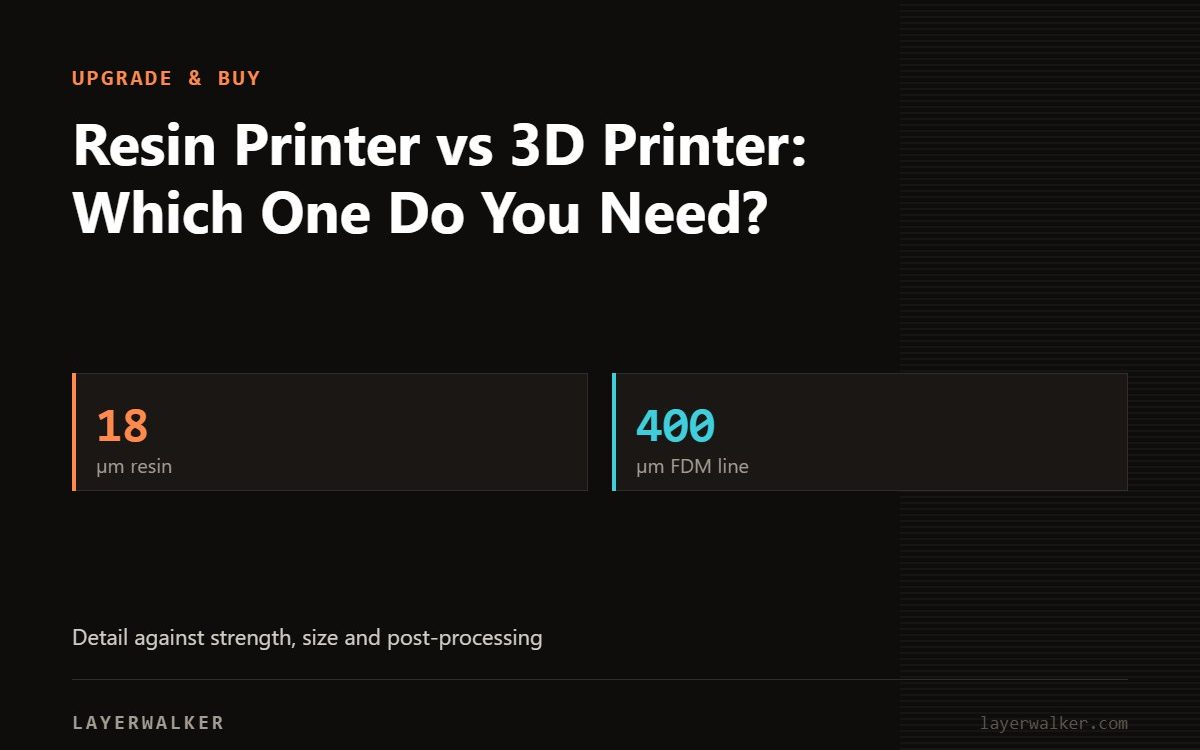
Resin Printer vs 3D Printer: Which One Do You Need?
LayerWalker is a participant in the Amazon Services LLC Associates Program. We may earn a commission when you buy through links on our site, at no extra cost to you.
A resin printer is a 3D printer. When people say “resin printer vs 3D printer” they mean resin (SLA/MSLA) versus filament (FDM). Buy resin if your parts are small and detail is the whole point: miniatures, jewellery masters, dental models. Buy filament for anything you will hold, screw into, or leave in a hot car. Filament is the better first machine for almost everyone, because resin adds a wet, gloved, ventilated workflow after every single print.
The phrasing trips up almost every beginner, and it is not their fault. Shops list “3D printers” in one aisle and “resin printers” in another, as if they were different categories of machine. They are not. Both build a part layer by layer from a digital file. What differs is the state the material arrives in and what has to happen after the printer beeps.
That second part decides whether you enjoy owning the thing. Below is how the two processes actually work, what each is genuinely good at, and the running costs that never appear on a spec sheet.
Where to buy


Both are 3D printers: the real split is resin versus filament
Filament machines (FDM, fused deposition modelling) melt a 1.75 mm plastic string and draw each layer with a moving nozzle. Resin machines (MSLA, the modern flavour of SLA) sit a tank of liquid photopolymer over an LCD panel and flash a whole layer of UV light at once, curing it against a build plate that lifts a fraction of a millimetre at a time.
That difference in how a layer forms explains nearly everything else. A nozzle has to travel, so an FDM print gets slower as the part gets wider. A resin layer cures all at once, so a resin print takes the same time whether you print one miniature or fill the plate with twelve. Its speed depends only on height.
SLA vs FDM: what you actually get
Resolution is where resin runs away with it. An Elegoo Mars 4 Ultra puts a 7-inch 9K mono LCD (8520 x 4320) behind the tank, which works out to 18 micron pixels in XY, with layer thickness set anywhere from 0.01 to 0.2 mm. No consumer FDM machine is in that conversation: its detail floor is set by nozzle width, typically 0.4 mm.
Build volume goes the other way. That same Mars 4 Ultra gives you 153 x 78 x 165 mm. A bigger resin machine like the Saturn 4 Ultra stretches to 219 x 123 x 220 mm with a 10-inch 12K panel (11520 x 5120) and prints up to 150 mm/h in height. Compare that with a mainstream enclosed FDM printer at 256 x 256 x 256 mm, running 500 mm/s and 20,000 mm/s2 accelerations. Resin gives you a shoebox of extraordinary detail; filament gives you a crate.
Materials are the third axis, and the one people underestimate. Filament covers PLA, PETG, TPU, ABS, ASA, nylon and carbon-fibre blends, which means parts that flex, take a thread, or survive heat. Cured resin is hard and precise but comparatively brittle, and it keeps aging in sunlight. Our resin vs filament breakdown goes deeper on the material properties themselves.
Where each one wins
| What you want to make | Better choice | Why |
|---|---|---|
| 28 mm miniatures, busts, terrain detail | Resin | 18 micron pixels resolve chainmail and faces a 0.4 mm nozzle simply cannot |
| Jewellery masters, dental and casting models | Resin | Dimensional accuracy and a surface that needs no smoothing |
| Brackets, jigs, replacement parts | Filament | Tough, threadable, heat-tolerant materials; large plate |
| Cosplay props and helmets | Filament | Volume per dollar; big pieces in fewer chunks |
| Toys and household prints with kids around | Filament | No liquid resin, no IPA, no gloves |
| Functional prototypes you will test to failure | Filament | Cured resin is brittle in thin sections |
If miniatures are the whole reason you are buying, read our notes on resin printers for miniatures and on how close a good FDM machine gets before you commit.
The running costs nobody puts on the spec sheet
An FDM print ends when the printer ends it. You flex the plate, the part pops off, you are done. A resin print ends with a plate covered in sticky photopolymer, and then the work starts: drain, wash in isopropyl alcohol, cure under UV, snap off supports, dispose of contaminated alcohol and paper. Every print. Nitrile gloves throughout, because uncured resin is a sensitiser and repeated skin contact is how people develop a permanent allergy to it.
Budget for the ongoing extras, not just the machine: alcohol, replacement FEP or ACF film in the tank, gloves, filters, and a wash-and-cure station unless you enjoy doing it in buckets. Resin also smells, so it wants a ventilated room or an enclosure that vents outside. Filament wants far less: dry storage and the occasional nozzle.
Which should you buy first
Buy a filament printer as your first machine unless every model you have saved is a miniature. It fails more gracefully, the consumables are cheap, a bad print costs you plastic instead of a tank of resin, and the material range means you can actually fix things around the house. Modern enclosed FDM machines also handle abrasive and engineering filaments once you fit a hardened nozzle.
Buy resin first only if you are certain about the use case: tabletop gaming, model kits, jewellery, or dental work. In that world, filament will disappoint you no matter how much you spend, and resin will delight you on day one, as long as you accept the post-processing bench that comes with it. Plenty of people end up owning both, and that is the honest end state for a serious hobbyist. If you are heading that way, our resin printer starting guide covers the setup you need around the machine.
The second machine, if resin wins
Owning both usually arrives in a particular order. People buy a filament printer, find a class of parts it cannot do well, add a small resin machine for those, and then discover the small resin machine is the one running every evening. If that is where you have landed, the next purchase deserves some thought, because the obvious move is the wrong one.
The obvious move is a second small resin printer. It doubles throughput and it doubles the bench work: two tanks to drain, two sets of film to replace, two plates to wash. The alternative is one large machine. The Elegoo Jupiter 2 prints 302.4 × 161.98 × 300 mm against the 218.88 × 122.88 × 220 mm of a Saturn 4 Ultra, roughly two and a half times the volume, and because an MSLA layer cures in a single exposure the bigger plate costs nothing in print time. One drain, one wash cycle, one film to change. It also feeds resin from the bottle automatically and heats the tank, removing two of the manual steps that make resin tedious at volume.
This is not an upgrade for someone printing a few miniatures a month. Running costs and failure costs both scale with plate size, and a large machine standing idle is worse value than a small one working. It is the right answer when the bottleneck has stopped being print time and started being your own hours at the wash station. If you are not there yet, the 10-inch class is still the sensible place to spend, and the process comparison is worth re-reading before you commit to more resin capacity at all.
Resin printer vs 3D printer FAQ
Is a resin printer really a 3D printer?
Yes. Resin (SLA/MSLA) and filament (FDM) are two additive processes; both are 3D printing. The shops just shelve them separately.
Is resin stronger than filament?
Harder and more precise, but generally more brittle. For a part that must flex, hold a screw, or take heat, filament materials like PETG, ABS/ASA and nylon are the safer answer.
Can one machine do both?
No. The processes need completely different hardware. Owning both is common; combining them is not a thing.
Does a resin print take longer if the plate is full?
No, and this is resin’s best trick. Each layer cures in one flash, so print time tracks height, not how many objects you nested on the plate.

LayerWalker
Print defect diagnosis, calibration procedures and parts that actually fit. Corrections welcome through the contact page.