Creality K2 Plus vs Bambu X1C: Size or Precision?
LayerWalker is a participant in the Amazon Services LLC Associates Program. We may earn a commission when you buy through links on our site, at no extra cost to you.
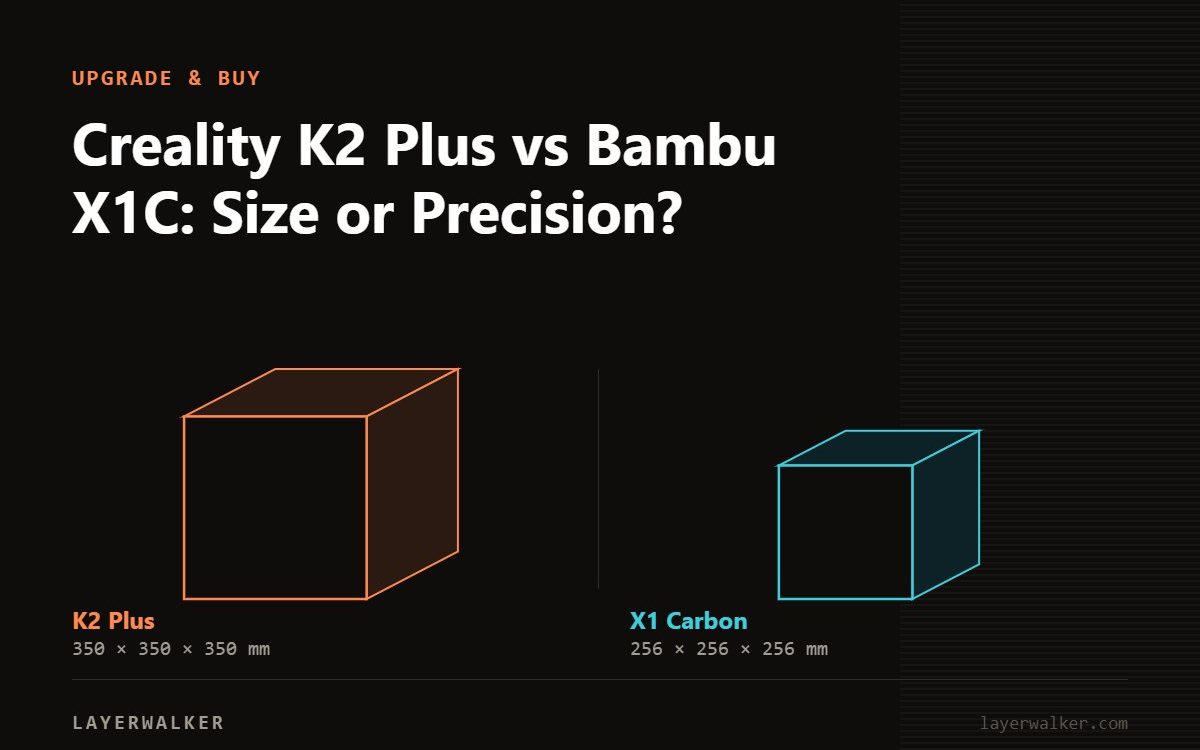
Buy the K2 Plus if you need volume: 350 x 350 x 350 mm, a 350 degC hotend and 30,000 mm/s2 acceleration, with CFS multi-colour that chains to four units. Buy the X1 Carbon if you need a compact, quiet, extremely well-calibrated machine that just works: 256 x 256 x 256 mm, lidar-based first-layer inspection, and the most mature slicer-to-printer pipeline on the market. Bigger box versus tighter tolerances, essentially.
These two rarely land on the same shortlist by accident. The K2 Plus is Creality reaching for the top of its own range with a large enclosed CoreXY, and the X1 Carbon is the machine that made Bambu Lab’s reputation. They overlap on price bracket and on the promise of enclosed, high-speed, engineering-material printing. They diverge on almost everything about how you would live with them.
Here is what the manufacturers’ own spec sheets say, and what those numbers mean once the door is closed.
Where to buy


Specs side by side
| Creality K2 Plus | Bambu Lab X1 Carbon | |
|---|---|---|
| Build volume | 350 x 350 x 350 mm | 256 x 256 x 256 mm |
| Max nozzle temp | 350 degC | 300 degC |
| Max bed temp | 120 degC | 120 degC |
| Chamber | up to 60 degC | 60 degC |
| Max speed | 600 mm/s | 500 mm/s |
| Max acceleration | 30,000 mm/s2 | 20,000 mm/s2 |
| Layer height | 0.05-0.3 mm | – |
| Weight | 35 kg | 14.13 kg |
| Footprint | 495 x 515 x 640 mm | – |
| Cameras | Two AI cameras (chamber + toolhead) | Live view plus 7 micron Micro Lidar |
| Multi-colour | CFS, up to 4 units = 16 filaments | AMS, up to 4 units = 16 filaments |
| Noise | Under 45 dB at 300 mm/s | – |
Build volume: the honest reason to pick the K2 Plus
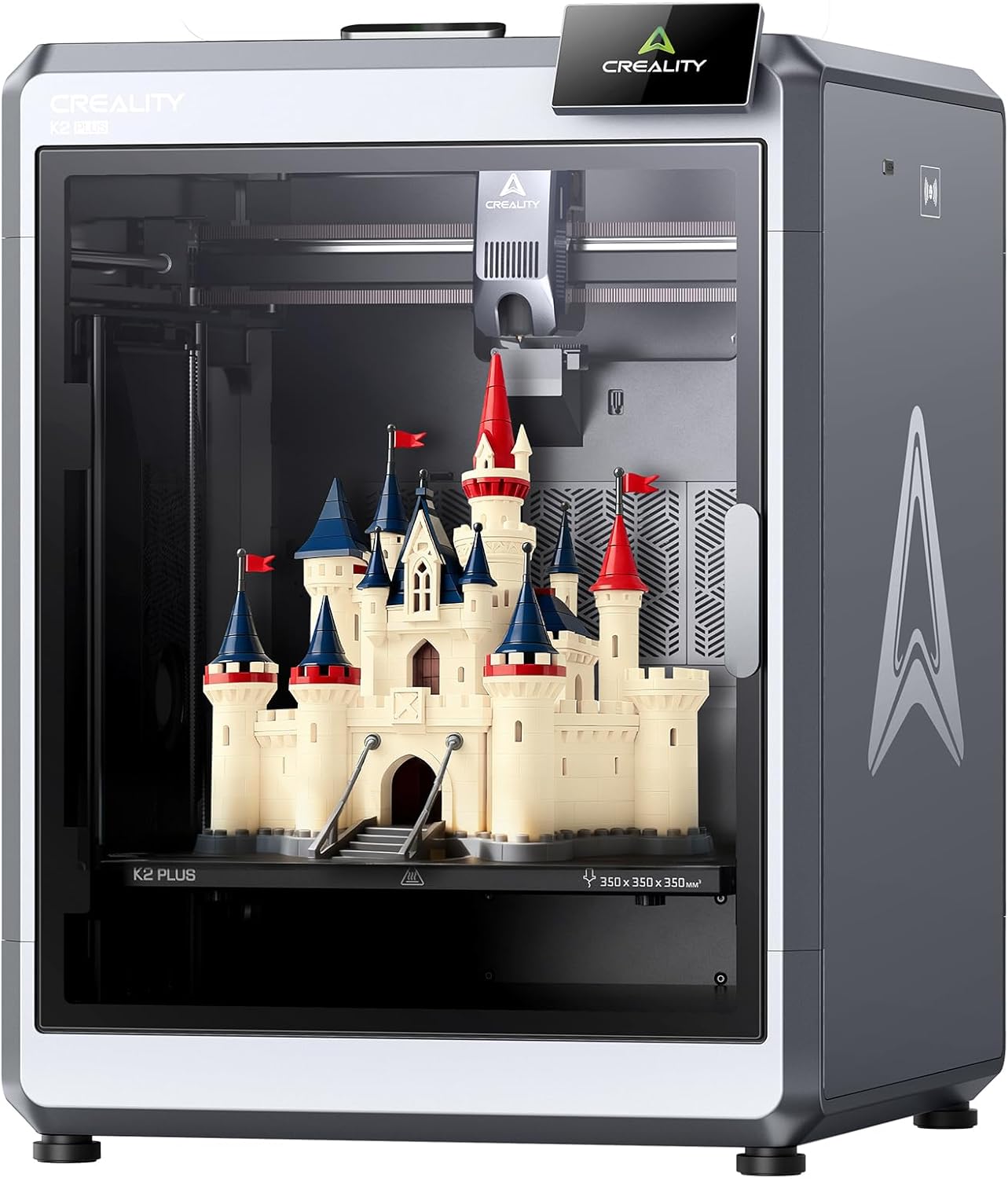
350 mm cubed against 256 mm cubed is not a marginal difference. In volume terms the K2 Plus gives you roughly two and a half times the space, and the extra height is what you notice first: helmets, large planters and tall functional parts fit in one piece instead of being cut and glued. If your saved models keep bumping the ceiling of a 256 mm box, that alone settles the argument. Our K2 Plus overview goes into what the frame does to keep that size rigid.
The cost of that box is mass and desk space: 35 kg and a 495 x 515 x 640 mm footprint, and taller again if you stack the CFS unit on top. The X1 Carbon is 14.13 kg. One of these you can move alone; the other you plan a spot for.
Speed, acceleration and what they mean in practice
On paper the K2 Plus wins both: 600 mm/s and 30,000 mm/s2 against 500 mm/s and 20,000 mm/s2. Creality also quotes step-servo motors, active belt tensioning and active bed tilt calibration, which is what a large gantry needs if it is going to accelerate that hard without ringing.
In practice neither machine prints most parts at its headline number, because flow rate and cooling become the limit long before the motion system does. Where the X1 Carbon claws it back is in not needing you to care: the 7 micron Micro Lidar scans the first layer and measures flow, so calibration is something the printer does rather than something you schedule. That reliability, not the top speed, is what people actually buy an X1 Carbon for.
Materials and the chamber
Both are enclosed with an active chamber at 60 degC, which is the temperature that matters for ABS, ASA and nylon. The K2 Plus goes further on the hotend: 350 degC against 300 degC, and its supported list includes PA-CF, PLA-CF, PET, ASA and PPA-CF. That extra 50 degC opens the door to higher-temperature engineering blends.
The X1 Carbon ships with a hardened steel nozzle as standard, which is the right default for abrasive filament. Either way, if carbon-fibre or glass-filled material is the plan, budget for spare hardened nozzles from the start, because abrasive filament eats brass in tens of hours, not hundreds.
Multi-colour: CFS versus AMS
The numbers match: four units, sixteen filaments, on both systems. The difference is maturity and the details. Bambu’s AMS has had several years and several revisions of public use, including RFID filament identification and, on the AMS 2 Pro, active drying up to 65 degC. Creality’s CFS also reads RFID filament, detects run-out and tangles, and relays automatically between spools; each CFS unit is 379 x 314 x 276 mm and 4.56 kg, holds four spools, and includes 20 W of drying.
Note the practical footnote on both: a combo box gets you one unit. Sixteen colours means buying three more, plus power for them.
Which one to buy
Choose the K2 Plus when the parts are big, when 350 degC and PPA-CF-class materials are on your list, or when you want the largest enclosed CoreXY you can put on one bench. Choose the X1 Carbon when 256 mm is enough, when the machine has to be quiet and compact next to you, and when you would rather spend your evenings printing than calibrating. Our X1 Carbon page covers the ecosystem in more detail, and if you are weighing the Creality range internally, K1 Max vs K2 Plus is the closer comparison.
One buying note: Bambu sells the A1, P1S and P2S through Amazon, but the X1 Carbon is generally a direct purchase from Bambu Lab. The Bambu machine in the box below is the P2S Combo, which is the closest enclosed Bambu you can buy alongside the K2 Plus in one order.
Creality K2 Plus vs Bambu X1C FAQ
Is the K2 Plus faster than the X1 Carbon?
Its ceiling is higher, 600 mm/s and 30,000 mm/s2 against 500 mm/s and 20,000 mm/s2. Real print times are closer than that, because both are limited by melt flow and cooling.
Can both print carbon fibre?
Yes, both are enclosed with a 60 degC chamber. The K2 Plus reaches 350 degC at the nozzle against 300 degC, so it covers more of the high-temperature blends. Use a hardened nozzle on either.
Which is quieter?
Creality quotes under 45 dB at 300 mm/s for the K2 Plus. Bambu does not publish a comparable figure for the X1 Carbon, so treat this as unverified rather than a win for either.
Do I need the combo version?
Only if you want multi-colour or automatic filament switching. Both combos include a single four-slot unit; more colours mean more units.

LayerWalker
Print defect diagnosis, calibration procedures and parts that actually fit. Corrections welcome through the contact page.