Prusa XL vs Bambu H2D: Toolchanger or Dual Nozzle for Serious Multi-Material
LayerWalker is a participant in the Amazon Services LLC Associates Program. We may earn a commission when you buy through links on our site, at no extra cost to you.
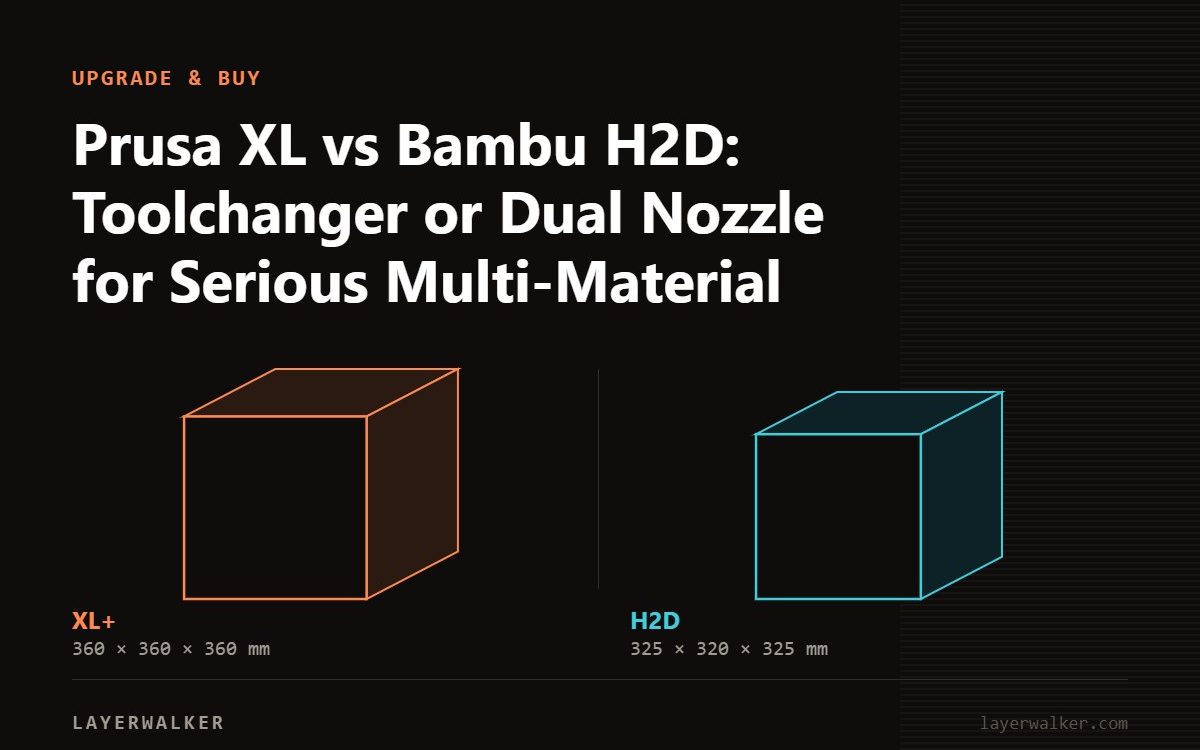
The XL is a platform: 360 × 360 × 360 mm, one to five swappable toolheads, open source, an optional enclosure to 50 °C (60 °C with a heater). The H2D is an appliance: 325 × 320 × 325 mm, two fixed nozzles, 350 °C, a 65 °C heated chamber standard, cameras everywhere and laser editions. For three or more materials or the biggest bed, the XL. For engineering filaments with two materials and the least setup, the H2D. Both are workshop money.
Where to buy


Side by side
| Spec | Prusa XL+ | Bambu H2D |
|---|---|---|
| Build volume | 360 × 360 × 360 mm | 325 × 320 × 325 mm single; 300 × 320 × 320 mm dual |
| Tools / nozzles | 1 to 5 toolheads, add later | 2 fixed nozzles |
| Material changes | Head swap, no purge | Nozzle switch, no purge between the two |
| Max nozzle temperature | 290 °C per head | 350 °C |
| Max bed temperature | 120 °C segmented | 120 °C |
| Chamber | Optional enclosure 50 °C; 60 °C with heater | 65 °C active, standard |
| Nozzle sizes per job | Any mix across heads | Two |
| Cameras | Optional | Live, nozzle, toolhead; vision encoder option |
| Laser / cutting | No | Optional 10 W or 40 W laser editions |
| Firmware | Open source | Proprietary |
| Amazon US | Marked-up listings; direct preferred | No; Bambu direct |
Where the XL wins
- More than two materials. Five heads means model, two supports, TPU and a colour in one job with zero purge.
- Nozzle mixing. 0.25 mm detail head and 0.8 mm infill head.
- Volume. 47 litres and a segmented bed that heats only where the part is.
- Openness and longevity. Printed parts, published firmware, Prusa support.
Where the H2D wins
- Materials out of the box. 350 °C and a 65 °C chamber standard; the XL needs the enclosure and heater add-ons to approach it and stops at 290 °C without a high-temperature hotend.
- Setup and monitoring. Vision-based calibration, three cameras, flame sensors.
- Laser and cutting in the same footprint.
- Two-material jobs swap faster than a toolchanger dock.
Decision
Count materials per job. Two: H2D, unless you need 360 mm or open source. Three or more, or a print farm standardised on Prusa: XL. Neither is for multi-colour PLA; a Combo does that for far less. See the XL page, the H2D page and dual nozzle printers for the wider field.
The units in the box
The H2D is Bambu direct. The listings are the Prusa XL with one toolhead, the Bambu P2S Combo as the Amazon-listed Bambu, and the AMS 2 Pro the H2D uses.
Prusa XL vs Bambu H2D FAQ
Can the XL reach 65 °C?
With the enclosure and external heater add-on, up to 60 °C.
Is the H2D faster?
Sustained flow is higher with its high-flow hotend; on multi-material jobs the XL’s zero-purge swaps can finish sooner.

LayerWalker
Print defect diagnosis, calibration procedures and parts that actually fit. Corrections welcome through the contact page.