DIY CoreXY 3D Printers: Voron, RatRig and What Building One Actually Involves
LayerWalker is a participant in the Amazon Services LLC Associates Program. We may earn a commission when you buy through links on our site, at no extra cost to you.
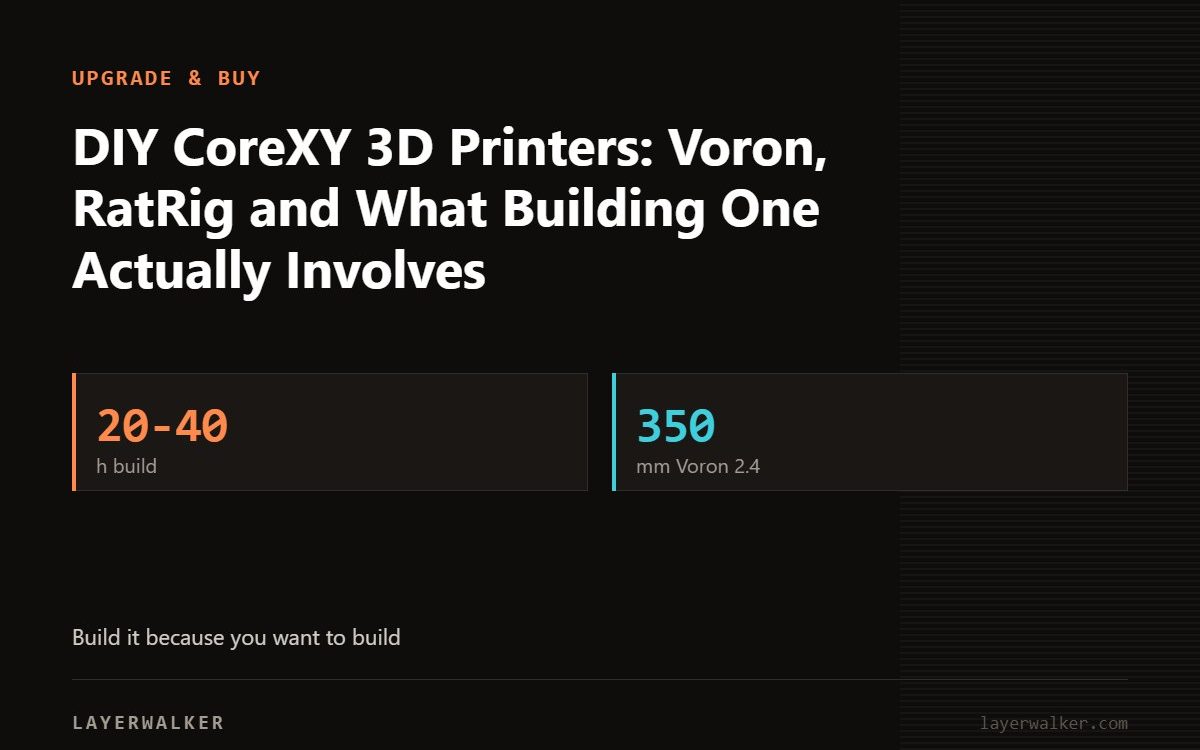
A DIY CoreXY means a Voron (2.4, Trident or 0.2), a RatRig V-Core or a similar open-source design, built from a sourced kit or your own bill of materials over 20 to 40 hours, then configured in Klipper from scratch. The result is a printer you understand completely and can modify without limit, and it usually costs more than an equivalent Bambu or Creality. The Sovol SV08 is the shortcut: a Voron 2.4 derivative that arrives 90 percent assembled. Build one because you want to build; buy one if you want to print.
Where to buy


The designs
| Design | Build volume options | Kinematics | Build time | Notes |
|---|---|---|---|---|
| Voron 0.2 | 120 × 120 × 120 mm | CoreXY, fixed bed | 15 to 25 hours | Compact, enclosed, very fast; small parts only |
| Voron Trident | 250, 300, 350 mm | CoreXY, bed moves in Z on three lead screws | 20 to 35 hours | Simpler than 2.4; great first Voron |
| Voron 2.4 | 250, 300, 350 mm | CoreXY, flying gantry on four belts | 25 to 40 hours | The reference; complex belted Z |
| RatRig V-Core 4 | 300, 400, 500 mm | CoreXY, three-point Z | 20 to 35 hours | Large volumes; IDEX option |
| Sovol SV08 | 350 × 350 × 345 mm | Voron 2.4 derivative | About 1 hour | Pre-built; the practical entry |
What building involves
- Sourcing: a kit (LDO, Formbot, Siboor, Fysetc) or your own BOM; printed parts you make on another printer or buy.
- Mechanical: frame squaring, linear rails, belt routing across two long loops, gantry alignment.
- Electrical: crimping, wiring a mains bed heater safely, CAN bus toolhead boards on modern builds.
- Software: Klipper installation, printer.cfg from scratch, PID, pressure advance, input shaping.
- Tuning: weeks of it, and that is the hobby.
Cost versus buying
A good 350 mm Voron 2.4 kit plus printed parts, extras and the inevitable upgrades usually costs more than a Creality K2 Plus and about what a Bambu H2S does. You are not saving money. You are buying a machine with no cloud, no locked firmware, every part replaceable from any vendor, and a community that has solved every problem. See kits for the easier options and CoreXY explained for why the layout matters.
The shortcut
The Sovol SV08 gives Voron 2.4 architecture, 350 mm and Klipper for a fraction of the build time. Many owners flash mainline Klipper and treat it as a Voron they did not have to assemble; see the SV08 page.
The units in the box
Voron kits are sold by kit vendors, not on Amazon US. The listings are the Sovol SV08 and the Prusa MK4S and CORE One+ kits as the other builds worth doing.
DIY Core XY 3D printer FAQ
Is a Voron enclosed?
The 2.4 and Trident are designed with panels; ABS is their home material.
Can a beginner build one?
A patient beginner can build a Trident; a 2.4 is easier after a first build.

LayerWalker
Print defect diagnosis, calibration procedures and parts that actually fit. Corrections welcome through the contact page.