CoreXY 3D Printers: What the Motion System Buys You, and What It Costs
LayerWalker is a participant in the Amazon Services LLC Associates Program. We may earn a commission when you buy through links on our site, at no extra cost to you.
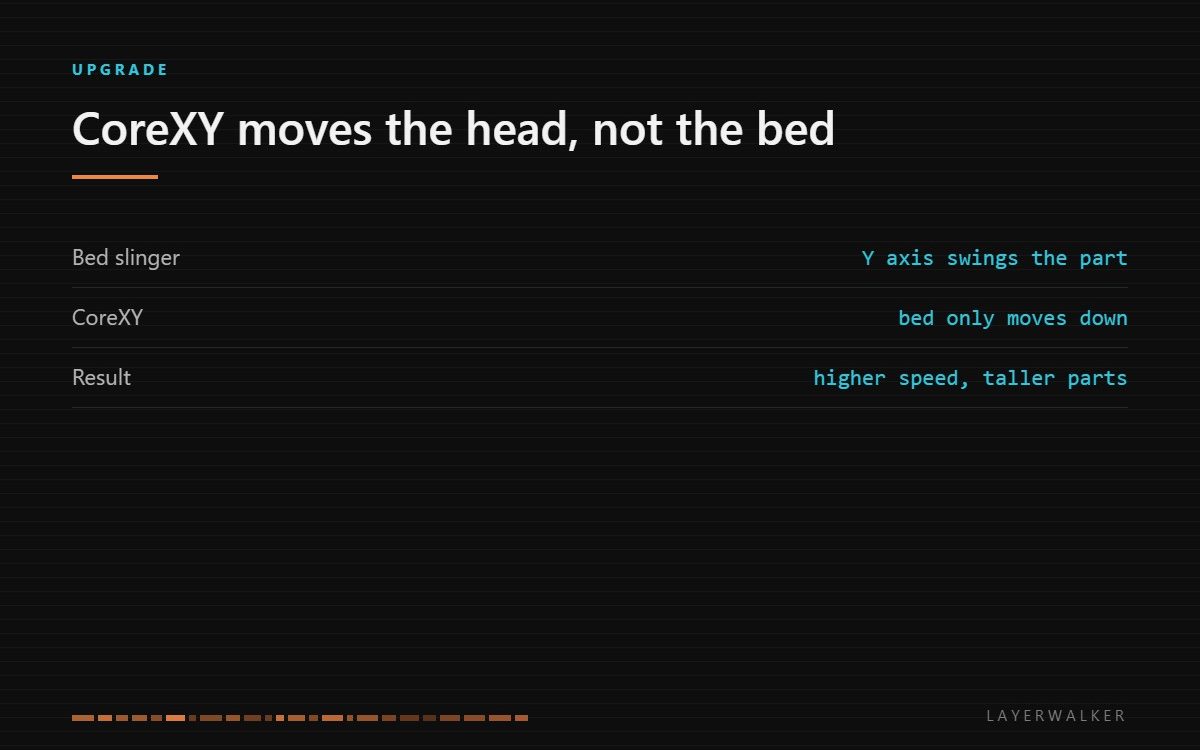
CoreXY moves the toolhead in both X and Y with two fixed motors and a crossed belt path, leaving the bed to move only downward. That removes the mass of the part from the fast axes, which is why a CoreXY prints quicker than a bed slinger at the same quality. It is a motion system, not a quality guarantee.
Where to buy


How it differs from a bed slinger
On the common budget layout the bed carries the part back and forth on the Y axis. Every gram you print gets accelerated and stopped thousands of times per layer, so as the part grows the machine has to slow down or the print starts ringing. That is the ceiling most people run into, and no amount of firmware tuning removes it.
CoreXY takes the part out of that equation. Two motors sit fixed on the frame and drive a pair of belts routed so that turning them together moves the head in X and turning them opposite moves it in Y. The only thing being accelerated is the toolhead. The bed moves once per layer, straight down, at a speed nobody cares about.
Two consequences follow. The machine holds its speed on tall parts rather than degrading through the print, and the frame is naturally a box, which is what makes an enclosure practical. That second point matters more than people expect, because an enclosure is what lets you run ABS, ASA and other materials that need chamber heat.
What you actually get for the money
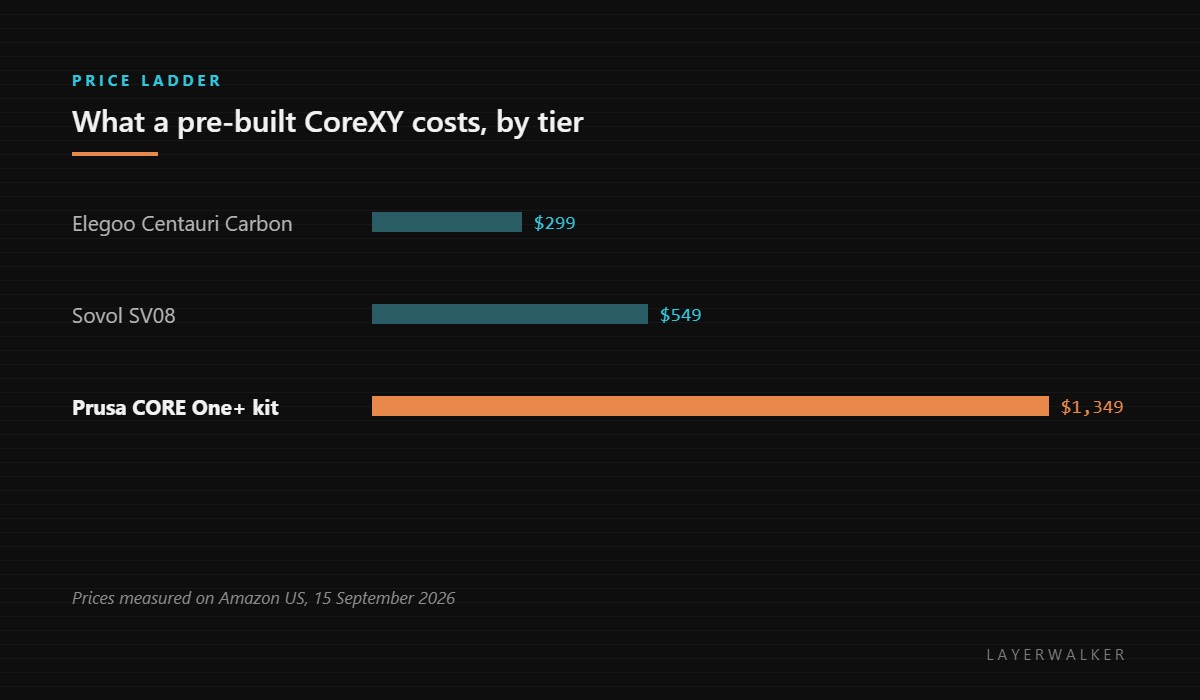
The CoreXY arrangement costs almost nothing to build; belts and idlers are cheap. So the price differences between machines are not about the motion system at all, and reading listings as though CoreXY were the feature will lead you to the wrong one.
| Tier | You get | You do without |
|---|---|---|
| Around $250 to $330 | CoreXY speed, auto levelling, open frame or light panels | Real chamber heat, multi-material, support depth |
| $500 to $600 | Bigger envelope, better hotend, enclosure, mature firmware | Active chamber heating, toolchanging |
| $1,300 and up | Fully enclosed, published spare parts, open firmware, long support | Little, at a price most hobbies do not need |
If you want to build the machine rather than buy it, that is a different decision with a different answer, and our page on DIY CoreXY builds covers Voron and RatRig properly. This page is about machines that arrive working.
Speed claims and what limits them
Every CoreXY listing quotes a headline speed in millimetres per second, and none of them can hold it while extruding. The real limit is how fast the hotend can melt plastic, measured in cubic millimetres per second, and that number is set by the heater and the melt zone rather than the motion system. A machine advertising 600 mm/s will print a real part somewhere well below that.
What CoreXY genuinely delivers is that the achievable speed does not fall away as the part gets bigger or taller. Our page on high speed printing goes through the flow-rate arithmetic, and it is the number worth comparing between machines.
The enclosure is half the reason to buy one
A CoreXY frame is a cube with the motors at the top corners, so panelling it is straightforward and several machines ship enclosed. That changes what the printer can do rather than how fast it does it: chamber heat keeps the layers below the nozzle warm enough to bond, which is the difference between an ABS part that holds together and one that splits along the layer lines.
If you only print PLA, an enclosure is a mild negative because PLA prefers cool air. Buy the enclosure when the materials need it, not as a general upgrade, and see enclosed printers for where the line falls.
Who should not buy one
If your prints are small, PLA, and occasional, a bed slinger will do the same job for less and the speed difference will be invisible in your workflow. CoreXY earns its price when you print often, print large, or print materials that need a warm chamber. Buying it for the specification alone is how people end up with a faster machine and the same output.
FAQ
Is CoreXY more accurate than a bed slinger? Not inherently. It is more accurate at speed, because there is less mass to control.
Does CoreXY need belt tensioning more often? It has more belt in the path, so tension matters more. Check it as part of routine maintenance.
Can I convert a bed slinger to CoreXY? In practice you would be building a new printer around the old parts. Buy or build directly instead.
Why do CoreXY machines list such high speeds? They are travel speeds. Extrusion is limited by the hotend, not the motion system.

LayerWalker
Print defect diagnosis, calibration procedures and parts that actually fit. Corrections welcome through the contact page.