High-Speed 3D Printers: What 600 mm/s Really Means and Which Ones Deliver
LayerWalker is a participant in the Amazon Services LLC Associates Program. We may earn a commission when you buy through links on our site, at no extra cost to you.
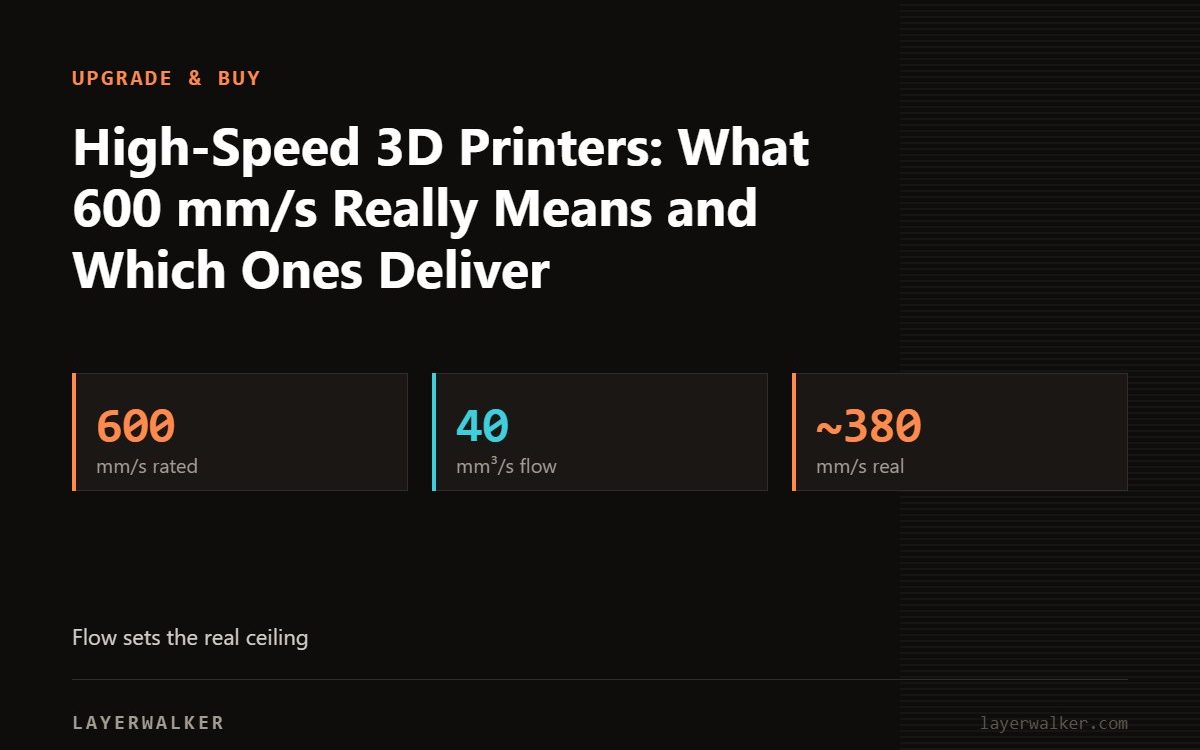
Every current CoreXY is rated 500 to 700 mm/s, and none prints a real part at that speed. The limit is flow: a standard 0.4 mm hotend melts about 20 to 40 mm³/s, which is 150 to 300 mm/s at a 0.2 mm layer. What separates fast printers is acceleration, frame stiffness, a high-flow hotend option and good input shaping. By that measure the Creality K1C, Sovol SV08, Bambu P2S and Flashforge AD5M are the fast machines at their prices.
Where to buy


How to read a speed spec
| Figure | Typical | What it tells you |
|---|---|---|
| Max toolhead speed | 500 to 700 mm/s | Travel moves only; marketing number |
| Max acceleration | 10000 to 40000 mm/s² | How fast it reaches speed on short segments; matters on small parts |
| Max volumetric flow | 20 to 40 mm³/s standard; 30+ high-flow | The real ceiling on print speed |
| Real print speed at 0.2 mm, 0.4 mm nozzle | 150 to 300 mm/s | Flow ÷ (layer height × line width) |
| Input shaping | Yes on all current machines | Lets acceleration be used without ringing |
The arithmetic: 32 mm³/s ÷ (0.2 mm × 0.42 mm) ≈ 380 mm/s absolute ceiling, and quality drops well before it. See volumetric speed.
Printers that actually print fast
| Printer | Frame | Accel | Flow | Why it is fast in practice |
|---|---|---|---|---|
| Creality K1C | Enclosed CoreXY | 20000 mm/s² | 32 mm³/s | Stiff 220 mm frame, tuned stock profiles |
| Sovol SV08 | Open CoreXY | 40000 mm/s² | About 30 mm³/s stock; high-flow options | Voron-derived; highest acceleration here |
| Bambu P2S | Enclosed CoreXY | 20000 mm/s² | 40 mm³/s | Highest stock flow; high-flow hotend option |
| Flashforge AD5M | Open CoreXY | 20000 mm/s² | About 32 mm³/s | Light gantry at a low price |
| Bambu A1 / A1 mini | Bedslinger | 10000 mm/s² | About 28 mm³/s | Fast for a bedslinger; auto-tuned |
What makes speed usable
- Acceleration and frame. A 350 mm bed at 20000 mm/s² needs a stiff frame or it rings. Smaller CoreXY frames win.
- Input shaping, calibrated per machine; see resonance.
- Cooling. Fast layers need strong part cooling or overhangs sag.
- A bigger nozzle. 0.6 mm at 0.3 mm layers doubles real throughput; that is how fast printing is actually done.
The units in the box
The listings are the K1C, the SV08 and the P2S Combo.
High speed 3D printer FAQ
Is a bedslinger ever fast?
The A1 series prints at 200 mm/s cleanly; beyond that the moving bed limits it. See CoreXY vs bedslinger.
Does speed hurt quality?
Above the flow ceiling, yes: under-extrusion and weak layers.

LayerWalker
Print defect diagnosis, calibration procedures and parts that actually fit. Corrections welcome through the contact page.