Delta 3D Printer: What the Geometry Buys, and What Is Still Sold
LayerWalker is a participant in the Amazon Services LLC Associates Program. We may earn a commission when you buy through links on our site, at no extra cost to you.
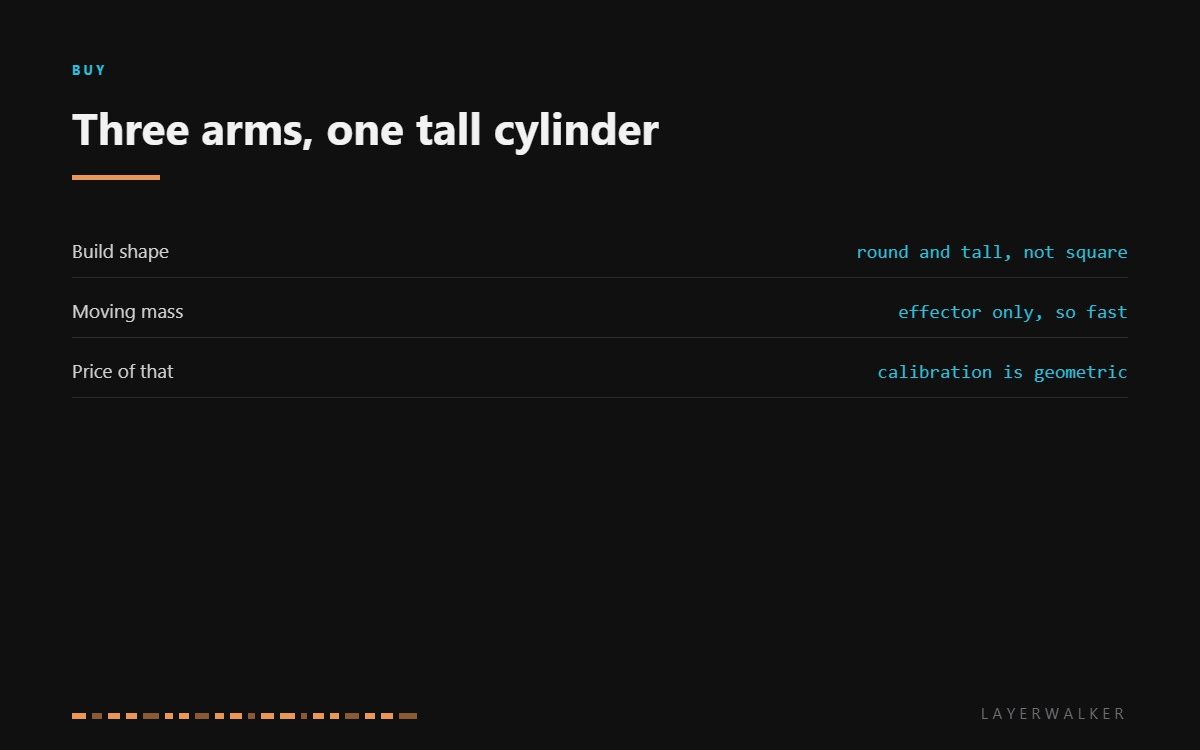
A delta 3D printer hangs the toolhead from three arms on vertical rails. Nothing heavy moves except the effector itself, which is why deltas were the fast machines before CoreXY arrived, and why they print a tall round cylinder rather than a box. The format has largely lost, and that is worth knowing before you buy: three machines are still listed on Amazon, and none of them is a mainstream recommendation.
Where to buy


What the delta geometry actually buys
Two things, and they are real. The moving mass is tiny, so acceleration is high without shaking the frame apart. And the build volume is a tall cylinder, which suits vases, tubes, cosplay horns, tall prints of any kind, in a footprint much smaller than a bed slinger of the same height.
Against that, everything is coupled. On a Cartesian machine an X problem shows up in X. On a delta, one arm that is slightly the wrong length bends every dimension in a way that looks like a warped bed and is not. Calibration is geometric: rod length, tower angle, delta radius. Modern firmware automates most of it, but when it goes wrong the diagnosis is harder than on any other layout.
The other honest problem is the extruder. A light effector is the whole point, so most deltas put the extruder on the frame and feed through a long Bowden tube. That costs you retraction control and makes flexible filament difficult, which is exactly where direct drive matters most.

The three delta 3D printers still on Amazon
The FLSUN Super Racer at $329 is the one to take seriously. FLSUN is the last maker treating deltas as a main line rather than a legacy product, and the Super Racer is a genuine 200 mm/s machine with auto levelling and a 260 mm diameter by 330 mm tall cylinder. If you want a delta, this is the default.
The Monoprice Mini Delta v2 at $170 is a pocket machine with a 110 mm circle and a heated plate. It is a toy in the good sense: quiet, cheap, assembled, and useful for small parts or a desk. Nobody should expect it to replace a main printer.
The K280 at $449 is a large delta with a two-in-one-out dual extruder, which is an unusual combination and the only route to two materials in this format. Treat it as a project machine; documentation and support are thin compared with anything from the brands in our brand guide.
Why the format faded
CoreXY took the speed argument away. A modern enclosed CoreXY accelerates as hard as a delta, keeps a square build volume, and is easier to enclose and heat because the frame is a box. Once CoreXY machines arrived at $300, the delta had only the tall cylinder left as an advantage.
The second reason is parts. When one maker still supports a format, spares and upgrades dry up. Arms, effectors and magnetic joints for anything but current FLSUN models are now a search rather than a purchase.
Who should still buy a delta
Buy one if what you print is tall and round, and you want it done in a small footprint. Vase-mode work, tall props, tubes and columns are genuinely nicer on a delta, and the tall cylinder costs less desk space than an equivalent box.
Buy one if you like the mechanism and want to tune it. Deltas reward the sort of owner who enjoys geometric calibration, and Klipper handles them well.
Otherwise buy a box. For a first printer, an entry-level bedslinger or a cheap CoreXY is easier to live with, easier to get parts for, and better supported by every profile you will ever download.
Delta 3D printer FAQ
Is a delta 3D printer faster than a CoreXY?
Not any more. Both move very little mass. Current CoreXY machines match or beat deltas and hold accuracy better at the edges of the build area.
Why is my delta printing circles as ovals?
That is the classic delta calibration signature: rod length or delta radius is off. It is a geometry setting, not a bed problem, and no amount of mesh levelling will fix it.
Can a delta print flexible filament?
Only with a direct-drive effector, and most deltas are Bowden by design. The Super Racer manages TPU slowly; the pocket machines do not.
Do deltas need a heated chamber for ABS?
They need one more than a box does, and get one less easily, because the tall open frame is hard to enclose. Treat ABS as out of scope on a delta unless you build the enclosure yourself.
Are delta 3D printers still worth buying in 2026?
For tall round parts in a small footprint, yes. As a general-purpose first printer, no.

LayerWalker
Print defect diagnosis, calibration procedures and parts that actually fit. Corrections welcome through the contact page.